The short answer
Use stable, readable product and category addresses with consistent linking and canonical signals. Give variants meaningful selectable URLs, distinguish pagination from utility parameters and avoid embedding volatile details. Keep established working URLs unless a real business or technical need justifies the mapping, redirects and validation required to change them.
Define what the URL needs to identify
An ecommerce URL identifies a destination, not a complete product database. It should remain useful when a title, promotion or merchandising placement changes. Start by distinguishing product, category, editorial, market and utility pages. Each type has different stability and selection requirements. A product should not need a new address every time it moves between collections.
Google's Designing a URL structure for ecommerce sites describes ecommerce URL considerations, including consistency and variant identification. Use those principles with the platform's actual routing rules. Do not assume a structure copied from another system can be implemented safely on Shopify or a custom storefront. Reserved paths, localization and app behavior can constrain the available design.
Write a short policy before creating or changing addresses: what each URL type represents, who can change it, which parameters affect content and how redirects are maintained. This reduces accidental variation between imported products, campaign pages and manually created collections. The policy should help catalog staff make routine decisions without needing to revisit abstract SEO arguments for every item.
Choose stable slugs and avoid volatile information
Use clear names that identify the item or category, with enough distinction to prevent collisions. Avoid embedding a price, current year, stock state or temporary campaign in a permanent product address unless that information truly defines the product. A promotion may end while the product remains the same. The address should not force a redirect for every trading update.
Keep naming conventions consistent, including case, separators and handling of special characters. Confirm the platform's normalization behavior rather than guessing. Human readability is useful, but a shorter URL is not automatically better if it loses the information needed to distinguish two items. Product identifiers can be appropriate when the catalog requires stable uniqueness.
In an illustrative store, /products/compact-desk may stay useful through a sale, whereas /products/compact-desk-199-october-sale becomes stale quickly. If two desks have the same generic name, add a durable model or range distinction. Do not change an established URL solely because the marketing team has rewritten the visible product title. Title, navigation label and address can evolve at different speeds.
 Keep this framework
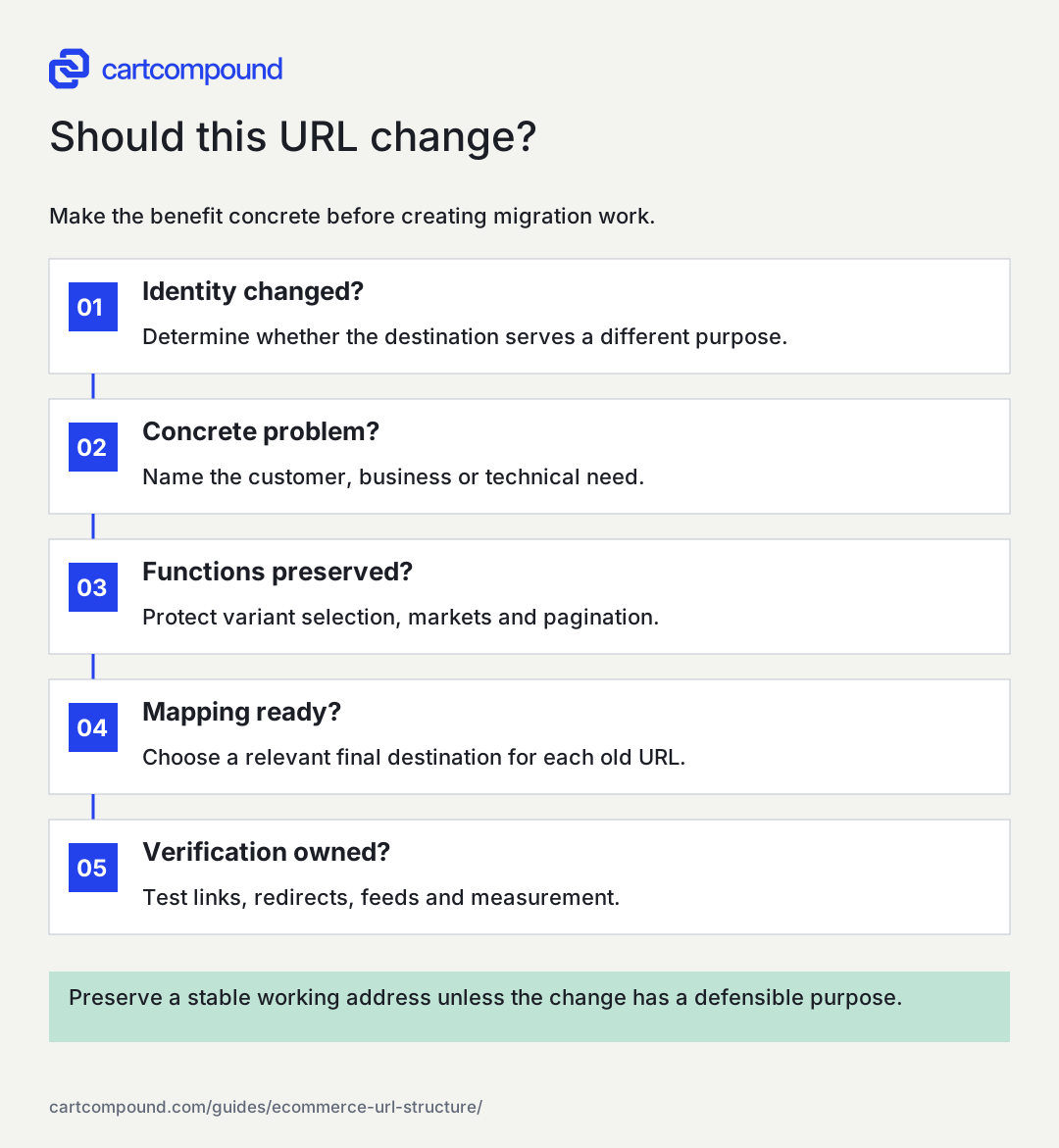
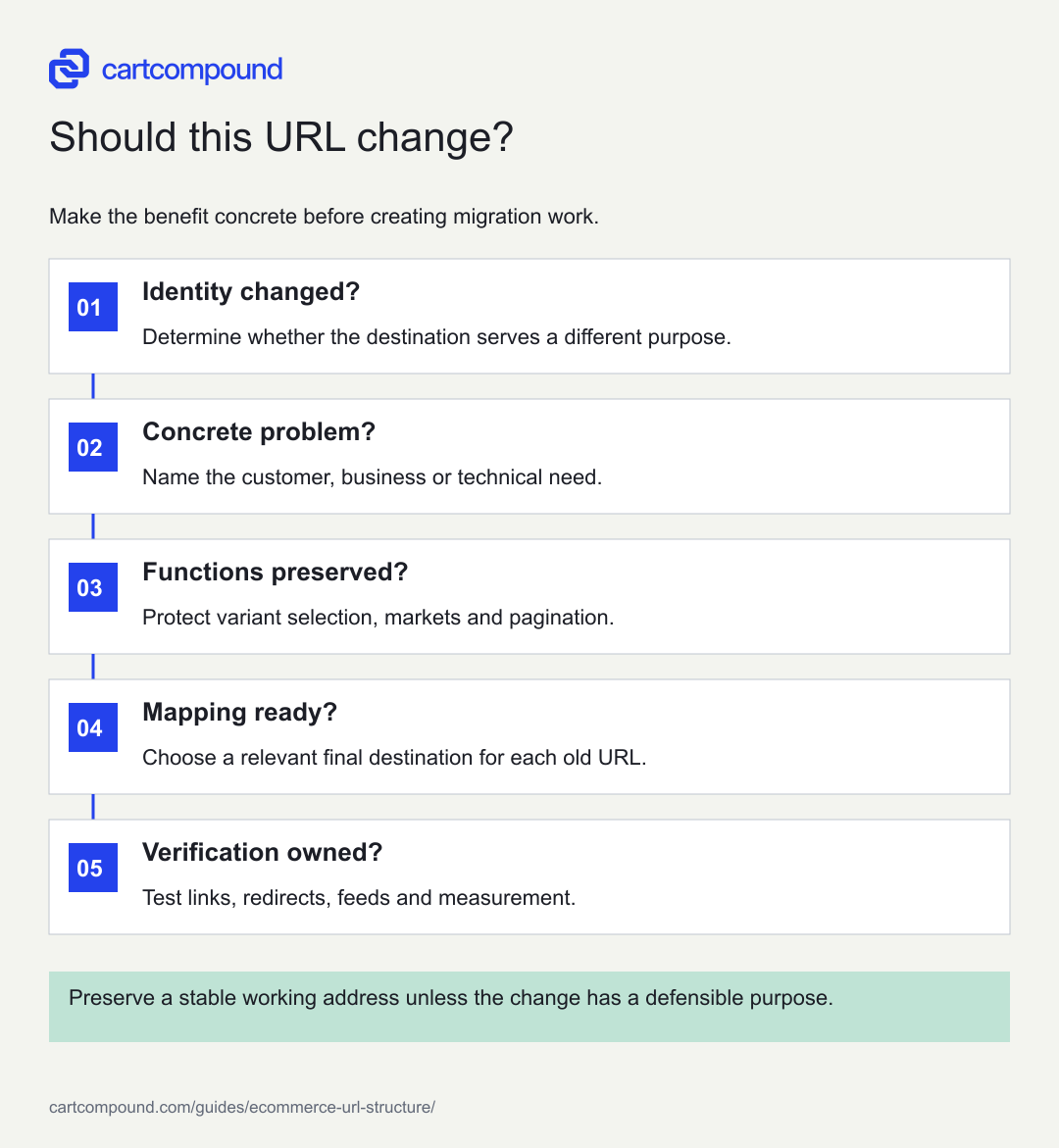
Should this URL change?
Make the benefit concrete before creating migration work.
- Identity changed?Determine whether the destination serves a different purpose.
- Concrete problem?Name the customer, business or technical need.
- Functions preserved?Protect variant selection, markets and pagination.
- Mapping ready?Choose a relevant final destination for each old URL.
- Verification owned?Test links, redirects, feeds and measurement.
Preserve a stable working address unless the change has a defensible purpose.
Use the steps with your store data. Examples in this guide are illustrative unless a source is named.
Separate hierarchy from product identity
A hierarchy helps customers understand the range, but putting every category level in a product address can make products dependent on merchandising structure. A product may belong to several categories or move to another department. Decide whether the platform's direct product address offers a more stable identity than a fully nested path.
Google's Help Google understand your ecommerce site structure explains that links play the central role in understanding ecommerce site structure. A readable hierarchy in navigation, category links and breadcrumbs matters even when the product URL is relatively flat. Do not rebuild stable product addresses merely to make their folders resemble a visual menu.
Treat category addresses as maintained destinations with their own definitions. If a category is renamed but still serves the same need, keeping its existing URL can be reasonable. If its purpose changes materially, evaluate whether it is really a new page. Record the distinction. Reusing an old address for an unrelated assortment can mislead returning visitors and make historical performance difficult to interpret.
Classify parameters by what they do
Parameters can select variants, paginate collections, sort inventory, filter an assortment or carry campaign measurement. A rule that removes all parameters treats different functions as if they were equivalent. Inventory the actual names and behavior, then decide the preferred treatment for each class.
Google recommends separately identifiable variant URLs and discusses optional variant parameters in its ecommerce URL guidance. Later collection pages also need distinct addresses for discovery; see Pagination and incremental page loading. Tracking parameters generally should not redefine the content identity, but removing them indiscriminately can affect attribution workflows. Coordinate the intended behavior with analytics owners.
On a small screen, swipe the table to see every column.
| Parameter purpose | What to preserve | What to review |
|---|---|---|
| Variant selection | Correct chosen configuration | Canonical model and cart agreement |
| Pagination | Distinct product slice | Discoverable links and page canonicals |
| Sort or utility filter | Customer control state | Crawl and index policy |
| Campaign measurement | Authorized measurement requirements | Duplicate representation and data handling |
Make signals agree on the preferred address
A preferred URL should be accessible and consistently represented in relevant internal links, canonical declarations and sitemaps. Google describes how these signals contribute to canonical selection in How to specify a canonical URL. They are not interchangeable guarantees, but conflicting signals can make an avoidable ambiguity harder to resolve.
Inspect the exact protocol, host, path and trailing-slash behavior. Check whether one route redirects and another serves the content directly. Avoid leaving internal links pointed at old addresses when the final destination is known. Ensure a theme or app does not generate a different canonical from the URL policy.
Use a representative matrix: homepage, category, product, variant, later grid page, editorial page and localized page. Record intended URL, live response, declared canonical and incoming link format. The matrix catches global errors such as a canonical builder using the wrong host or a link component adding unnecessary collection context. A policy only works if the templates generating addresses actually follow it.
Evaluate whether an established URL change is worth it
Changing URLs creates work across redirects, links, feeds, measurement, campaigns and external references. It also requires search systems to process the new addresses. A real platform move, domain change, catalog consolidation or structural defect can justify that work. Cosmetic preference alone often does not.
Write a decision note: current problem, affected destinations, customer benefit, technical constraint, proposed mapping, dependencies and rollback plan. Quantify implementation effort where possible, but do not invent a forecasted ranking benefit from shortening the path. Identify which systems store addresses and whether they can be updated together.
For example, removing an obsolete supplier name from a handful of important URLs may be justified by a contractual or customer clarity need. Renaming thousands of stable product URLs to include an extra keyword requires a much stronger case. The same visible title improvement may be achievable without changing addresses. Make that tradeoff explicit before committing to a migration project.
Map and test changes as a migration
For approved changes, build one row per old address and the intended final destination. Keep equivalent content where possible, use relevant permanent redirects and update internal links and data sources. Google's Site moves with URL changes covers URL mapping, redirect testing and monitoring. Do not use a catch-all homepage redirect to compensate for an incomplete map.
Test exact old URLs, including important variant and market forms. Confirm the final destination is public, returns the intended response and does not redirect through several unnecessary hops. Check for loops and collisions where two products accidentally receive the same slug. Verify that product feeds land on the required item and that analytics does not lose key page or transaction behavior.
Plan redirect retention and ownership. Old emails, packaging, backlinks and customer bookmarks can survive much longer than the launch window. Keep the mapping record with the release so future cleanup does not delete useful redirects blindly. If the new structure creates another layer of redirects after a later move, review direct mappings to the relevant final destination.
Prevent URL collisions during imports and renaming
Bulk catalog changes can bypass the careful decisions applied to individual products. Before an import, compare proposed slugs with existing active URLs, archived pages and retained redirect sources. Decide how the platform resolves a collision. An automatic suffix can be acceptable for uniqueness, but it should not quietly connect a product feed or campaign to a different item than the team intended.
Use a preflight sheet with stable product ID, existing address, proposed address, reason for change and collision result. A stable ID is important because names can repeat and spreadsheets can reorder. Do not match products solely by a title when mapping addresses. Review a sample of renamed and unchanged products after the import to confirm the integration preserved the expected relationship.
Also check reusing old slugs. A retired product address may still receive visits from packaging or instructions. Giving that address to an unrelated new item can be more confusing than returning a clear retirement page. If reuse is approved, document why the new content fulfills the existing destination's purpose and update the historical record. These controls make the URL policy practical for the people importing products, rather than leaving stability dependent on every person remembering an informal convention.
Maintain URL rules through normal catalog work
A URL policy should be short enough to use during product imports and collection creation. Add checks for duplicate slugs, unsupported characters, temporary promotion text and unplanned route changes. Give staff a clear process for renaming a product without automatically changing its address. Record exceptions when an item genuinely changes identity.
Monitor broken links, unexpected redirects, canonical differences and the appearance of new parameter patterns. Review the policy after adding localization, a search app or a new catalog integration. These systems can generate addresses outside the original template logic. Check customer-facing routes on actual mobile and desktop states because a technically valid address can still land on the wrong option.
The next action is to document the store's current URL classes and compare them with ten representative examples. Correct inconsistency in generated links before proposing a broad structural change. If the existing addresses identify the right content, work reliably and can be maintained, preserving them may be the best decision. Stable URLs support dependable navigation and measurement; their value comes from that reliability rather than an imagined ideal folder depth.
Your action checklist
Use this to decide what to do next. Your checks stay on this page and are not sent or saved.
0 of 6 checked
Common questions
Are shorter URLs always better for SEO?
No. Prefer stable, understandable addresses. A shorter form that requires a risky migration or loses useful identity information is not automatically an improvement.
Must product URLs contain the category?
No. A product can have a stable direct address while categories and breadcrumbs explain its context. Follow the platform routing model and maintain coherent links.
Should I change the URL whenever a product title changes?
Usually only if the destination itself needs a new identity or there is another concrete reason. A visible naming update can often happen while retaining the established address.
Sources and review
Source documentation checked October 27, 2026. Platform features and interfaces can change. The recommendations and illustrative examples explain how to make the decision; they do not promise results.
- Designing a URL structure for ecommerce sites
Consistent product and variant URLs and handling empty categories. - Help Google understand your ecommerce site structure
Crawlable hierarchy and links connecting category and product pages. - Pagination and incremental page loading
Discoverable paginated URLs and distinct canonical pages in sequences. - How to specify a canonical URL
Canonical signals, consistent internal links, and limits of canonical declarations. - Site moves with URL changes
URL mapping, permanent redirects, monitoring and redirect retention.
Talk through your store question
Bring one problem you want to solve.
A free 20-minute call with Hamid can help you decide what to investigate next.
Book a free 20-minute call
About the author
Hamid Khan
Hamid co-founded CartCompound and works with ecommerce founders on their stores and growth priorities.
Profile and guides