The short answer
Define the funnel and eligible population, then separate payment failures, unavailable delivery, unexpected totals, form errors, and ordinary hesitation. Reproduce the affected scenarios and use backend evidence. Fix verified blockers before adding discounts or recovery messages.
Define what abandoned means in your report
Cart abandonment and checkout abandonment describe different stages. A person who adds an item to compare later may never begin checkout. Another person may enter delivery details and experience a payment failure. Combining both into one rate obscures the work needed. Record the starting event, completion event, unit of analysis, time window, and eligible sales channels.
Use consistent counts. A user-based checkout-start rate cannot be subtracted directly from an order count without understanding repeat attempts and multiple purchases. A session-based report can split a returning customer's journey. Backend abandoned-checkout records may cover only people who provided enough information, while browser events can represent a broader group. Keep the definitions beside the numbers instead of assuming the labels match.
Set the commercial objective. You want more valid paid orders at acceptable contribution, with clear customer expectations. A lower abandonment rate achieved through an unsustainable discount can be a poor decision. Include payment success, shipping subsidy, fraud, returns, and support burden as appropriate guardrails. This focuses the investigation on useful completion rather than a dashboard percentage alone.
Locate the affected context and timing
Compare complete, equivalent periods and annotate releases, promotions, carrier changes, payment changes, consent updates, and inventory events. Segment by device, country, payment method, and product or shipping profile when there is enough data. A single unavailable shipping service can affect one region while the storewide rate hides the problem.
Look at where the change first appears. Did fewer people begin checkout, did shipping information fail, or did payment attempts stop completing? Verify that the events still fire in the affected environment. An analytics gap after an accelerated-checkout change may be a measurement problem rather than an increase in shopper abandonment. Cross-check with valid backend orders and payment records.
Keep the investigation bounded. Choose the largest material affected group and one plausible failure path. If the evidence is too thin for a segment, combine longer comparable periods or use direct task testing. Do not keep slicing until a small group produces an alarming percentage. A handful of attempts can be operationally important, but its rate should not be presented as a stable behavioral pattern.
 Keep this framework
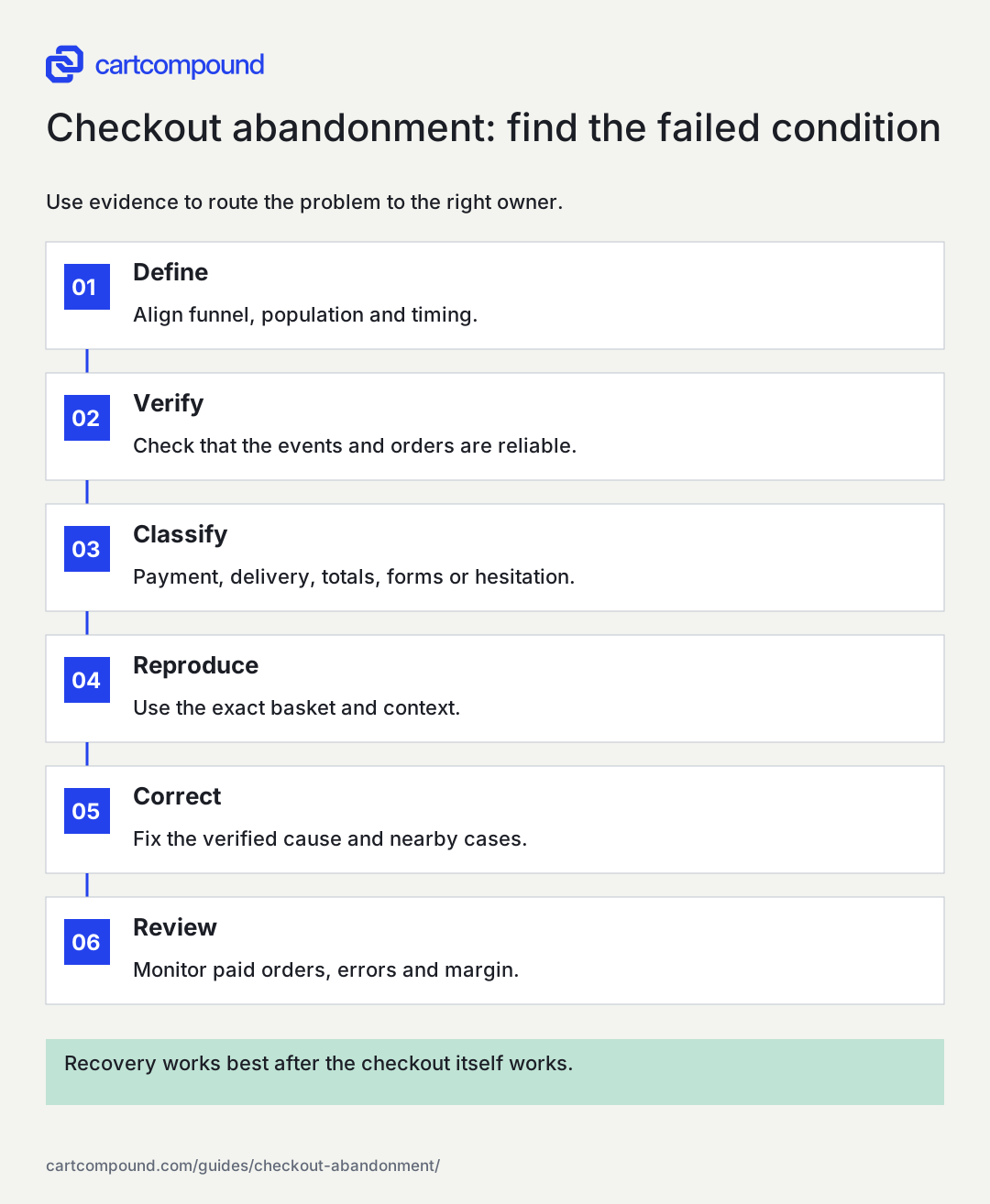
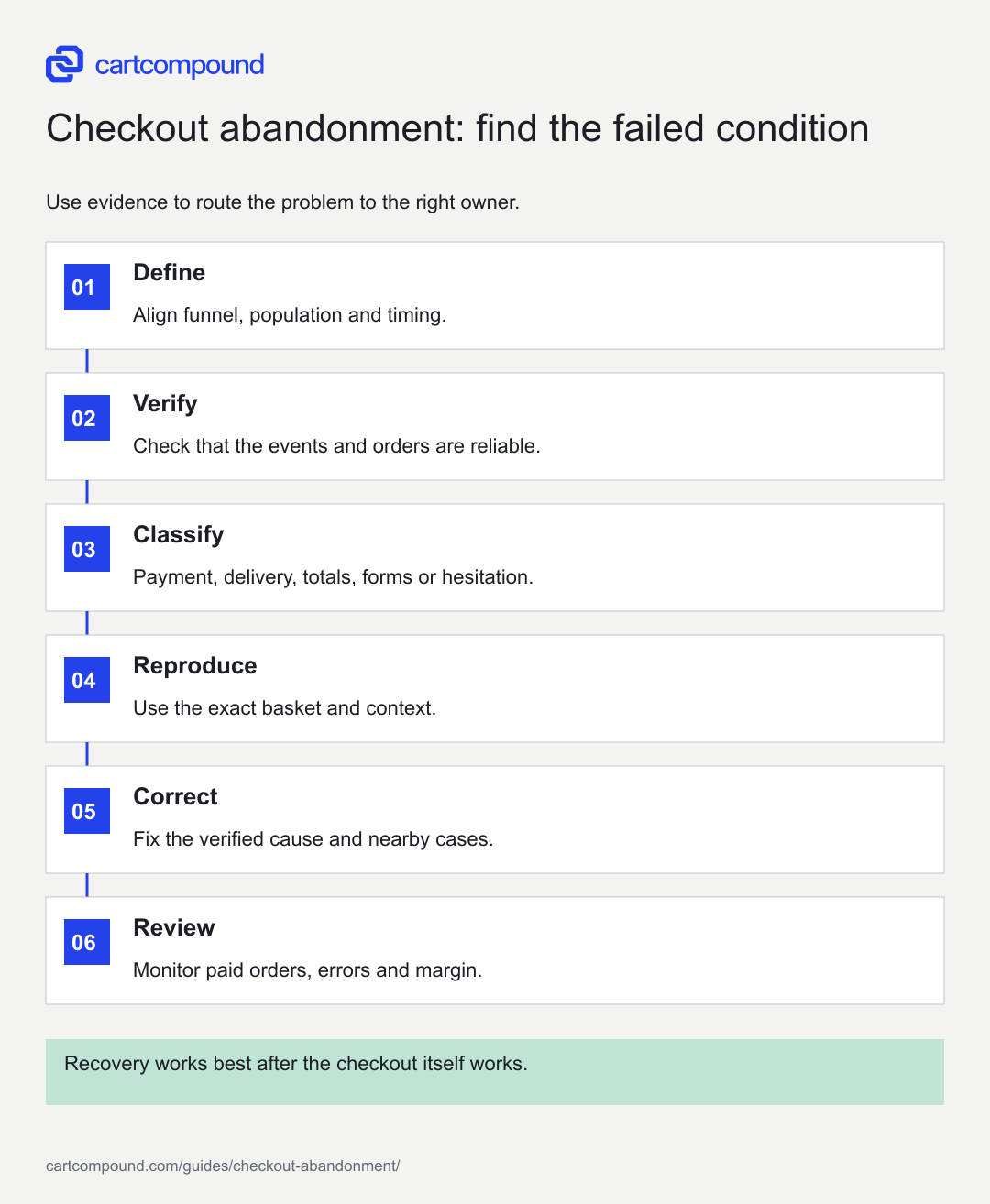
Checkout abandonment: find the failed condition
Use evidence to route the problem to the right owner.
- DefineAlign funnel, population and timing.
- VerifyCheck that the events and orders are reliable.
- ClassifyPayment, delivery, totals, forms or hesitation.
- ReproduceUse the exact basket and context.
- CorrectFix the verified cause and nearby cases.
- ReviewMonitor paid orders, errors and margin.
Recovery works best after the checkout itself works.
Use the steps with your store data. Examples in this guide are illustrative unless a source is named.
Inspect payment evidence before changing persuasion
Payment failures can come from the bank, provider, configuration, authentication, currency, or customer details. Shopify's payment troubleshooting guide explains that failed attempts generally appear in abandoned-checkout timelines, while successful payments have an order record. Use the appropriate backend evidence to understand the failure rather than inferring it from a drop-off chart.
Record the error category, payment method, device or browser when known, currency, and time. Avoid copying sensitive payment or customer data into an audit document. Group repeated operational patterns and distinguish a store-wide failure from individual declines. If a provider incident is suspected, check its authoritative status information and escalate through the approved support route.
Test the normal and failed paths using the platform's supported test process. Confirm that customers can retry or choose a different eligible method without losing their basket. Do not weaken fraud controls simply to improve completion. A change that increases accepted transactions while producing unacceptable fraud or chargebacks is not a successful checkout improvement. Keep security and payment-owner approval attached to changes in this area.
Test delivery availability and total-cost clarity
Use representative addresses and baskets to exercise the actual shipping rules. Include a common domestic address, a remote area you serve, a heavy or oversized product, and a mixed basket from relevant shipping profiles. Verify that an eligible service appears and that exclusions are explained. A checkout with no available rate is an operational blocker, not a copywriting problem.
Compare the promise before checkout with the final total. Does the free-shipping message use the same qualifying subtotal as the checkout? Are delivery estimates consistent with processing time and carrier service? Are taxes, duties, or other applicable charges explained at the appropriate point? Use the store's verified policies and applicable market review rather than making legal assumptions.
Check discount interactions. A promotion may reduce the qualifying basket below a free-shipping threshold, or a code may not combine with another offer. Explain the actual rule clearly and test boundary values. The shopper should be able to understand why a charge changed. Do not solve confusion by hiding the rule until the final step or by displaying a progress message that checkout cannot honor.
Review forms and recovery states
Complete checkout on the main real customer environments, including mobile. Test address autocomplete, manual address entry, apartment information, postal codes, keyboard behavior, and invalid inputs. Confirm that required information is clearly labeled and that valid fields remain populated after an error. A concise error beside the relevant field is more useful than a generic instruction to try again.
Inspect account prompts and express-payment paths. If guest checkout is part of the offer, ensure it is discoverable in the actual flow. If a payment method skips certain steps, verify that required delivery and product information is still captured correctly. Do not assume that a successful desktop card test validates a mobile wallet or a different currency.
Check loading, back navigation, and repeated submission behavior. A slow response should make it clear that payment is processing without inviting repeated clicks. A failure should preserve the basket and provide a safe next step. Review order records for duplicate or inconsistent submissions after changes. The goal is a recoverable, understandable transaction, not merely a shorter form.
Use a diagnosis table to choose the next action
On a small screen, swipe the table to see every column.
| Evidence pattern | Likely investigation | First useful action |
|---|---|---|
| Payment attempts with recurring provider error | Gateway configuration or provider issue | Review authoritative error details and test path |
| No rate for a valid address and basket | Shipping profile, coverage or weight rules | Reproduce exact basket and address |
| Drop after total changes | Offer clarity, discounts and shipping eligibility | Compare pre-checkout promise with final calculation |
| Repeated address correction | Validation, autocomplete or instructions | Observe the failed entry and improve recovery |
| Backend orders stable, tracked purchases fall | Event coverage or consent changes | Audit collection before redesign |
| No error, customers still comparing | Intent, timing or unresolved product questions | Use customer evidence before adding an offer |
Assign each row an owner and an evidence requirement. A payment owner may need to investigate provider errors; a fulfillment owner may need to repair rate coverage; an editor may need to clarify a delivery promise. Routing everything to the designer can delay the actual fix.
Keep confirmed facts and hypotheses separate. “No rate returned for this eligible basket” is confirmed when reproduced. “Customers dislike the shipping price” requires additional evidence. The first can be corrected directly. The second may need research or a controlled commercial test that includes contribution and service costs.
Work through an illustrative checkout incident
Suppose a store records 500 eligible checkout starts and 300 completed checkouts in one complete period. Its defined completion rate is 60%, and abandonment is 40%. In the next comparable period, starts remain 500 and completions fall to 260, so abandonment rises to 48%. These are illustrative session-level figures with an assumed consistent definition.
Investigation finds a shipping-rule change affecting a group of heavy baskets. Forty checkout attempts in that group show no eligible rate. This is a strong operational lead, but it does not establish that all forty people would have purchased. Reproduce the coverage gap, correct the intended rule with fulfillment approval, and verify heavy and mixed baskets. Report the affected attempts rather than claiming forty recovered orders before observing them.
After release, monitor rate errors and valid paid orders in the affected group. Keep the comparison period, traffic mix, and any promotion changes visible. If the total rate improves, explain both the correction and the remaining uncertainty. The example shows why an incident-specific investigation is more useful than immediately sending a discount to every abandoned checkout.
Plan for an active incident and a later improvement
A confirmed checkout failure needs an incident response as well as a later audit. Record the affected scope, first known occurrence, evidence, owner, and safe workaround. Follow the business's authority rules for pausing traffic, disabling a feature, or changing payment and shipping configuration. Do not broaden the intervention beyond the verified problem without a reason.
Preserve the evidence needed to understand what happened while avoiding unnecessary customer or payment data. Capture the relevant error category, basket conditions, timestamps, and configuration change. A useful incident record lets the team verify the repair and prevents the same issue from being rediscovered through customer complaints.
After service is restored, separate immediate recovery from prevention work. A fallback shipping option may restore checkout while the underlying rate integration still needs repair. Assign a follow-up acceptance check and remove temporary measures only when the supported route is verified. Do not mark the incident fully resolved simply because one test order succeeded if the affected baskets or currencies remain untested.
Fix the cause before designing recovery
Prioritize inability to pay, missing eligible delivery, incorrect totals, and destructive form errors. Release a bounded correction with acceptance checks and a rollback path. Test the exact failed scenario plus nearby cases so the remedy does not create a different gap. Keep the operational owner involved when the change affects payment, shipping, tax, or fraud behavior.
Recovery messages can help customers resume a legitimate interrupted purchase, but they do not repair a broken checkout. Follow the store's messaging permissions, frequency rules, and suppression logic. Do not send an offer that conflicts with the final checkout price or suggest that stock is reserved unless that is true. A helpful recovery route should lead to a working, accurate basket.
The immediate next action is to define the abandonment calculation and examine a small, recent set of failed attempts from the largest affected segment. Classify them, reproduce the strongest pattern, and assign a fix with a clear retest. Continue measuring valid orders, contribution, and errors after release. This turns an abandonment concern into a concrete operational improvement.
Your action checklist
Use this to decide what to do next. Your checks stay on this page and are not sent or saved.
0 of 8 checked
Common questions
Is a high abandonment rate always a checkout problem?
No. Some people compare, save items, or lack purchase intent. Investigate changes, errors, and customer evidence before assuming every incomplete basket represents preventable friction.
Should I offer a discount to everyone who leaves?
Evaluate the cause and economics first. A discount cannot fix a missing shipping rate or payment error and can reduce margin on customers who would have returned anyway.
Why do analytics and abandoned-checkout records differ?
They can cover different people, stages, channels, and time rules. Document the population in each system and use backend evidence for payment diagnosis rather than expecting equal counts.
Sources and review
Source documentation checked October 27, 2026. Platform features and interfaces can change. The recommendations and illustrative examples explain how to make the decision; they do not promise results.
- Troubleshooting checkout payment issues
Payment failure investigation and appropriate abandoned-checkout versus order timelines.
Talk through your store question
Bring one problem you want to solve.
A free 20-minute call with Hamid can help you decide what to investigate next.
Book a free 20-minute call
About the author
Hamid Khan
Hamid co-founded CartCompound and works with ecommerce founders on their stores and growth priorities.
Profile and guides