The short answer
Validate measurement, locate the affected journey and segment, reproduce the friction, and collect customer or operational evidence. Prioritize confirmed blockers and costly confusion before speculative design ideas. Give each fix an owner, acceptance check, and outcome measure.
Start with a commercial and measurement brief
A CRO audit should answer a specific question about the purchase journey. “Improve conversion” is too broad. Define whether the concern is product discovery, variant choice, checkout completion, order value, or unsuitable purchases. Add the affected market, device, product group, and period. The more precise starting question helps distinguish a store problem from a change in the people arriving.
Confirm the definitions behind the dashboard. Record the source of sessions, purchases, revenue, and refunds. Check whether tracking changed recently and whether completed orders reconcile sufficiently for the decision. A funnel chart with a missing mobile checkout event can make a working experience appear broken. An audit should identify collection limits before prioritizing changes from them.
Include the economics. Higher conversion is not automatically a better outcome if discounts, shipping subsidy, fraud, or returns remove the contribution. Define the primary outcome and a few guardrails. For a fit-focused product-page change, useful guardrails might include wrong-size returns and support questions. For checkout, examine successful paid orders and payment errors rather than only clicks on the final button.
Locate the affected journey before inspecting everything
Compare relevant segments across equivalent complete periods. Begin with device, market, acquisition source, landing-page type, and product group, then narrow only where there is enough evidence. A storewide rate can fall because more visitors enter an educational guide while product-page performance stays stable. The audit should identify that composition change instead of immediately recommending a new product-page layout.
Map the actual purchase paths. Some shoppers enter directly on a product, others use search or filters, and some return with a saved cart. A single linear funnel will not represent all of them. Use the funnel to locate questions, then inspect the paths that matter. Record whether counts represent users, sessions, events, or orders so the stages are interpretable.
Choose representative scenarios. Include a common product, a product with several variants, a low-stock item, a discounted basket, and an address that exercises shipping rules. Prioritize your major real customer environments, including mobile browsers and relevant payment methods. The goal is a meaningful sample of states and tasks, not a superficial screenshot review of every page.
 Keep this framework
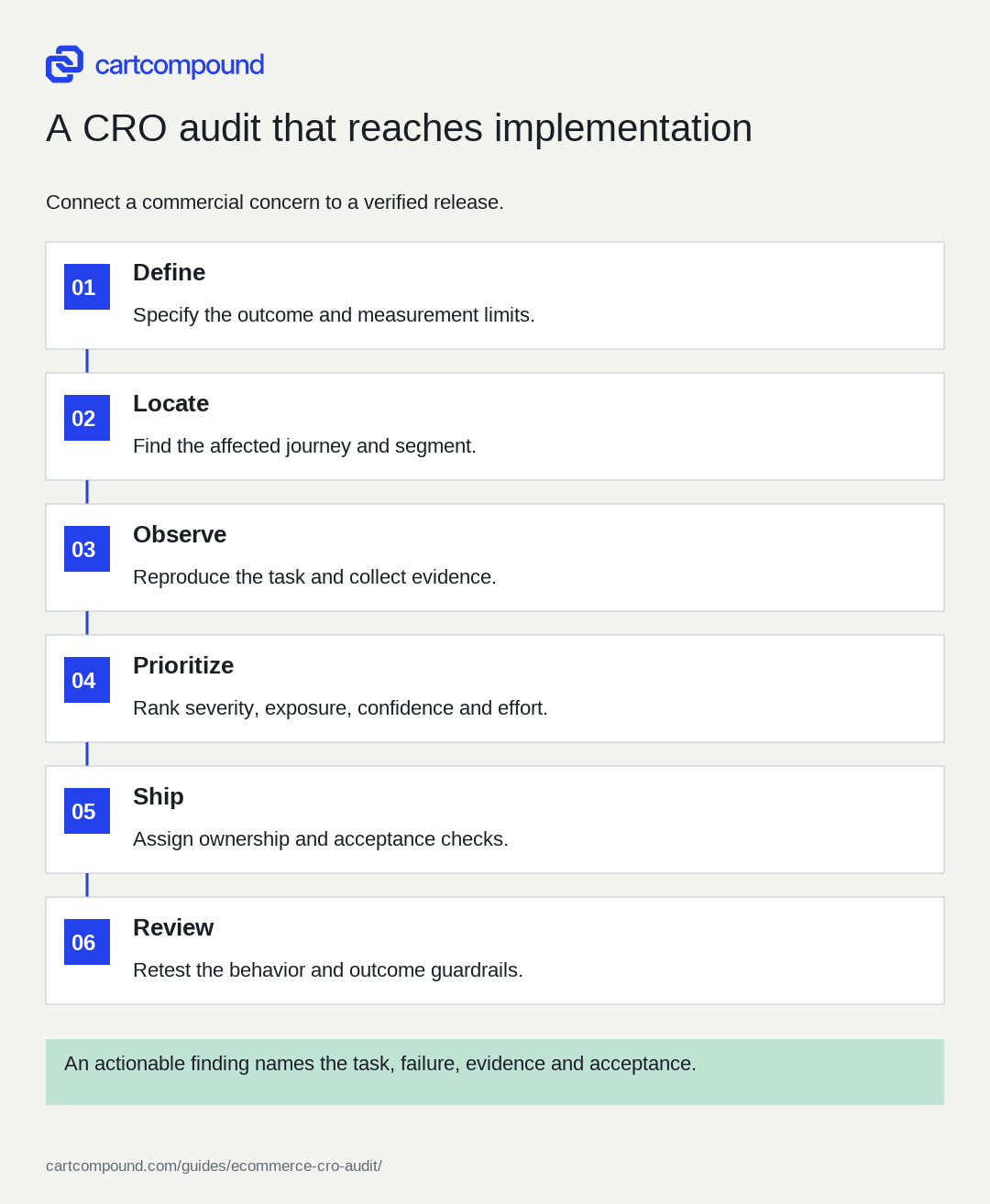
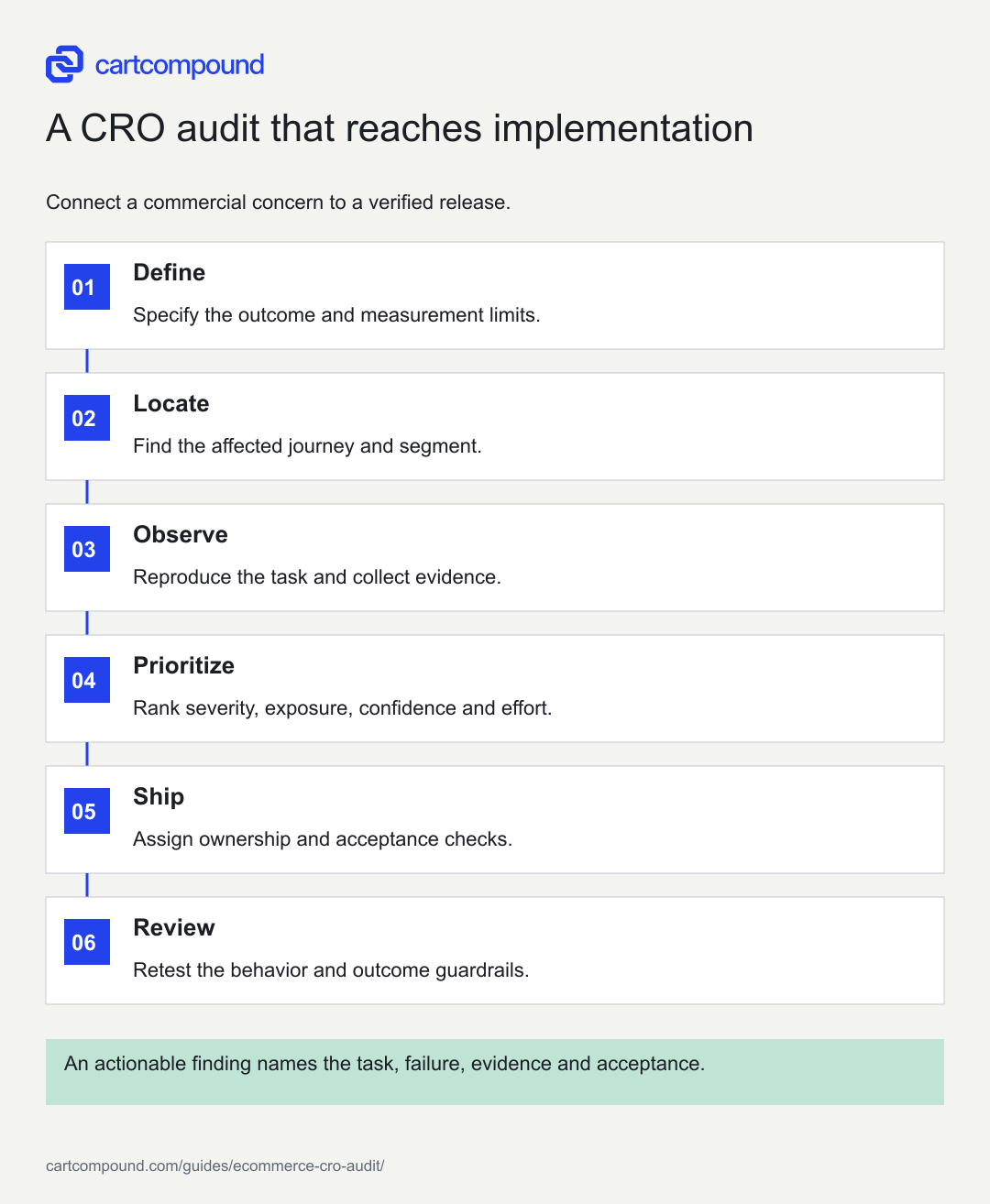
A CRO audit that reaches implementation
Connect a commercial concern to a verified release.
- DefineSpecify the outcome and measurement limits.
- LocateFind the affected journey and segment.
- ObserveReproduce the task and collect evidence.
- PrioritizeRank severity, exposure, confidence and effort.
- ShipAssign ownership and acceptance checks.
- ReviewRetest the behavior and outcome guardrails.
An actionable finding names the task, failure, evidence and acceptance.
Use the steps with your store data. Examples in this guide are illustrative unless a source is named.
Run task-based reviews of the store
Give each review a task: find a suitable product, confirm fit, choose a variant, understand delivery, edit the cart, and complete checkout. Record the exact point of uncertainty or failure. “The page looks busy” is an opinion. “The selected size is not visible in the cart and the shopper cannot confirm it” is a reproducible issue with an obvious acceptance check.
Baymard's ecommerce UX audit guidance highlights the purchase journey and cart review/editing tasks. Use established research to inform what you inspect while confirming the issue on your own store. Do not convert a research finding into a guaranteed uplift estimate. Your audience, products, implementation, and traffic conditions can differ.
Test with the real interaction states. Open menus, change variants, enter invalid addresses, remove products, apply an ineligible discount, and retry after an error. Inspect loading and failure behavior as well as the default screen. A product page can look clear in a design file but become confusing when the chosen combination is unavailable or the price changes after a selection.
Combine quantitative clues with observed evidence
Use analytics to locate a problem and direct observation to understand it. Review customer support themes, return reasons, payment failures, and permitted recordings or usability sessions. Keep personal data protected and follow the store's collection permissions. Do not install a new recording tool simply because an audit checklist mentions one. Existing evidence and direct task testing may answer the question.
Distinguish observations from explanations. Repeated clicks around a selector can indicate confusion, but may also reflect comparison or a slow response. A shopper saying “I cannot tell which color is selected” is more direct evidence. Record what happened, what the person said, and what you infer separately. This makes the finding easier to challenge and reduces the temptation to turn every behavior into a conversion story.
Look for agreement across sources. A rising wrong-variant return reason, unclear cart labels, and observed selection confusion point toward a stronger problem than a low heatmap concentration alone. Conversely, if the analytics signal cannot be reproduced and customer evidence does not support it, mark the issue as uncertain and define the next investigation. An audit can contain unanswered questions without pretending they are confirmed defects.
Write issues that a delivery team can use
On a small screen, swipe the table to see every column.
| Issue field | Illustrative finding | Why it matters |
|---|---|---|
| Task and context | Mobile shopper chooses a medium blue shirt | Defines the state to reproduce |
| Observed failure | Cart shows title and image but omits size | Buyer cannot verify selection |
| Evidence | Screenshot, reproduction steps and support theme | Separates fact from opinion |
| Proposed change | Show selected size beside color in cart | Connects remedy to failure |
| Acceptance | Variant remains correct after edit and reload | Makes completion testable |
| Outcome | Track selection-related support and paid orders | Checks usefulness and guardrails |
Add affected templates, estimated exposure, severity, implementation owner, dependency, and effort range. Exposure is the number of relevant opportunities, not the whole site's traffic. A mobile selector issue affects the people reaching that selector, not every email visitor. If exposure cannot be measured reliably, label the estimate and use it for prioritization cautiously.
Avoid prescribing a redesign when a smaller fix addresses the evidence. The issue above might require a cart label and state correction, not a new product template. Also identify whether the root problem sits in product data, theme logic, policy, or operations. Visual changes cannot repair an inaccurate inventory feed or a delivery promise the warehouse cannot meet.
Prioritize blockers, confidence, and execution cost
Put confirmed inability to purchase, wrong-product selection, incorrect charges, and serious accessibility barriers at the top. These are defects to fix, not ideas that need to win an experiment first. Then consider repeated uncertainty with meaningful exposure and a plausible remedy. Keep speculative aesthetic preferences lower unless new evidence strengthens them.
Use a simple prioritization discussion rather than a complicated score that hides judgment. For each candidate, ask: how severe is the customer problem, how many relevant people encounter it, how strong is the evidence, how costly is a wrong decision, and how much work is required? Record the answer. A low-effort change can still deserve review if it affects pricing or checkout behavior.
Create three delivery lanes: confirmed fixes, improvements suitable for a controlled test, and unresolved research questions. This is an operational recommendation, not a claim that every store needs an experimentation platform. A low-volume store may need usability research and carefully monitored releases before it can detect purchase-rate differences reliably. Assign the next step that resolves the actual uncertainty.
Work through an illustrative prioritization
Suppose a store reviews three issues. First, a mobile cart fails to update the total after quantity changes. Second, a product page hides the return-cost explanation. Third, the team prefers a different button color. The first issue is reproduced in two major mobile browsers. Support records show several quantity-related complaints. The second appears in customer questions but needs a clearer view of the affected product groups. The third has no supporting evidence. These are illustrative conditions.
Prioritize the cart defect, define the calculation and state checks, and release it through the normal approval process. Investigate and clarify the return information next, with the policy owner reviewing the summary. Keep the button-color idea in the backlog until there is a reason to believe it solves a specific problem. Do not assign invented conversion gains to any of the three.
After the cart correction, verify quantity, discounts, shipping messages, and order totals across the relevant scenarios. Monitor errors and customer questions. If paid orders improve, report the observation with other changes and traffic context. The audit has already produced value by removing a verified inconsistency; a causal revenue claim requires stronger measurement.
Set acceptance across connected components
A proposed fix often touches more than the screen where it was discovered. A product-card improvement can affect search results, collections, recommendations, and saved lists. Identify shared components and document which surfaces inherit the change. Include at least one representative check for each affected context.
Use negative cases as well as successful actions. If a cart total is corrected, test an invalid discount, an unavailable quantity, a removed item, and a slow update. Confirm that the interface explains the state and that the backend receives the intended values. A working happy path does not establish reliable recovery.
Separate issue acceptance from business evaluation. Acceptance verifies that the agreed behavior is correct in the tested states. Evaluation asks whether the change helped customers and economics over time. Both matter, but they have different evidence and timing. Do not leave a confirmed defect open because purchase volume is too low for a lift estimate, and do not declare a speculative improvement commercially successful merely because its screenshot looks correct.
Deliver a short release plan and review it
The final audit should give the team a manageable sequence of work. Include a brief diagnosis, evidence links, prioritized issues, named owners, dependencies, acceptance checks, and the first review date. A long report without an implementation path creates more decisions than it resolves. Keep detailed evidence available, but make the next action easy to find.
Retest every shipped correction in the affected states and at actual mobile and desktop sizes. Confirm that analytics still works and that the fix did not shift the failure elsewhere. A clearer selector is not complete if a quick-add card still submits the wrong variant. Check the full path from entry to cart and order confirmation for the changed behavior.
The immediate next action is to choose one commercial question and run three representative shopper tasks on your main mobile environment. Capture reproducible issues, connect them to available data, and assign the strongest one for a bounded fix. Review the result before broadening the audit. This creates a practical improvement cycle grounded in evidence and delivery capacity.
Your action checklist
Use this to decide what to do next. Your checks stay on this page and are not sent or saved.
0 of 8 checked
Common questions
Do I need a testing tool for a CRO audit?
No. Reliable reporting, task reviews, support evidence, and implementation checks can reveal useful work. A controlled-testing tool is appropriate when the question and available sample justify it.
How many issues should the audit contain?
Enough to explain the important problems and create a deliverable plan. A short prioritized list with evidence is more useful than hundreds of unchecked recommendations.
Should every improvement be A/B tested?
Confirmed defects should be corrected and verified. Uncertain alternatives may benefit from experimentation when traffic and risk permit it. Use the method that addresses the uncertainty.
Sources and review
Source documentation checked October 27, 2026. Platform features and interfaces can change. The recommendations and illustrative examples explain how to make the decision; they do not promise results.
- Ecommerce UX Audit: How to Find What Is Hurting Your Conversion
Task-oriented ecommerce review and cart verification/editing concerns.
Talk through your store question
Bring one problem you want to solve.
A free 20-minute call with Hamid can help you decide what to investigate next.
Book a free 20-minute call
About the author
Hamid Khan
Hamid co-founded CartCompound and works with ecommerce founders on their stores and growth priorities.
Profile and guides