The short answer
Model contribution for actual baskets before and after the offer, including lost customer shipping payments, carrier cost, fees, fulfillment, and returns. Compare total contribution across a realistic order mix. A larger average order value alone does not establish that a threshold is profitable.
Define the offer and the decision
Write the proposed offer precisely: qualifying merchandise amount, eligible destinations, service level, excluded products, and interaction with discounts. “Free shipping over $75” is incomplete if some heavy products, remote addresses, or currencies follow different rules. The message and checkout calculation must describe the same offer.
Decide whether you are lowering an existing threshold, raising it, adding free shipping for the first time, or limiting an offer that currently applies broadly. Each change affects different orders. Lowering a threshold can give a subsidy to baskets that would have happened anyway. Raising it can increase basket size for some people while discouraging others. Your model needs both effects.
Set the objective in contribution terms. You may want higher total contribution, improved first-order acquisition economics, or a clearer delivery proposition. Be explicit if you are willing to accept lower immediate contribution for a defined strategic reason. Do not disguise that tradeoff with an average-order-value chart. Record the review period, owner, and maximum acceptable exposure before changing the live offer.
Build the order economics from actual costs
Start with net merchandise revenue after product discounts and returns according to the chosen accounting definition. Subtract product cost, payment fees, pick-and-pack, packaging, carrier cost, and expected return-related variable cost. Add customer shipping income if your revenue figure excludes it. Avoid counting the same shipping income twice. Keep taxes collected for authorities outside this management contribution calculation.
Separate percentage costs from fixed or stepped costs. Product margin and payment processing may vary with revenue, while packaging or a carrier tier can jump when an extra item changes parcel weight. A single average margin rate can be a useful first approximation but should not replace basket-level inspection. A cheap add-on can trigger an expensive parcel change.
Use recent fulfilled-order data that represents the planned offer period and destinations. Flag unusual orders, fraud, wholesale, and one-time promotions rather than deleting them without explanation. Include return experience where relevant, recognizing that a recent cohort may not have matured. Ask finance and fulfillment to review the assumptions so the threshold is not based only on the marketing dashboard.
 Keep this framework
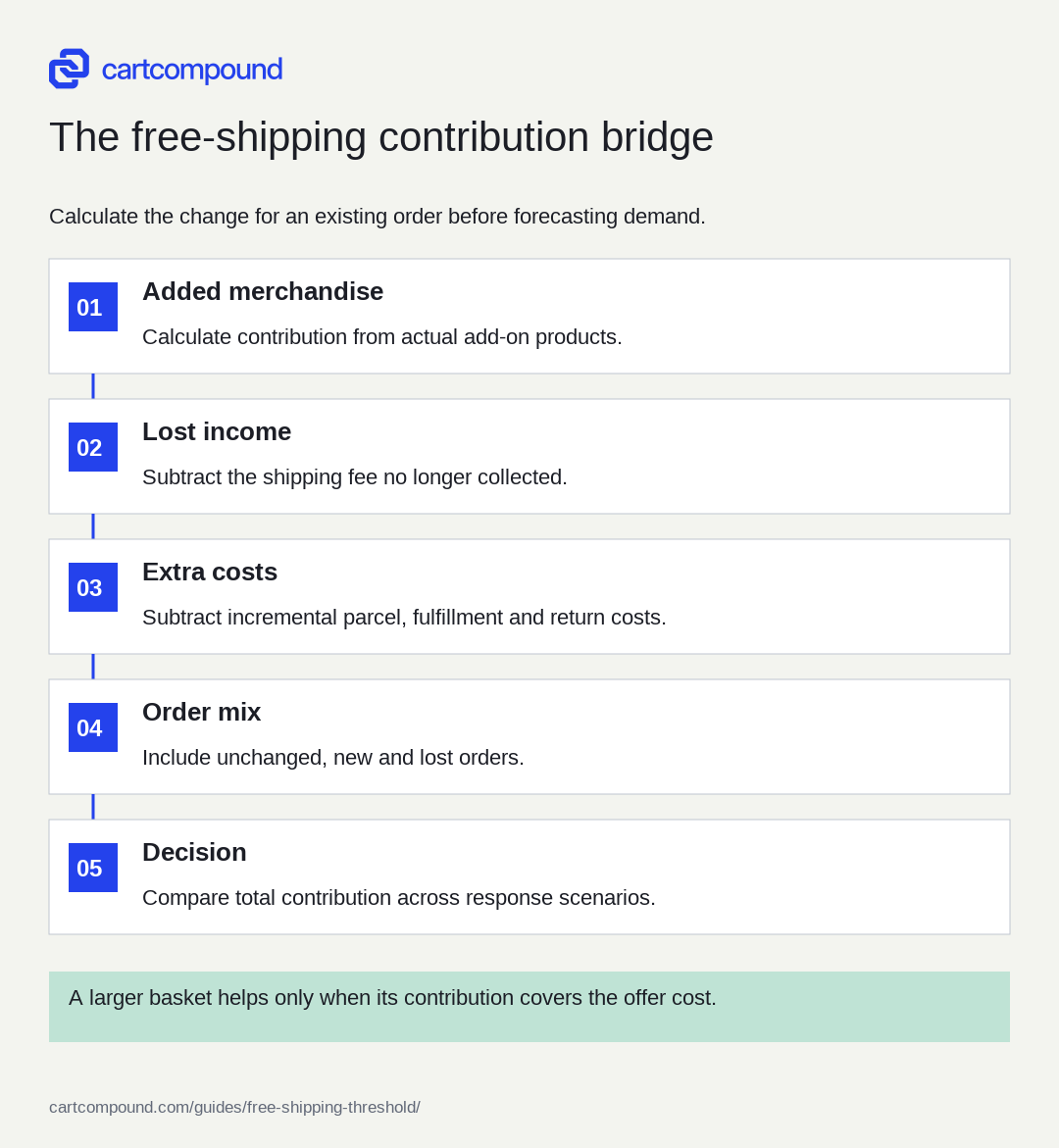
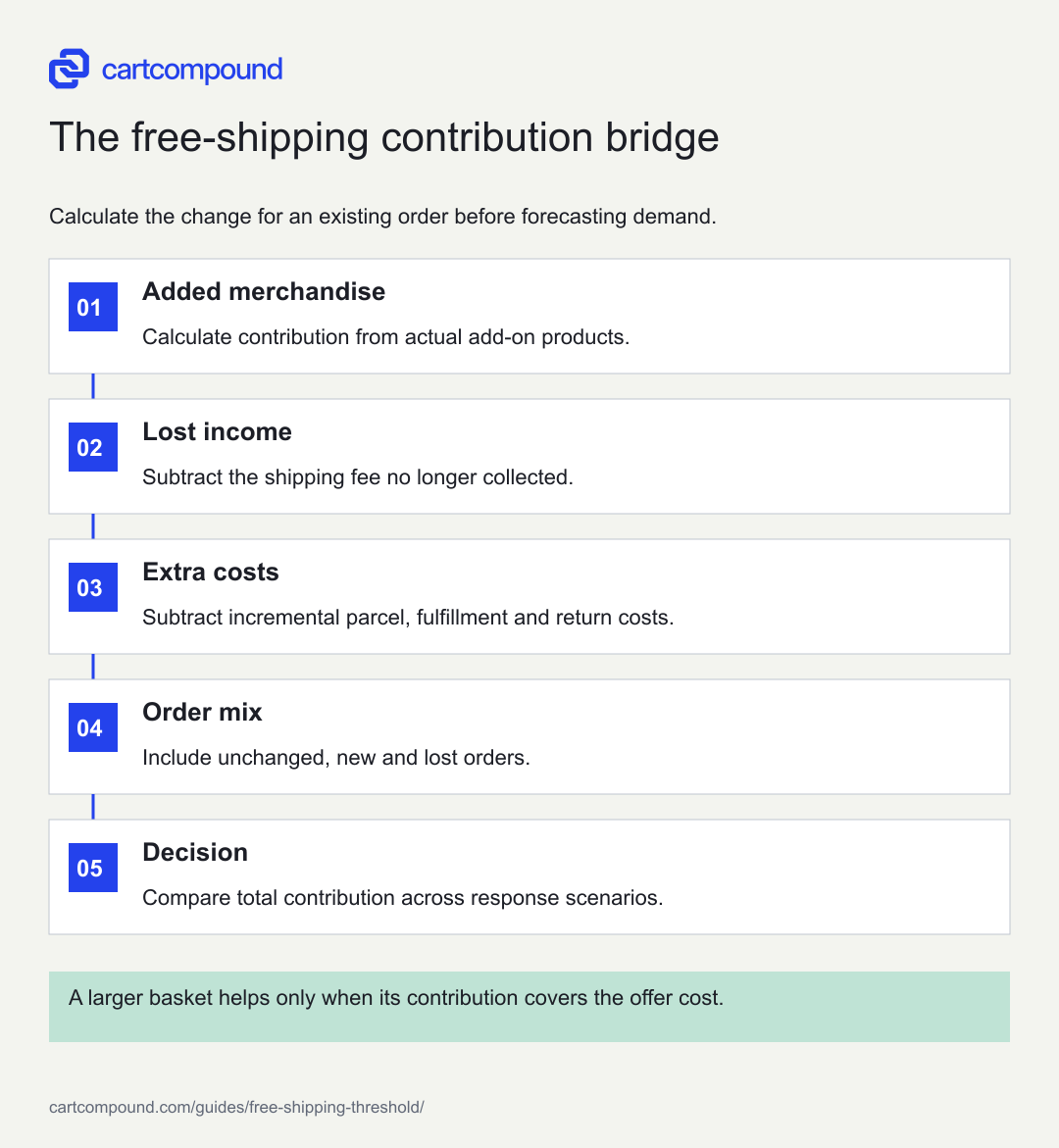
The free-shipping contribution bridge
Calculate the change for an existing order before forecasting demand.
- Added merchandiseCalculate contribution from actual add-on products.
- Lost incomeSubtract the shipping fee no longer collected.
- Extra costsSubtract incremental parcel, fulfillment and return costs.
- Order mixInclude unchanged, new and lost orders.
- DecisionCompare total contribution across response scenarios.
A larger basket helps only when its contribution covers the offer cost.
Use the steps with your store data. Examples in this guide are illustrative unless a source is named.
Distinguish covering shipment from preserving contribution
A basic shipping-cost-divided-by-margin calculation only asks how much merchandise contribution covers a shipment under simplified assumptions. It does not account for the contribution you already earned on the original basket or the shipping payment you are about to stop collecting. It is therefore not a complete threshold decision model.
For an existing basket that already ships, the additional merchandise contribution must cover lost customer shipping income plus any extra variable cost caused by the larger basket if you want to preserve contribution per order. If the carrier cost stays the same, do not charge it again as an incremental cost. If it increases, include the difference. This distinction prevents both understatement and double counting.
Write the simplified bridge: additional merchandise contribution minus lost shipping income minus incremental fees, fulfillment, shipment, and return costs equals the contribution change for that order. Use this only when the original order would have happened anyway. New orders and lost orders need their own scenarios because their full contribution changes the total result. The model is conditional arithmetic, not a prediction of shopper behavior.
Calculate an illustrative basket bridge
Suppose an existing order contains $60 of net merchandise and produces a 45% contribution rate before shipping, with all other variable costs already included in that rate. It therefore contributes $27 before shipment. The customer pays $6 shipping and the carrier costs $8, leaving $25 contribution. These are illustrative assumptions, not benchmarks.
The shopper adds $15 to reach a $75 free-shipping threshold. Merchandise contribution becomes $33.75 at the same assumed rate. Customer shipping income becomes zero. If the carrier still costs $8, order contribution becomes $25.75, an increase of $0.75. The extra $6.75 of merchandise contribution covered the lost $6 shipping payment. If the larger parcel raises carrier cost to $11, contribution falls to $22.75, which is $2.25 below the original order.
Under the simplified unchanged-shipment assumption, preserving the original contribution requires $6 divided by 0.45, or $13.33 of additional merchandise, before rounding and other incremental costs. This is not a recommendation to set the threshold at $73.33. It is a sensitivity check for this basket. The store must still examine the distribution of baskets, actual add-on margins, customer response, and destination costs.
Model the whole order mix
On a small screen, swipe the table to see every column.
| Order group | Effect of the offer | What the model needs |
|---|---|---|
| Already above the new threshold | May receive a subsidy without adding items | Lost shipping income on existing orders |
| Near the threshold | May add products or abandon | Actual add-on margin and parcel changes |
| Far below the threshold | May ignore the offer or feel pressured | Conversion and basket behavior |
| Newly acquired orders | Adds full order contribution | Incremental order estimate and costs |
| Lost orders after a higher threshold | Removes contribution | Plausible lost-order scenarios |
| Remote or oversized baskets | Can change shipping economics sharply | Destination and product exclusions |
Build conservative, central, and optimistic order-response scenarios. Keep assumptions visible rather than choosing one optimistic conversion lift. Calculate total contribution for each scenario and compare it with the current offer. Include orders already qualifying because they often account for a substantial part of subsidy cost, even though their baskets do not change.
Use the basket distribution, not only its average. A store with many $30 and $150 orders can have the same average as a store concentrated around $90. A threshold near the average affects those stores differently. Inspect the number of eligible baskets within realistic add-on distances and whether the catalog contains useful products at those prices.
Make eligibility and messaging match checkout
Confirm how the platform calculates eligibility. Shopify's free-shipping discount documentation states that minimum purchase amounts use product prices, exclude taxes, and account for applicable product discounts. Distinguish a discount-based offer from a configured shipping rate and test the mechanism you actually use. Do not assume every app or customization follows the same rule.
Shopify's shipping-rate documentation also describes coverage requirements and warns about gaps in conditional tiers. Verify the store's current setup because shipping options are changing gradually across stores. Test just below, exactly at, and just above the threshold, plus large baskets beyond the highest configured tier. Check each relevant profile and destination.
Write progress messages using the same eligible subtotal. If the shopper removes a product or applies a discount, update the remaining amount accurately. State the service and geographic limits where they affect the decision. Avoid promising free express shipping when the offer covers only standard delivery. Confirm that the final order, not just the cart banner, reflects the intended rule.
Test the commercial decision without hiding uncertainty
If traffic and infrastructure support a controlled test, define the offer, eligible population, primary contribution measure, and guardrails before launch. Use a consistent assignment method and include the full order economics. Evaluate new customers separately when that distinction matters, but avoid unsupported conclusions from tiny segments. A threshold experiment can change both conversion and basket composition.
If a controlled test is not feasible, use a carefully bounded rollout with a baseline, documented external changes, and a review plan. Label before-and-after findings as observational. Seasonality, media mix, stock, and promotions can explain some movement. Do not claim the offer caused an increase simply because the periods differ.
Monitor contribution per eligible visitor or another consistently defined opportunity measure alongside total contribution, conversion, average order value, shipping subsidy, and returns. AOV can rise while total profit falls if fewer people order. Shipping cost per order can rise because the basket changed rather than because carriers became more expensive. Interpret the measures together and investigate the operational explanation.
Account for returns and delayed cost information
A threshold offer can change the items people buy, including additions made only to qualify. If those items are returned later, the initial order-value increase may not persist. Review mature order cohorts and record what your contribution estimate assumes about returns, label costs, damaged goods, and refund fees. Avoid comparing a fully matured baseline with a recent cohort whose returns have not arrived.
Carrier invoices can also arrive after the order and include adjustments. Reconcile estimated shipment cost with billed cost for representative parcels, including dimensional weight and surcharges where they apply. If the model relies on an estimated shipping field, label it and update the analysis when actual costs are available.
Decide how mixed orders and partial returns affect the original shipping offer under the approved policy. This is a policy and operational question, not something to improvise in a progress bar. Ensure the checkout message, return process, and support guidance agree. If terms need to change, obtain the relevant authority and market review before treating the new rule as an available optimization.
Choose the next threshold action
Create a short decision sheet with the current offer, proposed threshold, eligibility, basket distribution, cost assumptions, and scenario results. Ask whether the proposal remains acceptable under a conservative response. If it requires a large unproven conversion gain, reduce the scope or improve the evidence before broad rollout. Keep the failure condition explicit.
Review product suggestions used to help customers reach the threshold. Recommend useful, compatible additions with adequate margin and stock. Do not encourage unnecessary purchases through misleading urgency or an inaccurate progress bar. The add-on should make sense for the order and should not create a parcel-cost step the model ignored.
The immediate next action is to take a representative set of fulfilled baskets and calculate contribution under the current and proposed rules. Include unchanged baskets as well as hypothetical additions. Test the actual checkout boundaries after the economics pass. Choose the offer only when the commercial model, operational coverage, and customer message agree.
Your action checklist
Use this to decide what to do next. Your checks stay on this page and are not sent or saved.
0 of 8 checked
Common questions
Should the threshold be above average order value?
AOV is one input, but the basket distribution, product prices, margins, and shipping costs determine what the offer changes. There is no universal percentage above AOV that guarantees a profitable threshold.
Does a higher AOV prove the offer worked?
No. Orders may fall, shipping subsidy may rise, or the added products may have weak contribution. Compare total economics and a consistent eligible-population measure.
Should I include shipping income in the model?
Yes, if the offer removes money customers currently pay. Keep its accounting treatment explicit and avoid counting it twice. Lost shipping income is different from the carrier expense.
Sources and review
Source documentation checked October 27, 2026. Platform features and interfaces can change. The recommendations and illustrative examples explain how to make the decision; they do not promise results.
- Free shipping discounts
Shopify minimum purchase and discount eligibility rules. - Setting up shipping zones and rates
Shipping-rate configuration, coverage gaps, and gradual platform changes.
Talk through your store question
Bring one problem you want to solve.
A free 20-minute call with Hamid can help you decide what to investigate next.
Book a free 20-minute call
About the author
Hamid Khan
Hamid co-founded CartCompound and works with ecommerce founders on their stores and growth priorities.
Profile and guides