The short answer
Compare equivalent periods by page, query, country, and device. Verify measurement and indexability, then inspect demand, search-result changes, product relevance, and content gaps. Refresh only the parts supported by the diagnosis, and record the baseline and review date.
Define the decline precisely
Content decay is a working label for a sustained loss of performance on an existing page. It is not a diagnosis by itself. Specify which measure declined: search clicks, impressions, qualified visits, product discovery, purchases, or contribution. A page can gain impressions while losing relevant clicks, or retain search traffic while its linked products become unavailable. Those situations require different responses.
Record the page URL, page type, first observed change, comparison periods, and business importance. Use complete periods and inspect weekday and seasonal patterns. A small page with a few visits can show a dramatic percentage change from a very small absolute difference. Prioritize meaningful losses and useful learning rather than automatically selecting the largest percentage decline.
Start a change log before editing. Include theme releases, redirects, consent changes, product substitutions, price changes, promotions, and inventory outages. A guide revised at the same time as a tracking installation cannot be evaluated from an unannotated session chart. Preserve the original text and performance export so later reviews can distinguish the effect of a content change from a change in what was measured.
Rule out access and measurement problems
Check whether the page still loads, uses the intended canonical URL, and can be indexed. Inspect representative affected URLs rather than assuming that a sitewide report explains every page. Review recent redirects, accidental noindex rules, login barriers, broken internal links, and missing content. If a page disappeared after a migration, rewriting its introduction will not repair the underlying problem.
Google's traffic-drop troubleshooting guidance separates technical problems, ranking changes, seasonality, security issues, and other causes. It recommends examining patterns across pages and search dimensions. Use that structure to establish whether the loss is isolated, template-wide, or broader. Check relevant status and data notices before treating every chart movement as a site defect.
Compare search clicks with measured visits directionally, while keeping their definitions separate. If Search Console clicks are stable but analytics visits drop after a consent or tag change, investigate collection first. If the page is available and reporting is dependable, continue to content and demand. Record the checks that passed. This prevents repeated troubleshooting and makes the eventual refresh rationale easier to audit.
 Keep this framework
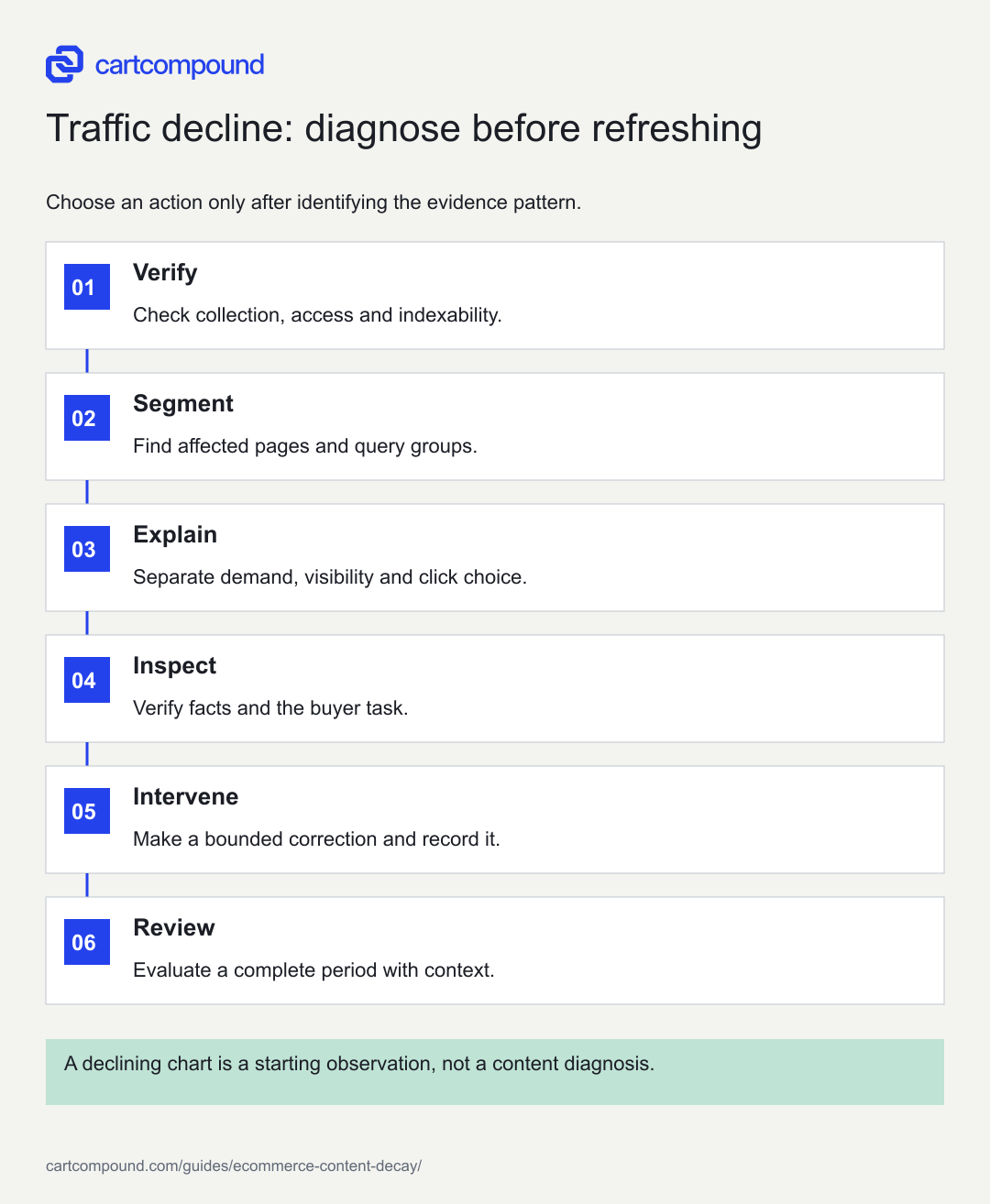
Traffic decline: diagnose before refreshing
Choose an action only after identifying the evidence pattern.
- VerifyCheck collection, access and indexability.
- SegmentFind affected pages and query groups.
- ExplainSeparate demand, visibility and click choice.
- InspectVerify facts and the buyer task.
- InterveneMake a bounded correction and record it.
- ReviewEvaluate a complete period with context.
A declining chart is a starting observation, not a content diagnosis.
Use the steps with your store data. Examples in this guide are illustrative unless a source is named.
Break the decline into demand, visibility, and click choice
Examine the affected query groups, not just the page total. A guide may lose a broad informational query while retaining the specific compatibility questions that bring useful buyers. Segment by country and device where volume supports it. Be careful with averages: a changing query mix can move average position without each important query moving the same way.
Use impressions, position, and click-through behavior as clues. Lower impressions with relatively stable visibility for a consistent query group can suggest changing demand, but it does not prove it. A sustained visibility loss across relevant queries suggests a different investigation. Stable impressions and fewer clicks can point toward title relevance, competing result features, or changes in the results people see. Inspect representative searches in the target context and record the observation date.
Compare seasonal context and external interest with an appropriate demand source. Do not turn a short-term fluctuation into a permanent trend. A holiday guide after the holiday has a predictable reason to decline. A technical guide whose referenced feature was removed may need a substantive update. Keep alternative explanations in the notes until the evidence is strong enough to choose an action.
Inspect the page against the current buyer task
Read the page as someone making the original decision today. Are the products still sold? Do dimensions, compatibility statements, policies, and screenshots remain accurate? Does the guide answer the question before asking for a purchase? Can a reader follow the instructions without opening several other pages to fill gaps? These checks identify practical problems even when the ranking cause remains uncertain.
Review support questions and product returns for newer misunderstandings. A guide may be accurate yet incomplete because the catalog or buyer context changed. Add a missing fit condition or a clearer example when that evidence supports it. Avoid expanding into every adjacent topic just to make the page longer. A focused correction is easier to review and less likely to dilute the original intent.
Inspect competing results for the job they help readers complete, not for phrases to copy. A new calculator, better comparison table, or clearer compatibility method may reveal an unmet need. Your response should be an original, supportable improvement. Changing the date or rearranging paragraphs without improving the decision does not resolve the underlying usefulness problem.
Choose the smallest effective intervention
On a small screen, swipe the table to see every column.
| Observed pattern | Candidate action | Evidence required |
|---|---|---|
| Broken or excluded URL | Repair access, canonical or redirect | URL inspection and release records |
| Outdated product facts | Update affected facts and recommendations | Current model documentation |
| Missing decision step | Add a worksheet or worked example | Customer question and verified method |
| Overlapping useful pages | Clarify roles or consolidate carefully | Query overlap, links and content audit |
| Seasonal demand decline | Maintain accuracy and plan the next season | Comparable seasonal history |
| Unclear cause and small movement | Monitor with a stated review date | Stable measurement and no critical defect |
Do not delete or consolidate pages simply because they have low recent traffic. Check their support role, links, historical demand, and uniqueness. A useful instruction page may serve existing customers outside search. If consolidation is justified, map what must be preserved, choose the destination, and plan redirects and internal-link updates. Treat it as a release with QA.
When a broad search update overlaps the decline, avoid speculative mass edits. Google's core-update guidance recommends evaluating the right comparison periods and the quality of affected content, and notes that changes do not guarantee an impact. Keep the intervention tied to a documented page problem rather than a theory that every old article needs a new date.
Work through an illustrative diagnosis
Suppose a luggage-size guide falls from 2,000 to 1,400 search clicks across equal comparison periods, a loss of 600. A query-level review shows 450 lost clicks associated with a discontinued suitcase model and 150 lost clicks across broader sizing questions. The guide still links to the retired model and contains an unclear measurement diagram. These numbers are illustrative and do not describe an actual store.
The first action is to verify the retired product's status and update the recommendation with a suitable alternative only after checking its dimensions. Preserve the model explanation if existing owners still need it. Next, correct the measurement diagram so it distinguishes internal capacity from external dimensions. Record those changes separately. The broader query decline may still reflect demand or visibility changes, so do not claim the whole 600-click loss is caused by the broken recommendation.
Set the evaluation plan before release: check page access immediately, verify product destinations, review relevant query groups after a suitable complete period, and examine whether support questions about measurements decline. The outcome may be a better page without a full traffic recovery. That is a useful result when it is described accurately and does not become a fabricated recovery case study.
Release and measure the update
Save the old version, evidence packet, change list, and intended outcome. Identify which sections changed and why. Keep useful URLs stable unless a change is necessary. Verify links, table values, visual labels, and mobile readability. If the page uses structured data or product components, include those in the relevant technical checks. A content refresh can introduce a broken recommendation even when its prose improves.
Use a small scorecard: indexing and access, relevant query clicks, product-detail discovery, observed purchases, and the specific customer problem addressed. Pick a review period that reflects volume, seasonality, and purchase cycle. Do not compare the first partial day after release with a complete prior period. Keep a record of unrelated price, stock, and campaign changes during the evaluation.
Treat results as evidence with limits. If the page improves while similar untreated pages also improve, broad demand may explain part of the change. If the page loses traffic after a correction, the correction can still be necessary for accuracy. Separate the editorial obligation to fix a wrong fact from the commercial question of whether the new content produces a measurable increase.
Separate lost revenue from a changed content role
A page can become more useful to existing customers while attracting fewer new buyers, or retain visits while sending people to discontinued products. Track the role the page is intended to serve. A setup instruction should not be judged by the same immediate purchase expectation as a product comparison.
Before retiring a low-traffic resource, check links from packaging, order messages, support templates, and account pages. Search analytics may miss much of its operational value. If the instructions remain necessary, maintain accuracy and accessibility even when their organic traffic is modest. If the product is no longer sold, existing owners may still need its care or compatibility information.
Where the original business role has changed, update the measurement plan as well as the content. Preserve the historical objective in the change log. Do not call the change a traffic recovery project if the new purpose is support. A clear role helps prioritize maintenance and prevents a useful customer resource from being removed to improve an arbitrary content score.
Create a manageable maintenance queue
Build a queue by combining material business loss, confidence in the diagnosis, importance of the information, and effort. An inaccurate compatibility claim can deserve immediate attention even on a low-traffic page. A small unexplained ranking fluctuation on a current page may deserve monitoring. Avoid a scoring formula that lets a serious factual problem disappear behind low traffic.
Assign one owner and one next action per page. Useful actions include verify product specification, inspect canonical, rewrite the measurement step, replace a discontinued recommendation, or revisit after the seasonal peak. “Refresh content” is too vague to schedule or accept. Add the required reviewer and the evidence that will establish completion.
The immediate next action is to inspect the ten pages with the largest meaningful losses and classify each before editing. Choose one where the evidence supports a bounded intervention. Complete the correction, preserve the change log, and evaluate it using the stated measure. This creates a repeatable maintenance process without turning every decline into an unnecessary rewrite.
Your action checklist
Use this to decide what to do next. Your checks stay on this page and are not sent or saved.
0 of 8 checked
Common questions
Should I update every article annually?
Check facts on a schedule appropriate to the subject, but update substance when evidence warrants it. Product changes and broken instructions can require immediate review; a stable explanation may need only verification.
Does changing the date help?
A date should reflect a meaningful update or review accurately. Changing it without improving the page does not resolve a content or demand problem.
What if traffic never returns?
Reassess the diagnosis, demand, page role, and implementation. A correct, useful page may still receive fewer search visits. Avoid promising recovery or deleting useful content solely because the prior peak did not return.
Sources and review
Source documentation checked October 27, 2026. Platform features and interfaces can change. The recommendations and illustrative examples explain how to make the decision; they do not promise results.
- Debugging drops in Google Search traffic
Google diagnostic categories, query/page segmentation and demand context. - Google Search core updates and your website
Core-update analysis timing and uncertainty of outcomes.
Talk through your store question
Bring one problem you want to solve.
A free 20-minute call with Hamid can help you decide what to investigate next.
Book a free 20-minute call
About the author
Hamid Khan
Hamid co-founded CartCompound and works with ecommerce founders on their stores and growth priorities.
Profile and guides