The short answer
Begin with the buyer situation, identify the constraints that exclude unsuitable products, explain the meaningful tradeoffs, and offer a short next step. Use verified product facts, a worked example, and links that preserve the decision the reader just made.
Choose a question that deserves a guide
A buying guide should solve a choice that a product grid cannot resolve on its own. Good candidates include sizing, material tradeoffs, compatibility, capacity, and required accessories. If the shopper simply wants all blue shirts in a size, a filtered category is probably more useful. If they need to understand whether a fabric or fit suits their use, a guide can add something the grid lacks.
Start with customer evidence. Review support questions, store-search phrases, product questions, and return reasons. Identify the point where buyers cannot translate their situation into a product requirement. A phrase such as “storage for a narrow entryway” suggests a space and access problem; an article that lists popular cabinets without a measurement method may leave the problem unsolved.
Search the actual question and inspect the result types in the relevant market. Record whether the results provide instructions, category pages, product comparisons, or broad inspiration. Use this observation to refine the task, not to copy headings. A guide is worth producing when your business can contribute a supportable explanation, measurement method, example, or product insight that makes the decision easier.
Separate hard constraints from preferences
Ask what must be true before an option can work. A rack may need to fit a doorway, a replacement part may need a compatible connector, and a container may need to hold a specific quantity. Put these conditions at the beginning. A buyer should not read a long recommendation list only to discover that every option fails a basic requirement.
Then describe preferences such as appearance, portability, ease of cleaning, and price. Explain the tradeoff rather than ranking every feature as a benefit. A larger container offers capacity but uses more space. A lighter material may change care requirements. Use only claims supported by product documentation or real testing. If the tradeoff is an inference from dimensions or construction, label the reasoning clearly.
Create a decision order that prevents wasted work: identify the task, measure the relevant space or requirement, exclude incompatible choices, compare the remaining tradeoffs, and inspect the exact product. This sequence can shape the whole page. It also helps the store decide which product filters belong beside the guide and which information must be visible on product pages.
 Keep this framework
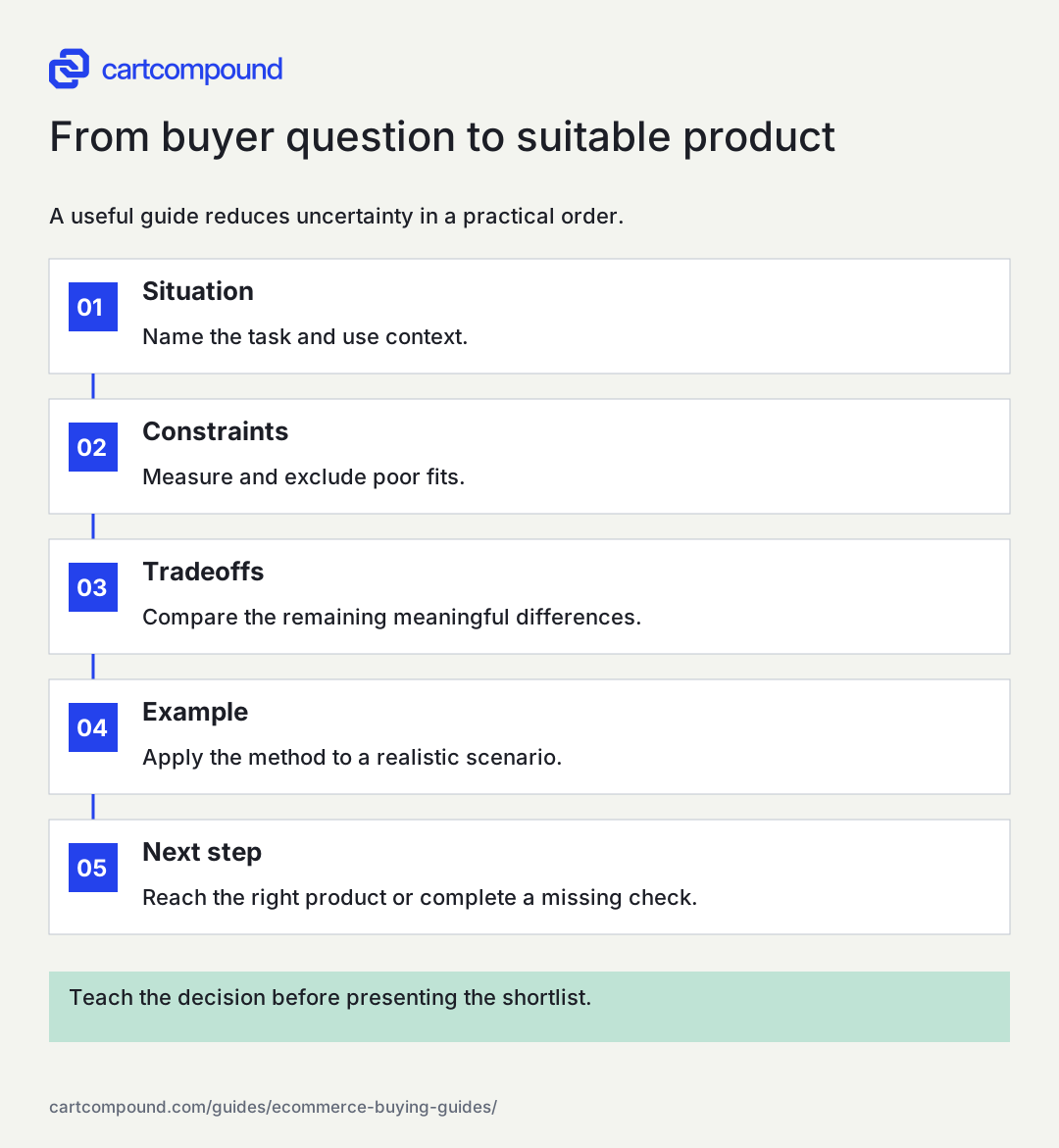
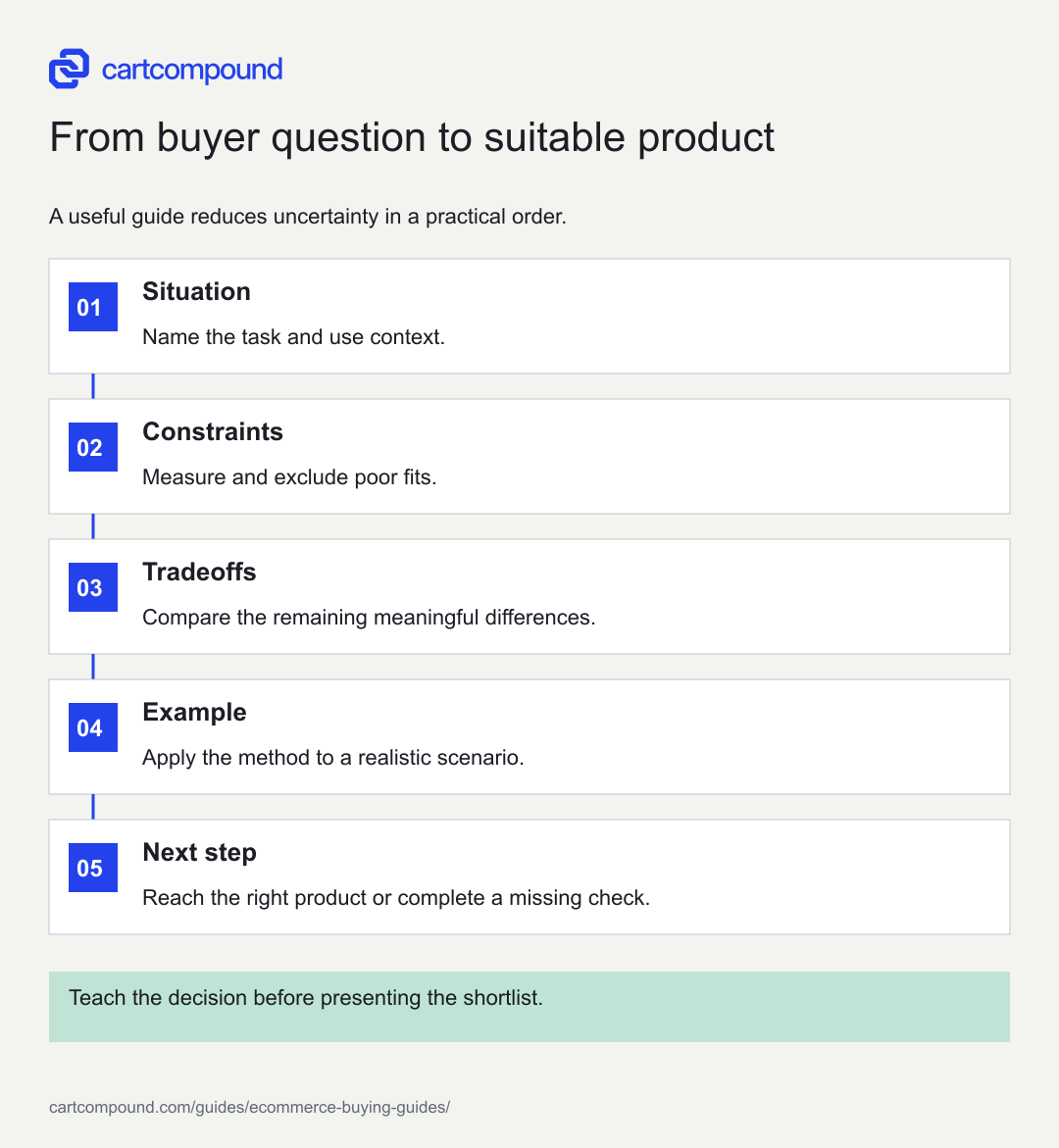
From buyer question to suitable product
A useful guide reduces uncertainty in a practical order.
- SituationName the task and use context.
- ConstraintsMeasure and exclude poor fits.
- TradeoffsCompare the remaining meaningful differences.
- ExampleApply the method to a realistic scenario.
- Next stepReach the right product or complete a missing check.
Teach the decision before presenting the shortlist.
Use the steps with your store data. Examples in this guide are illustrative unless a source is named.
Use product knowledge without inventing experience
Gather manufacturer specifications, model instructions, verified measurements, and the product team's documented observations. Record which facts are current and who reviewed them. If a writer has not used the product, do not imply a hands-on trial. A guide can explain a specification-based decision honestly. Where a claim depends on actual use, commission a test or narrow the claim.
Google's content guidance asks whether a page offers useful original information or analysis and leaves readers able to achieve their goal. In a buying guide, original value might be a fit worksheet, a compatibility decision tree, or a transparent calculation. It does not require an invented anecdote or a dramatic claim about years of experience.
Distinguish product facts from general educational statements. A material description may need a different source from a model-specific dimension. Keep safety, health, environmental, and regulatory claims within the expertise and evidence available. Link to applicable instructions rather than improvising a shortcut. If a critical requirement cannot be confirmed, say what the buyer needs to verify before ordering.
Build the page around a usable decision path
Open with a concise answer for the reader who needs orientation. State the main factors and the first check to complete. Follow with the method in the order the reader can use it. Avoid making people scroll through a category history before they learn what to measure. Define unfamiliar terms beside the first decision that depends on them.
Use a compact table when the same criteria apply to several options. Use a decision flow when one condition changes the next question. Add a worked example when the buyer must combine dimensions, capacity, or quantity. Keep product recommendations after the method so their relevance is understandable. A reader should know why an option appears, not merely that it is one of the store's products.
Include the wrong-fit cases. Explain when the category may be unsuitable and when a different approach deserves consideration. This can be brief, but it should be meaningful. A guide that treats every visitor as a buyer of the same product is less useful than one that helps someone recognize an incompatible installation or an unnecessary purchase before they commit.
Work through an illustrative capacity decision
Imagine a guide to organizing a 24-inch-wide shelf with two rectangular containers. Container A is 10 inches wide and holds an illustrative 8 quarts; Container B is 11.5 inches wide and holds an illustrative 10 quarts. Two A containers occupy 20 inches and offer 16 quarts. Two B containers occupy 23 inches and offer 20 quarts. These values are invented solely to demonstrate the calculation.
A useful guide does not stop at capacity. It asks whether the shelf has enough usable depth and height, whether lids need clearance, and whether a hand can remove the container. If B needs more removal clearance than the shelf permits, its larger capacity is irrelevant. If A leaves space for a third type of item, the unused width may be useful rather than wasteful.
Show the worksheet: usable shelf dimensions, quantity, external dimensions, combined occupied space, required gaps, and the volume the buyer actually needs. Explain that external size and internal capacity are different measurements. Ask the reader to check exact model instructions and measure the real space. The goal is a repeatable method that can be applied to any suitable option, including one outside your catalog.
Map guide outcomes to the right destinations
On a small screen, swipe the table to see every column.
| Reader outcome | Useful next destination | Check before release |
|---|---|---|
| Needs a shallow fit | Collection of verified shallow models | Products match the depth described |
| Has narrowed to two options | Focused comparison page | Criteria and model versions agree |
| Knows exact required size | Relevant product or selected variant | Destination preserves the choice |
| Still lacks a measurement | Worksheet or measurement instructions | Instructions identify reference points |
| Has an incompatible setup | Alternative approach or support route | No unsupported compatibility promise |
Keep the next action proportional to the reader's certainty. A shopper who has not measured should not be pushed straight into a specific variant. A reader who has completed the checks should not have to start again on an unrelated category page. Link labels should describe the destination and the criterion being carried forward.
Avoid a product carousel that undermines the article's advice. If the guide excludes oversized products but the recommended cards show them anyway, the page creates a new decision problem. Treat recommendation logic as part of the editorial review. Where live inventory changes the selection, define how unavailable items are handled and who checks that the replacement still meets the stated requirements.
Review the guide as a novice would use it
Ask a colleague unfamiliar with the category to follow the guide with a plausible scenario. Have them explain what they would measure, which choices they would exclude, and what they would do next. Confusion is evidence that an instruction or definition may be missing. Do not coach them through the task and then conclude that the guide was clear.
Check the page on a phone as well as a desktop. Tables need clear labels and a usable reading order. Illustrations should show the actual measurement reference points. Any infographic needs a text explanation that produces the same decision. Avoid shrinking dense diagrams until the words become difficult to read. Break complex steps into a sequence when that is easier to use.
Verify all product facts, numerical examples, links, and conditional recommendations. Check the guide against current product pages and policies. Remove unsupported superlatives and claims that every reader will get the same outcome. Record the reviewer, source dates, and unresolved limitations. If the guide relies on a specialist claim, obtain that review before treating the page as ready.
Support readers who do not match the main example
A single worked example should not imply that every household or installation shares the same conditions. Add a brief exception section for the variations most likely to change the choice. These might include unusually shallow storage, mixed-size objects, limited lifting ability, or an installation that requires specialist advice. Use actual product and customer evidence to select the exceptions.
Give each exception a useful check. “Results may vary” does not tell the reader what to do. “Measure the opening at its narrowest point and compare it with the exact assembled dimensions” is actionable when supported by the product context. Avoid giving safety-critical instructions outside the evidence or expertise available.
If the reader cannot determine suitability from the guide, explain which information remains missing and where to verify it. A clear stop condition can be valuable: do not select a model until the required connector or space is confirmed. That is a better outcome than steering every uncertain reader toward the default bestseller.
Measure and maintain the guide
Review relevant search queries, entrances, product-detail clicks, and observed purchase paths. Interpret these together with support questions and return reasons. A guide can be commercially useful by preventing unsuitable orders or answering questions before support is needed. Do not judge it solely by immediate purchases in the same session, but do not assign invented revenue to unmeasured benefits either.
Create an update list with product versions, source dates, important links, and the owner. Trigger reviews when the assortment changes, a model is revised, a compatibility limit changes, or a repeated customer question exposes a gap. A periodic check can catch issues, but significant product changes should not wait for the next calendar reminder. Preserve useful explanations when replacing a discontinued recommendation.
The immediate next action is to select one recurring buyer question and write the decision order in five lines. Attach the evidence for each constraint, add one worked example, and map the outcomes to useful destinations. If the method works without the product cards, the guide has a solid educational core. Then add the commercial path that helps the right reader move forward.
Your action checklist
Use this to decide what to do next. Your checks stay on this page and are not sent or saved.
0 of 8 checked
Common questions
How many products should a buying guide include?
Include enough to represent meaningful choices without overwhelming the decision. A short set tied to clear constraints is more useful than a long list of nearly identical products.
Should the guide recommend only products in stock?
Recommendations should accurately describe availability and a useful next action. Keep educational advice independent of short stock changes, and review any replacement product against the original criteria.
Can a buying guide rank without original testing?
No ranking outcome can be promised. A specification-based guide can still be useful when it provides original analysis and a clear method. Label its evidence and avoid implying tests that did not occur.
Sources and review
Source documentation checked October 27, 2026. Platform features and interfaces can change. The recommendations and illustrative examples explain how to make the decision; they do not promise results.
- Creating helpful, reliable, people-first content
Original value, useful task completion, accurate sourcing and transparent expertise.
Talk through your store question
Bring one problem you want to solve.
A free 20-minute call with Hamid can help you decide what to investigate next.
Book a free 20-minute call
About the author
Hamid Khan
Hamid co-founded CartCompound and works with ecommerce founders on their stores and growth priorities.
Profile and guides