The short answer
Compare options against the same buyer-relevant criteria, distinguish measured findings from specifications, and recommend by use case. State important exclusions and unknowns. A comparison should help the reader eliminate a poor fit and understand the tradeoff behind the remaining choice.
Check that a comparison is the right page
A comparison page works when a shopper is choosing between credible alternatives. The options might be two named products, two materials, or two approaches to the same task. It is less useful when the items solve unrelated problems and the only reason to place them together is a keyword opportunity. Write the shared decision before choosing the title.
Identify the reader's starting knowledge. Someone searching for two model names may already know the category and need meaningful differences. Someone comparing linen with cotton may need definitions, care requirements, and different expectations before a product recommendation. Set the scope accordingly. Avoid adding a long category introduction to a model comparison while leaving the actual fit or compatibility question unanswered.
Use search observations, internal search, support tickets, and customer questions to identify genuine alternatives. Record the date and market context. These are qualitative signals, not proof of demand size. If your store sells one option, acknowledge the commercial perspective and still explain when the other option may suit the reader better. A useful comparison does not require your product to win every row.
Choose criteria before scoring products
List the constraints that can eliminate an option: dimensions, compatibility, required accessories, power, capacity, maintenance, and availability in the reader's market. Put those before preferences such as finish or appearance. A product that cannot fit the installation is unsuitable regardless of its feature count. Ask the product specialist which differences lead to support problems or returns.
Use the same measurement basis for each option. Compare usable capacity with usable capacity, included accessories with included accessories, and the same warranty or service region. If sources use different definitions, explain the mismatch rather than converting it into a seemingly precise ranking. A larger number is not automatically better when it refers to weight, footprint, or energy use.
Avoid a universal weighted score unless the weights reflect an explicit use case. A commuter and a weekend traveler can reasonably value different features. Provide conditional recommendations instead: choose A when compact storage is essential; consider B when capacity matters more than weight. If you do use scores, publish the criteria and explain that the weighting is an editorial model, not an objective measurement of product quality.
 Keep this framework
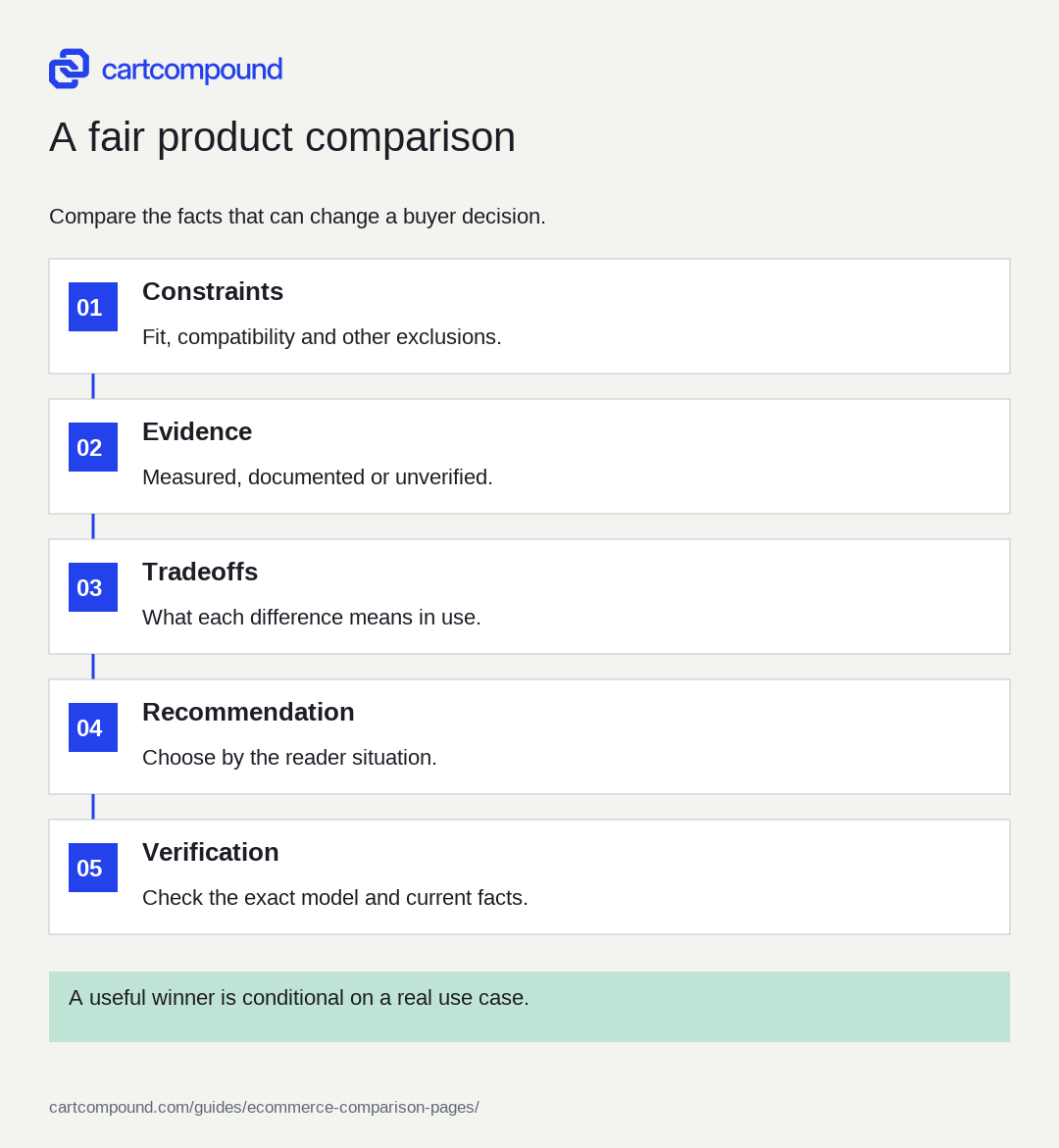
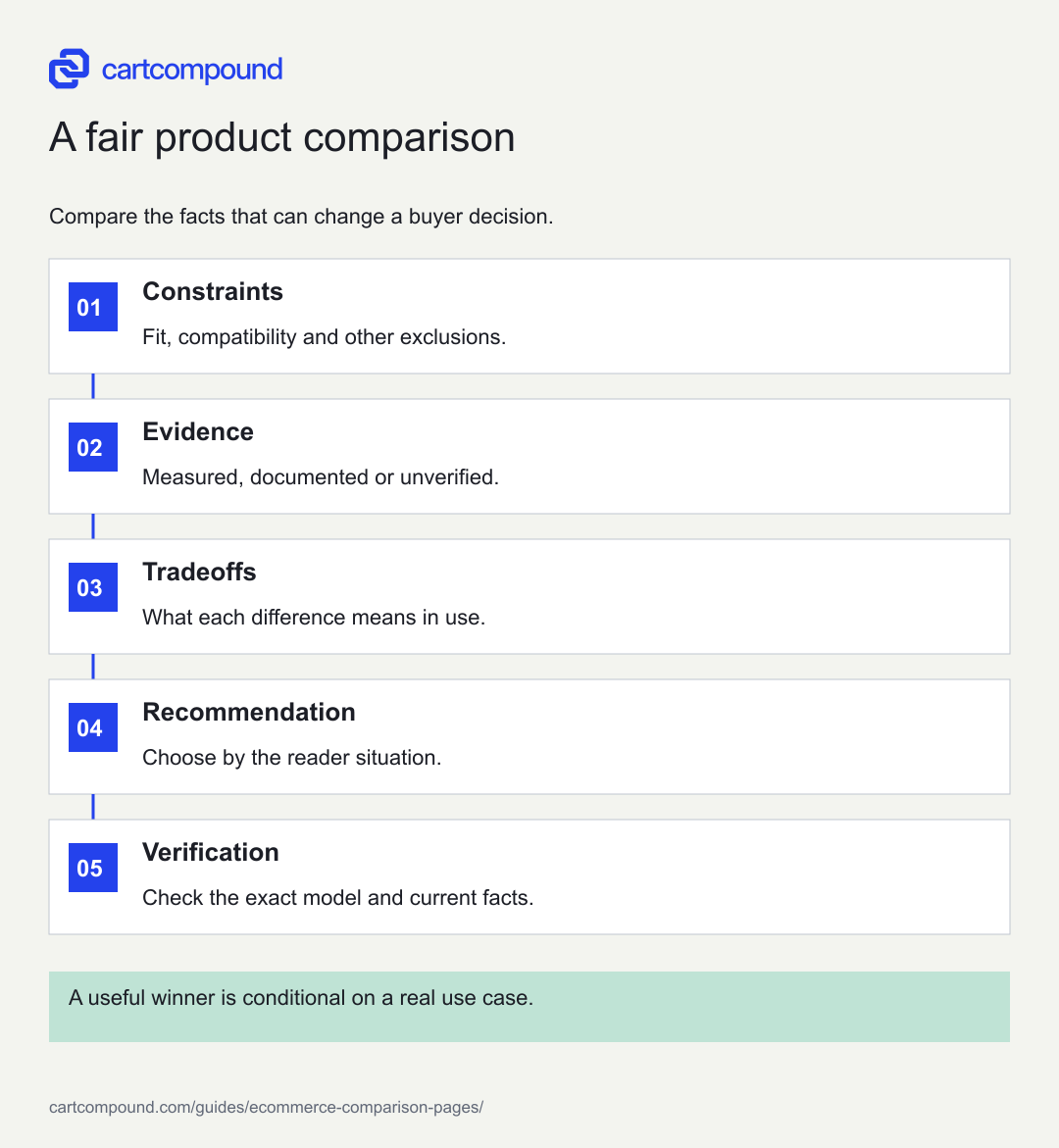
A fair product comparison
Compare the facts that can change a buyer decision.
- ConstraintsFit, compatibility and other exclusions.
- EvidenceMeasured, documented or unverified.
- TradeoffsWhat each difference means in use.
- RecommendationChoose by the reader situation.
- VerificationCheck the exact model and current facts.
A useful winner is conditional on a real use case.
Use the steps with your store data. Examples in this guide are illustrative unless a source is named.
Build a claim ledger for every option
Record each comparison fact with the model, variant, source, date, and evidence type. Use current manufacturer documentation for specifications and your actual test records for observed performance. Keep unknown fields visible. If you have not tested noise, do not turn a marketing phrase into a measured decibel claim. A specification-based comparison can be useful when it is labeled accurately.
Google's review guidance encourages evidence of experience, useful measurements, differences, benefits, and drawbacks. Apply that principle by showing how a claim was established. A photograph should support a relevant observation, such as connector clearance, rather than implying that an unperformed test took place. Do not invent an author biography to make the comparison appear more authoritative.
For competitor products, link to the exact relevant source and avoid assumptions about their current price, inventory, or support. Quote sparingly and write your own analysis. If a material fact cannot be verified, mark it as unconfirmed or omit the ranking that depends on it. Set an update trigger for model revisions, changed specifications, and discontinued options. A timestamp alone does not keep a table accurate.
Translate specifications into consequences
The value of a comparison is the explanation between the numbers and the decision. “Option A weighs 0.4 pounds less” becomes useful when the reader understands whether that difference matters in a pack, on a counter, or during installation. Keep the consequence tied to the use case and avoid claiming a measured effect you have not established.
Separate must-have requirements from tradeoffs. A countertop appliance that needs a particular electrical supply may be excluded for one buyer. A larger footprint may simply be inconvenient for another. Mark these differences clearly so readers do not confuse a safety or compatibility limit with a preference. Where specialist safety instructions apply, direct the reader to the product documentation rather than improvising instructions.
Explain total ownership requirements without inventing lifetime costs. Identify consumables, replacement parts, maintenance, storage, and required accessories. If you calculate a scenario, show the assumed usage and prices, label it illustrative, and avoid treating the result as a forecast. Readers should be able to replace the assumptions with their own circumstances. This gives the page practical value beyond a table of manufacturer specifications.
Use a worked fit comparison
Consider an illustrative comparison of two storage bins for a shelf with 31 inches of usable width. Bin A is 10 inches wide and Bin B is 12 inches wide. Three A bins occupy 30 inches, leaving 1 inch before required clearances. Two B bins occupy 24 inches, leaving 7 inches. These invented example dimensions demonstrate the method, not real product performance.
The page should next ask about usable depth, handle projection, shelf taper, and the clearance needed to remove each bin. If a divider consumes part of the shelf, the available width changes. A reader who needs three separate categories may favor A if all other fit conditions pass. A reader who needs to store taller objects may still choose B if its verified dimensions better match that requirement.
Do not declare A the winner because it uses more shelf width. State what the calculation establishes and what remains unresolved. Include a small worksheet: usable width, number of bins, bin width, total occupied width, required gaps, and remaining space. The example becomes a reusable decision method and reveals why nominal furniture size is insufficient for a reliable recommendation.
Design the comparison table around decisions
On a small screen, swipe the table to see every column.
| Comparison row | How to present it | What to avoid |
|---|---|---|
| Compatibility | Exact supported condition and source | A vague checkmark without limits |
| Dimensions | Same units and measurement definition | Comparing packed with assembled size |
| Evidence type | Measured, documented or unknown | Implying all products were tested |
| Included items | List what is in the evaluated package | Treating optional accessories as standard |
| Best-fit use case | Conditional explanation | Universal winner without criteria |
| Price reference | Current context and verification date | Permanent cheapest claim |
Keep the table short enough to scan and explain the decisive rows nearby. Put minor specifications in a secondary section rather than forcing every buyer through a huge matrix. On mobile, preserve row labels and the relationship between the criterion and each option. A pair of stacked product cards can work if it retains the same comparison order and does not require the reader to remember values from several screens earlier.
Make uncertainty legible. “Not verified” is different from “not supported.” A blank cell can imply either. Define the state in text and avoid using color or icons as the only explanation. Link directly to the relevant product detail after the recommendation so the reader can verify the exact variant before adding it to the cart.
Review for fairness, clarity, and commercial accuracy
Ask someone to find a situation in which each option is the wrong choice. If the draft cannot identify a meaningful limitation, it may be repeating marketing copy rather than comparing. Review whether the page gives competitors the same evidence standard as your own products. Do not accept an unsupported advantage because it favors the store.
Check every product link and variant. A recommendation for a compact model should not land on the larger default variant without a clear selection. Verify that stock, bundle contents, and regional compatibility have not changed since the evidence packet was prepared. Where prices are shown, use a maintainable source and disclose the context. Avoid a recommendation that silently depends on an expired promotion.
Read the page without the table. The prose should still explain the major tradeoffs. Then read only the table and recommendation summaries. They should not overstate what the full text supports. This two-pass review catches a common problem: careful limitations hidden in the article while a bold comparison card makes a much stronger claim. Ensure the visual model and text equivalent make the same decision.
Handle changing price and availability without bias
A comparison can become misleading when one product is temporarily discounted or unavailable. Decide whether the recommendation concerns the product's enduring suitability or a current offer. Keep those judgments separate. A short promotion may affect today's price comparison without changing the compatibility or maintenance tradeoff.
If you show prices, identify the exact package, quantity, market, and verification date. Compare like-for-like included components. A bare product and a bundle containing necessary accessories should not be ranked on headline price alone. Where live price maintenance is unreliable, explain the cost components and direct readers to current product information instead of publishing a permanent cheapest claim.
When an option is sold out, preserve the useful comparison and state the current next step accurately. Do not silently replace it with a different model under the same heading. Reevaluate the substitute against every decisive criterion and update the evidence ledger. Readers who arrive looking for the original model still need to understand what changed and whether the alternative meets their requirement.
Measure usefulness and maintain the choice
Track visits from relevant comparison queries, product-detail clicks, and subsequent observed purchases with the limits of attribution stated. Also inspect support questions and return reasons related to the compared features. A high click rate to the wrong option is not success if customers later discover a compatibility problem. Give product suitability and factual accuracy a place in the review.
Create an update register with the compared models, evidence dates, owner, and triggers. A new model, changed package, revised specification, or altered shipping availability can require a review before the calendar date arrives. When an option is discontinued, explain the status and replace the recommendation only after evaluating the successor. Preserve a useful archived explanation when readers still own the older product.
The next action is to choose one real comparison question and build the claim ledger before drafting. Identify the two or three criteria most likely to change the choice. Create a conditional recommendation and a worked example around those criteria. If the available evidence does not support a winner, publish a clear tradeoff analysis instead of manufacturing certainty.
Your action checklist
Use this to decide what to do next. Your checks stay on this page and are not sent or saved.
0 of 8 checked
Common questions
Can a store compare its product with a competitor?
Yes, when the facts are verified, the comparison basis is fair, and the commercial perspective is clear. Explain situations where the competing option may be preferable and obtain appropriate review for sensitive claims.
Do all products need hands-on testing?
No. A documented specification comparison can answer useful questions. Label the evidence accurately and avoid language or images that imply testing you did not perform.
Should I show a total score?
Only when the criteria and weighting help a defined buyer. Conditional recommendations often make the decision clearer because different buyers have different constraints.
Sources and review
Source documentation checked October 27, 2026. Platform features and interfaces can change. The recommendations and illustrative examples explain how to make the decision; they do not promise results.
- Write high quality reviews
Evidence, user perspective, measurements, differences and drawbacks in review content.
Talk through your store question
Bring one problem you want to solve.
A free 20-minute call with Hamid can help you decide what to investigate next.
Book a free 20-minute call
About the author
Hamid Khan
Hamid co-founded CartCompound and works with ecommerce founders on their stores and growth priorities.
Profile and guides