The short answer
Classify each provider and purpose before editing robots.txt. Search, potential training and user-initiated retrieval can have different controls. Verify representative public pages through robots rules and infrastructure, and protect private content with authentication rather than robots directives.
Start with an access policy, not a copied blocklist
Write down what the business wants public systems to do. A store may want products discoverable in search while declining use for model training. It may also want user-requested product lookups to work while preventing excessive automated traffic. These are separate choices. A single “block AI” instruction is too imprecise to implement or verify responsibly.
Create a policy owner and a technical owner. The policy owner decides acceptable uses; the technical owner checks which controls each provider documents and how the hosting stack enforces them. List public product pages, collections, buying guides, images and policy pages separately from accounts, checkouts, administration and order histories. The latter require appropriate access controls regardless of crawler preferences. Do not interpret an old agency robots file as a current business decision. Record why each provider is allowed or restricted and schedule a review when the provider's behavior or the store's publishing strategy changes.
Distinguish search, training and user retrieval
OpenAI's crawler documentation separates OAI-SearchBot for search, GPTBot for content that may be used in model training, and ChatGPT-User for certain user-initiated actions. It explicitly describes independent settings. This makes a search-access decision different from a training-access decision. Read the current documentation instead of assuming every agent sharing a company name has the same purpose.
User-requested retrieval is another category. The provider notes that robots rules may not apply to some user-initiated actions, and ChatGPT-User is not the control for search eligibility. This does not justify exposing private resources. It means a robots directive should not be treated as a complete access-enforcement mechanism. For other providers, document their own published agents and controls separately. Similar names do not establish equivalent behavior. Keep the provider, agent token, documented use, verification method and policy decision in the access register.
 Keep this framework
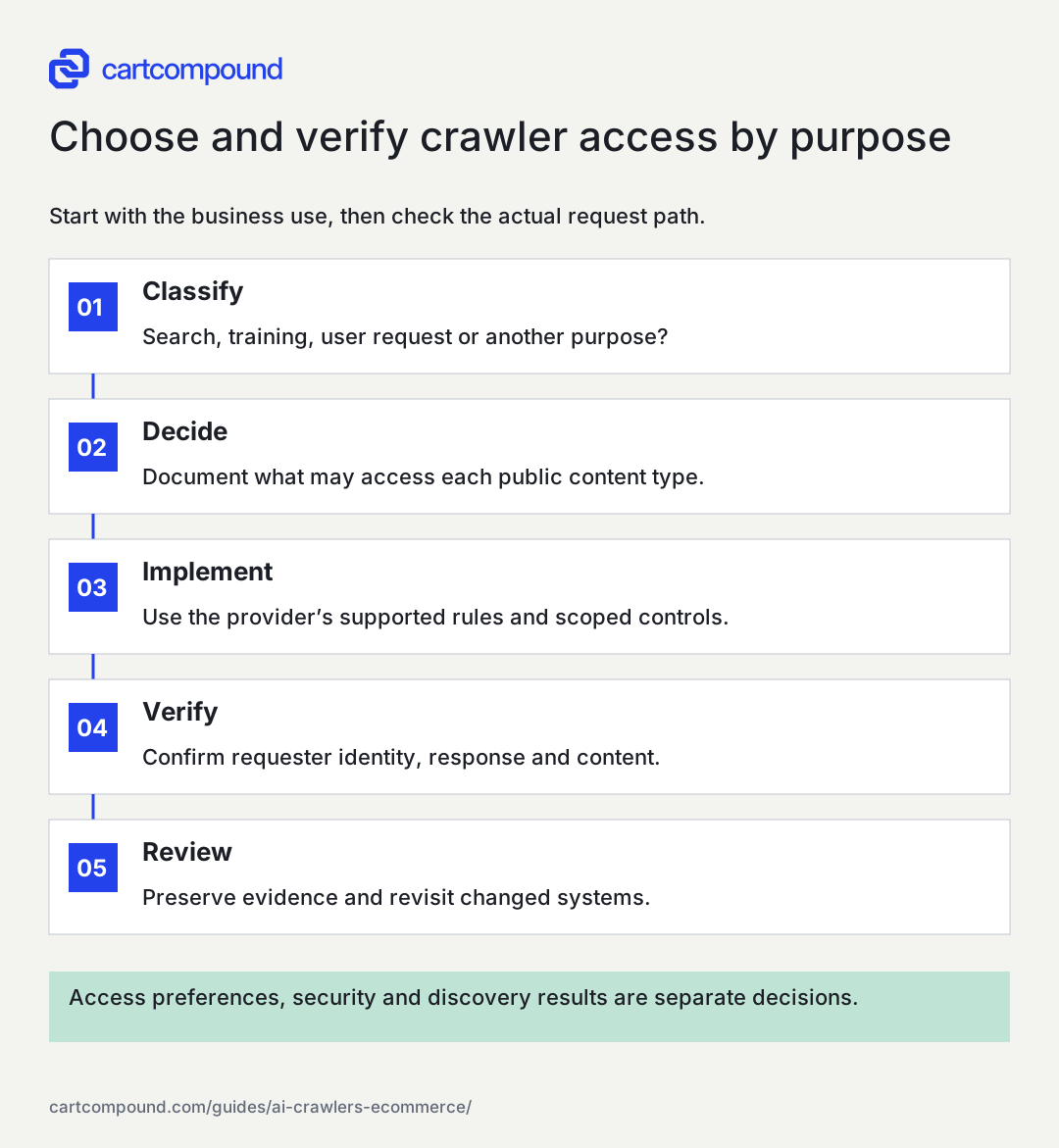
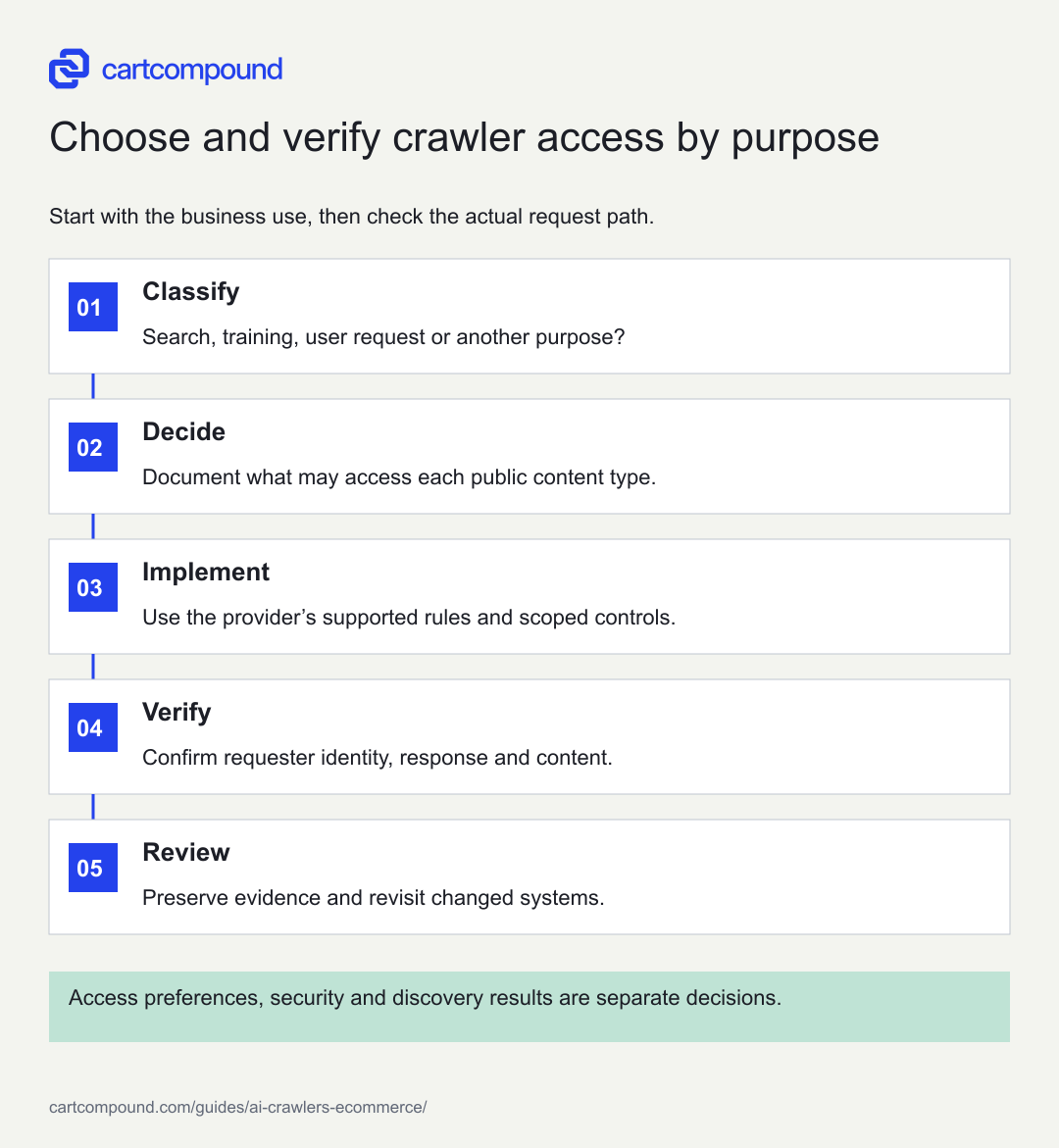
Choose and verify crawler access by purpose
Start with the business use, then check the actual request path.
- ClassifySearch, training, user request or another purpose?
- DecideDocument what may access each public content type.
- ImplementUse the provider’s supported rules and scoped controls.
- VerifyConfirm requester identity, response and content.
- ReviewPreserve evidence and revisit changed systems.
Access preferences, security and discovery results are separate decisions.
Use the steps with your store data. Examples in this guide are illustrative unless a source is named.
Keep Google Search controls distinct
Google's AI features documentation explains that Googlebot governs crawling for Search, including its AI features, while other controls apply to some separate Google systems. Do not block Googlebot as an accidental consequence of attempting to change a training preference. That can affect the ordinary search visibility the store already relies on.
Decide whether the business wants to limit crawling, indexing or displayed snippets. Those are different outcomes and can require different mechanisms. A crawl restriction can prevent a system from reading a page-level instruction, so indiscriminately stacking directives is not a reliable removal strategy. Have the technical owner evaluate the exact target and verify the result in the relevant platform's diagnostic tools. Avoid making a provider-wide change based only on a monitoring tool's red status. The monitor may be checking a capability the business intentionally declined, rather than identifying an implementation error.
Inventory the full request path
A public request passes through more than robots.txt. DNS, hosting, a CDN, a web application firewall, rate limits, authentication and application code can all affect the response. A page returning a challenge screen with a successful status is still not delivering its product content. Conversely, a robots policy can forbid a page that a basic HTTP request can technically retrieve.
Map the request path with the store's technical owner. Test the homepage, a collection, a standard product, a selected variant, an image and a policy page. Include one retired or unavailable product to check that its actual response matches the intended behavior. Record status, final URL, content type, challenge state and whether the important facts appear in the returned content. A screenshot from an ordinary signed-in browser proves little about the public crawler path. Check realistic requests without weakening the protections that keep checkout and customer accounts secure.
Build an auditable control register
On a small screen, swipe the table to see every column.
| Register field | Example entry | Why it matters |
|---|---|---|
| Purpose | Public product search | Separates discovery from training |
| Provider and agent | Documented search crawler | Prevents rules aimed at the wrong token |
| Business decision | Allow public catalog retrieval | Establishes the intended result |
| Infrastructure check | CDN permits verified requests | Finds blocks beyond robots.txt |
| Evidence and review | Dated test and documentation link | Makes future changes traceable |
Keep this register small enough to maintain. Include only providers relevant to your traffic, commercial goals or policy obligations. A long list of unknown agents creates upkeep without a clear decision. Preserve existing rules before changing anything and note which application or theme owns the served robots response. On hosted platforms, a local file may not be the file actually served. Verification must use the public URL and actual response after the change.
Verify identity before granting exceptions
A user-agent string is a claim made by the requester. Anyone can send a string that looks like a known crawler. When using provider-specific exceptions, follow the provider's current published identity verification method, such as its published IP ranges where applicable. Do not maintain an improvised permanent allowlist copied from a months-old forum post. Assign someone to monitor the source of those ranges and the implementation method.
Review the smallest necessary exception. If verified public search requests are challenged, the solution should be scoped to the documented requester and public content rather than disabling bot protection for every visitor. Check rate patterns and application cost. A store with expensive dynamic filters may need performance controls even for legitimate retrieval. Keep security logs and avoid posting access tokens, customer identifiers or full private request payloads into a marketing report. The access review needs enough evidence to explain the result, not unrestricted copies of operational data.
Work through a conflicting policy
Consider an illustrative store whose robots file allows a search crawler but whose CDN challenges all automated requests. The marketing team sees the allow rule and concludes that access is working. Verified logs show requests to product pages receiving a challenge body instead of product facts. The implementation fails the store's own intended policy even though robots.txt looks correct.
The technical owner first confirms requester identity, then creates a narrowly scoped public-path exception through the supported infrastructure controls. Next, they retest the product, image and returns page and preserve the results. They leave account and administrative protections intact. Separately, the business keeps its training preference unchanged. A later discovery check may still show no product recommendation, because successful access is a prerequisite rather than proof of inclusion. This example separates a concrete retrieval defect from the much broader question of whether a system chooses the product for a shopping request.
Use logs to diagnose symptoms carefully
On a small screen, swipe the table to see every column.
| Symptom | Possible explanation | Next check |
|---|---|---|
| 403 response | Firewall or access restriction | Verified request and rule match |
| 200 with challenge HTML | Bot protection replacing content | Response body and CDN action |
| No logged requests | No crawl, incomplete logging or another path | Logging coverage before conclusions |
| Wrong facts after retrieval succeeds | Stale or conflicting sources | Page, markup and catalog agreement |
Do not interpret crawl frequency as consumer demand or as a ranking score. A crawler can revisit because content changes, because requests fail or for reasons not visible in your logs. Requests are operational evidence, not shopper sessions. Exclude bot requests from customer acquisition interpretations. Keep response failures, bandwidth or application cost in a separate operations view so a large automated request count is not mistaken for a successful marketing channel.
Avoid treating robots.txt as security
Robots directives express crawling preferences to cooperating systems. They do not authenticate a person, authorize a request or prevent a malicious client from requesting a known URL. Sensitive pages need server-side protections and appropriate authorization. A private price list, order history or customer export should not become public merely because it appears under a disallowed path.
Google's robots.txt introduction explains the distinction between managing crawler traffic and hiding information. Apply that distinction to AI access as well. Review any proposed markdown mirror, product export or agent endpoint for accidental disclosure before enabling it. Product discovery usually needs public product facts and policies, not email addresses, order IDs, draft products or supplier credentials. When a vendor asks for broad access, evaluate the concrete data and permissions required rather than accepting “AI readiness” as sufficient justification.
Test the policy as a set of expected outcomes
Create a small acceptance sheet before implementing a crawler policy. Use columns for URL class, documented requester, intended outcome, observed response and evidence location. Include public product HTML, a product image, an applicable policy page, a retired product and a protected account resource. The purpose is to test the business policy as a whole. A single successful request to robots.txt should not be the only acceptance criterion for a change intended to make product facts retrievable.
Review broad rules and provider-specific rules together using the provider's documented interpretation. Do not assume that a copied specific block cancels every conflicting broad rule in every system. If the store uses a hosted robots template, inspect the resulting served file rather than only the editor. If a security service applies its own bot categories, record how those categories map to the verified requester. Keep caches and deployment timing in the test notes so an old response is not mistaken for a failed implementation or a new response mistaken for full propagation.
For an allowed public product request, verify both status and meaningful content: the correct item, current offer and essential facts should be present rather than a generic challenge or empty application shell. For protected resources, verify actual authentication and authorization separately. A robots disallow line is not the protection test. Have the technical owner sign off the observed outcomes and preserve a rollback. Reuse this acceptance sheet after a CDN migration, security-rule update or theme change. It provides a concrete regression test without pretending that successful access proves search selection, training use or future compliance by every automated requester.
Release a small change and keep a rollback
Before editing, save the existing served rules and relevant infrastructure configuration. State the intended outcome in one sentence, identify the affected public paths and define how the team will verify it. Test parsing and representative requests after release. Check that ordinary storefront behavior, canonical URLs and important assets still work. Allow for documented processing delays without assuming a change will be reflected everywhere immediately.
Your first action should be an access register and a small public-URL test set, not a universal crawler policy rewrite. Route unresolved policy choices to the business owner and technical defects to the appropriate implementer. Preserve the date, exact documentation and observed responses in the handoff. Review after major infrastructure, theme or provider changes. This creates a manageable process for changing systems while avoiding the false certainty that one robots file either guarantees discovery or permanently controls every future use of public content.
Your action checklist
Use this to decide what to do next. Your checks stay on this page and are not sent or saved.
0 of 5 checked
Common questions
Does blocking GPTBot automatically block ChatGPT search?
OpenAI documents GPTBot and OAI-SearchBot controls independently. Review both the served robots rules and infrastructure rather than treating one token as a universal switch.
Can I identify a crawler from its name in the logs?
The name alone is not reliable because user-agent strings can be copied. Use the provider’s documented verification information before granting exceptions.
Does allowing a crawler guarantee AI recommendations?
No. It establishes access under the tested conditions. Selection, freshness and suitability remain separate questions.
Sources and review
Source documentation checked October 27, 2026. Platform features and interfaces can change. The recommendations and illustrative examples explain how to make the decision; they do not promise results.
- Overview of OpenAI crawlers
Independent search/training settings and user-requested retrieval distinctions. - AI features and your website
Google Search access controls and separate system distinctions. - Introduction to robots.txt
Robots directives manage cooperating crawler access; they are not security.
Talk through your store question
Bring one problem you want to solve.
A free 20-minute call with Hamid can help you decide what to investigate next.
Book a free 20-minute call
About the author
Hamid Khan
Hamid co-founded CartCompound and works with ecommerce founders on their stores and growth priorities.
Profile and guides