The short answer
Make public product facts accurate, consistent and easy to retrieve. Check search access, investigate the supported catalog integration for your platform, and test the exact buying questions your products answer. Eligibility and a working feed do not guarantee product inclusion.
Define the shopping decision before changing the site
Start with a purchase decision your catalog can genuinely answer. A useful target is “an insulated bottle that fits a bicycle cage and can be cleaned without a special brush.” “Best bottles” provides little guidance about which attributes are missing. List the constraints a shopper would need to compare: dimensions, capacity, material, insulation, care, price, stock, delivery destination and returns. Ask merchandising or support to confirm each answer against a current source.
Treat ChatGPT discovery as another way shoppers research products. Your product page still has to complete the decision when a visitor arrives. If the assistant summarizes the product correctly but the landing page hides compatible sizes or adds unexpected delivery costs, discovery alone has little commercial value. Choose a small, representative product group before editing an entire catalog. Include a simple item, several variants, an unavailable item and a product with a meaningful limitation. These expose different failure modes without turning the project into a large speculative rewrite.
Separate discovery eligibility from feed and checkout access
OpenAI's current integration guide says direct product-feed onboarding is available to approved partners. A published schema does not establish that your store can upload a feed immediately. Confirm the integration path available to your platform and account before buying software or commissioning custom development. Record who supplies the catalog, who maintains it and where failures are reported.
Keep three questions separate: can public pages be retrieved, does an approved integration supply product information, and is a checkout integration enabled? These are different capabilities. A feed validator passing is evidence about the submitted records, not proof that products will appear for every relevant conversation. Similarly, a shopping card observed once does not prove reliable coverage across shoppers, markets or future prompts. Use the supported path you actually have and avoid creating duplicate catalog connections without understanding how conflicting records will be reconciled.
 Keep this framework
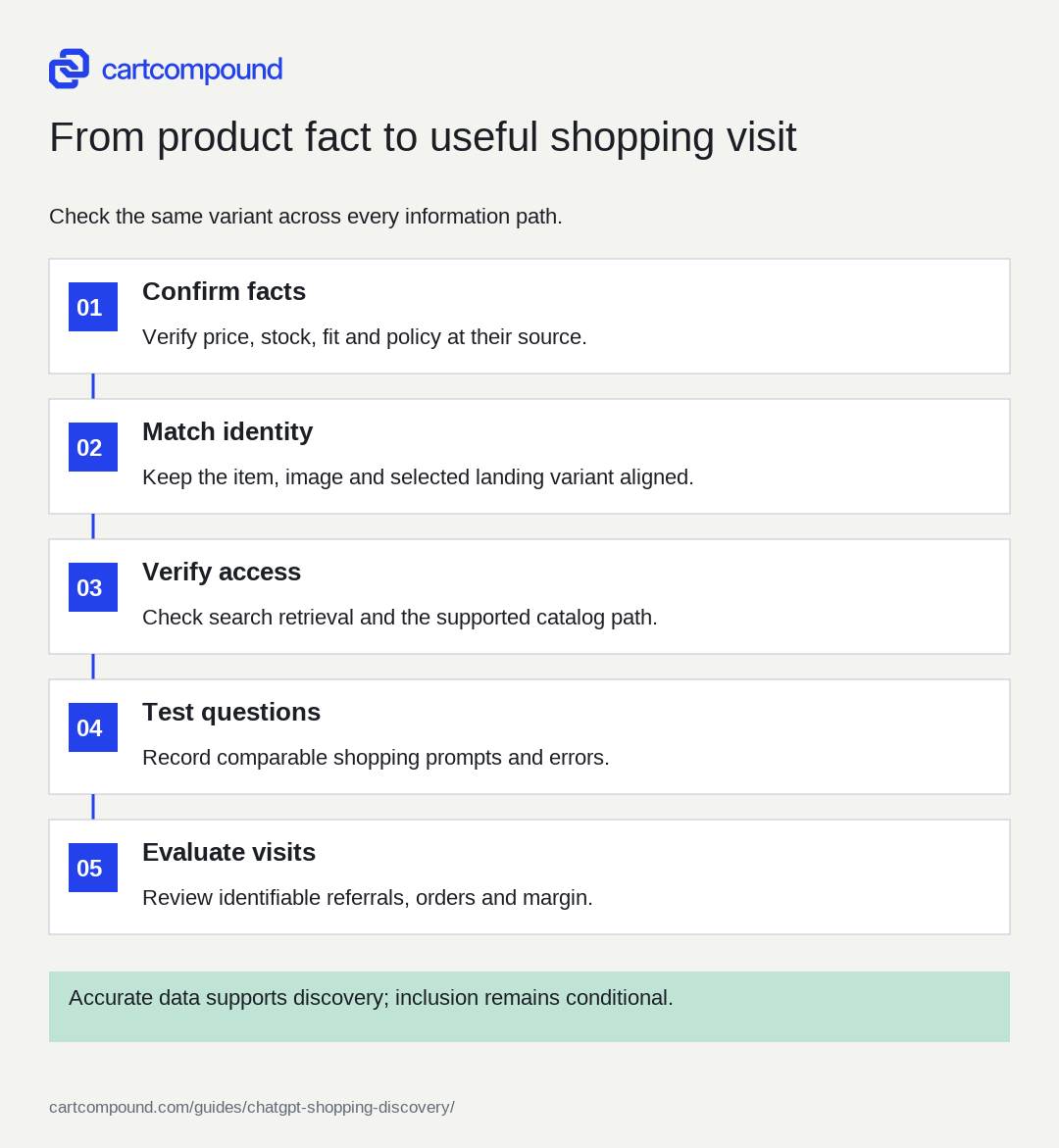
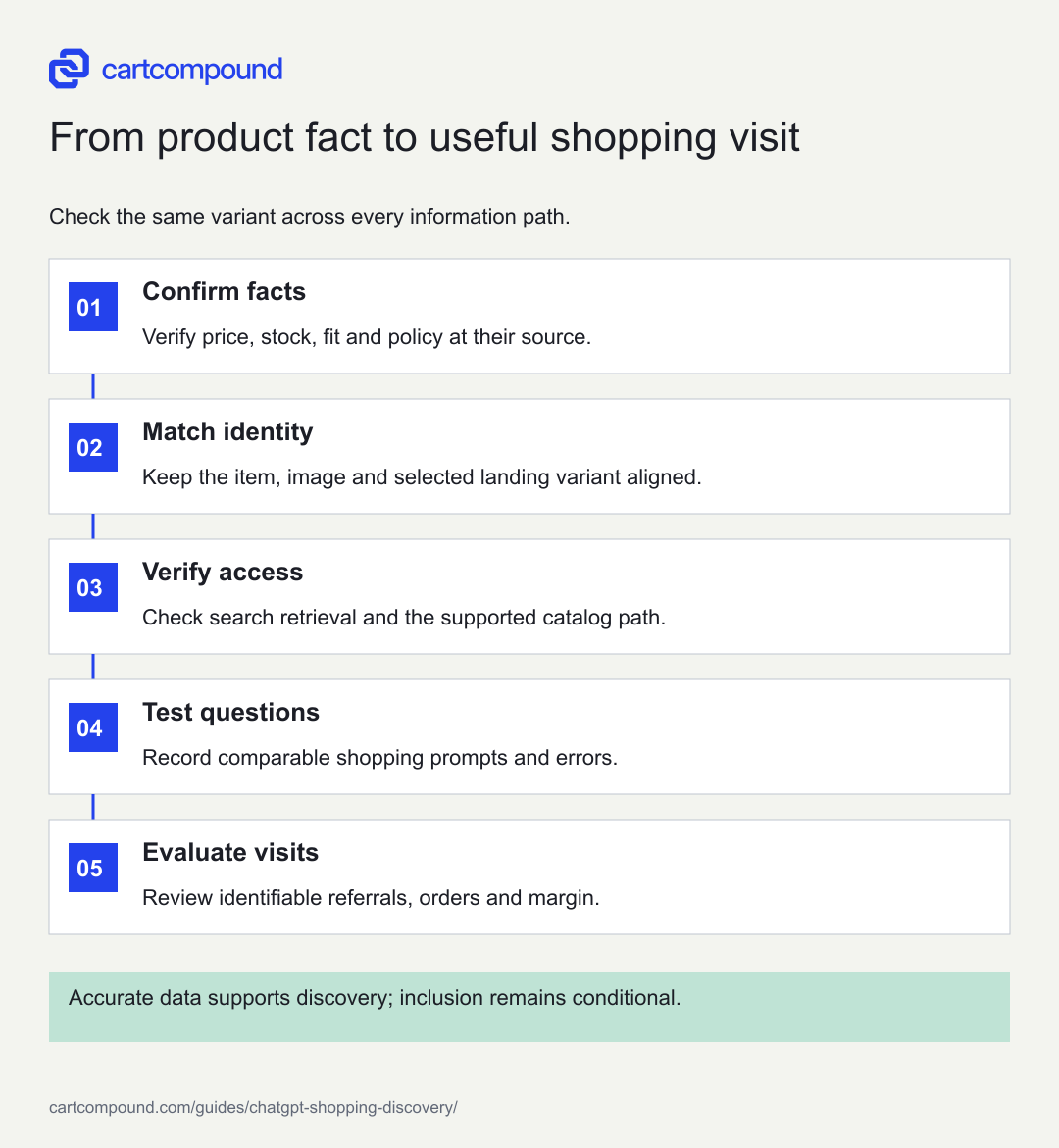
From product fact to useful shopping visit
Check the same variant across every information path.
- Confirm factsVerify price, stock, fit and policy at their source.
- Match identityKeep the item, image and selected landing variant aligned.
- Verify accessCheck search retrieval and the supported catalog path.
- Test questionsRecord comparable shopping prompts and errors.
- Evaluate visitsReview identifiable referrals, orders and margin.
Accurate data supports discovery; inclusion remains conditional.
Use the steps with your store data. Examples in this guide are illustrative unless a source is named.
Build a product truth sheet
Create one row per purchasable variant in your working audit. Include the stable product and variant identifiers, canonical landing URL, selected option, price and currency, stock status, primary image, dimensions with units, compatibility, material and the applicable policy links. Add a source and owner for every field that changes or requires evidence. A supplier PDF may establish dimensions while the inventory system owns stock and the store owns the final selling price.
Write descriptions that answer constraints, including exclusions. “Fits standard cages” is weaker than a verified diameter and a clear note about cages it does not fit. Do not create unsupported certifications, medical benefits or environmental claims to make the description more persuasive. Keep unknown values visible in the internal sheet so they become research tasks. Removing a blank by guessing creates a new factual defect. Separate a confirmed product characteristic from an editorial recommendation: an 18-ounce capacity is a fact; suitability for a particular ride depends on the rider's requirements.
Audit the information paths together
On a small screen, swipe the table to see every column.
| Information path | Check | Useful evidence |
|---|---|---|
| Visible product page | Selected variant, price and stock agree | Dated page capture and option selection |
| Structured data | Offer describes the displayed product | Parsed markup and validation output |
| Catalog integration | Latest accepted record matches current offer | Sync timestamp, item ID and error report |
| Public policies | Shipping and return exceptions are findable | Working links and product-specific terms |
Walk through these paths for the same item rather than inspecting unrelated examples. A page can show today's price while a scheduled export still contains yesterday's sale. A parent image can misrepresent a selected color. A group-level availability flag can imply every size is purchasable when only one is left. Assign the correction to the source that should own the value. Editing only the downstream feed may be overwritten during the next sync. Save the before and after values, the correction time and the next successful sync so a later discrepancy can be traced.
Check search retrieval without weakening security
OpenAI documents independent search and training controls in its crawler reference. OAI-SearchBot serves search discovery; GPTBot concerns potential model training. Review the relevant search access decision with the store owner. A training preference should not be changed casually as a supposed shopping requirement. Check robots rules, public-page status, CDN restrictions and challenge screens with the technical owner.
Test representative product, collection and policy URLs. A successful homepage request does not prove that variant pages or images work. Investigate verified request logs when available, including response codes and challenge responses. A request with a familiar user-agent string alone is not trustworthy identification because that string can be copied. Use the provider's published verification information. Keep account pages, order histories and administrative surfaces protected. Public catalog retrieval should never require exposing customer information or disabling the store's security controls across the whole domain.
Use the supported product schema carefully
OpenAI's product file reference distinguishes supported Stable uploads from a Draft schema intended for planning. It also separates discovery data from additional integration requirements. Use the schema supported by your actual integration and preserve its field meanings. A merchant's spreadsheet column called “price” may include tax or a promotion differently from the destination field.
Build a mapping document rather than changing labels until an upload passes. For each source field, record the transformation, example value, destination field and validation rule. Check money with currency, absolute URLs, variant identity, public images and explicit stock states. Reject records with missing required facts to an exception queue. Do not represent “not yet checked” as “in stock.” Treat optional fields as optional when evidence is unavailable. A smaller accurate catalog is a better operational starting point than a complete export containing invented attributes or unsupported availability promises.
Work through a variant mismatch
Consider an illustrative store selling a bottle in blue and gray. The blue variant costs $32 and is unavailable; gray costs $30 and is available. The page defaults to gray, but a feed row for blue links to the default URL and uses the gray image. An assistant could send a shopper to a product that appears cheaper and available even though the requested color is not.
Repair the identity path first. Link the blue record to a URL that selects blue when the platform supports it, use the blue image, and submit blue's own price and status. Keep the shared parent grouping stable. Then open that URL in a fresh session and verify the visible selection, cart behavior and current policy. Recheck the accepted downstream record after syncing. Document the issue as variant selection and offer mismatch, rather than “AI does not understand our brand.” That diagnosis produces a testable fix across shopping feeds, organic search and human visits.
Test useful prompts and classify failures
Build a small panel from genuine product-selection questions, support conversations and category research. Include an unbranded need, a comparison, a compatibility question, a price constraint and a branded verification question. Record the exact prompt, service, date, market context, visible result and cited or linked URL. Repeat under comparable conditions without continually changing the wording to obtain a favorable answer.
Classify failures as missing appearance, wrong attribute, wrong variant, outdated offer, unsuitable recommendation or broken landing experience. These require different responses. A missing appearance has many possible causes and is not proof of a technical penalty. A wrong attribute with an identifiable obsolete source gives you a concrete correction path. Preserve unfavorable observations as well as favorable ones. Avoid turning one screenshot into an “AI ranking” claim. Conversations and product experiences can vary, and your sample represents only the questions and conditions actually tested.
Measure visits and business value with limits
Use analytics to inspect identifiable referral visits from AI services, their landing pages, product interactions and purchases. Keep that report distinct from the prompt panel. A visible recommendation may generate no click, and a click can lose its source information. Recorded referral revenue is therefore an observed portion of activity, not a complete count of AI influence. Reconcile purchase tracking before interpreting a small number of orders as a commercial trend.
Pair the commercial report with operational measures: mismatched offers, failed catalog records, stale stock and broken links. Those tell you whether the readiness work is improving information quality even when traffic is small. Set a sensible review cadence based on catalog volatility. A daily-changing catalog needs automated discrepancy alerts more than occasional polished visibility screenshots. Assess margin and returns as well as gross revenue when deciding whether further integration work deserves investment.
Review third-party product evidence
A product can be described by retailers, review sites, distributors and old campaign pages as well as the merchant. Map these references for the pilot products when an observed answer contains a wrong fact. Record the exact source, date, item identity and current authoritative value. A retailer listing for an earlier generation should not be treated as evidence about a revised model merely because the names are similar. Check whether the obsolete source can be corrected through an existing authorized relationship. Do not contact third parties or republish their material without the relevant authority.
Use a correction brief with five fields: affected item, incorrect assertion, current supported assertion, evidence source and correction owner. Separate a factual error from an unfavorable opinion. A reviewer preferring another product is not necessarily a defect to remove. Do not buy favorable mentions or manufacture reviews as a response to low observed visibility. A more useful response is to make the actual product limitations and strengths inspectable. If the product does not meet the shopping constraint, excluding it can be the appropriate answer.
After correcting an owned source, monitor without assuming a guaranteed refresh time. Preserve the original observation and the correction date, then repeat the same relevant question under the panel protocol. If the answer remains wrong, investigate other conflicting sources and record uncertainty. The next decision might be another source correction, a clearer model identifier or no further action because the recommendation concerns a different item. This process ties visibility work to verifiable information quality. It also prevents the team from treating every unfavorable result as a reason to create more promotional copy or promise a ranking outcome that the evidence cannot support.
Choose the next correction from evidence
Start with the defect that creates the greatest risk for a real shopper. An incorrect price, unavailable variant presented as purchasable, or false compatibility statement deserves attention before rewriting a brand introduction. Assign one owner, expected correction time and verification method. Check the fix both in the source system and downstream after the next update.
For the first work session, select ten representative variants, complete their truth sheets, verify retrieval and document the available catalog path. Produce a short issue register ordered by shopper impact, not by the novelty of the AI terminology. The release record should state which products were checked, which integration was verified, what remains unknown and when the next review occurs. The aim is a reliable product-information process that supports discovery while giving the team an honest basis for evaluating what happens next.
Your action checklist
Use this to decide what to do next. Your checks stay on this page and are not sent or saved.
0 of 5 checked
Common questions
Do I need to allow training to appear in ChatGPT search?
OpenAI documents search and training controls separately. Review OAI-SearchBot access for search and make the GPTBot training decision independently using the current crawler reference.
Can a feed guarantee a shopping recommendation?
No. Accepted catalog data supports accurate discovery information, but eligibility does not guarantee display for a particular conversation. Confirm onboarding access and measure observed results.
Should I rewrite every product description first?
Start with products that expose the most consequential data defects. Price, stock, selected variant, compatibility and policy accuracy usually provide a clearer correction plan than a blanket rewrite.
Sources and review
Source documentation checked October 27, 2026. Platform features and interfaces can change. The recommendations and illustrative examples explain how to make the decision; they do not promise results.
- Get started: Agentic Commerce
Approved-partner feed onboarding and supported integration path. - Products: Agentic Commerce
Supported discovery schema, variant records and eligibility limits. - Overview of OpenAI crawlers
Independent search and training controls; search crawler role.
Talk through your store question
Bring one problem you want to solve.
A free 20-minute call with Hamid can help you decide what to investigate next.
Book a free 20-minute call
About the author
Hamid Khan
Hamid co-founded CartCompound and works with ecommerce founders on their stores and growth priorities.
Profile and guides