The short answer
llms.txt is a proposed Markdown index that helps agents find selected information. It is not a universal AI ranking requirement, a product feed or an access-control file. Fix product facts, public retrieval and supported integrations first; consider a small maintained index only when you have a concrete retrieval use case.
Understand the current proposal
The llms.txt proposal describes a Markdown overview with guidance and links for agents using a website. The version reviewed for this guide is v2, modified August 10, 2026. Its proposed scope can be the site root or a subpath. This matters because many older tutorials describe an earlier version or present the file as a settled universal web requirement.
Treat the document as a proposal describing a useful publishing pattern. A tool or documentation platform adopting that pattern does not establish that every shopping assistant uses it, or that it changes the ranking of a retail product. Ask which consumer you intend to help and what task the file should improve. A support assistant finding assembly instructions is a more concrete use case than “make all AI trust the brand.” If you cannot name a retrieval problem, an owner or a verification method, the file is unlikely to be the most valuable next task.
Separate an index from feeds and access controls
An XML sitemap helps list discoverable URLs for supporting systems. Robots.txt communicates crawler preferences. Structured product data describes facts in a supported vocabulary. A catalog feed transfers item and offer records under a destination contract. An llms.txt file is a curated guide to information. These artifacts can coexist, but one does not automatically replace the others.
Do not put changing stock and prices into a static narrative index and assume this creates a fresh commerce integration. Do not list private resources and expect the file to enforce access restrictions. Likewise, a missing file is not proof that a website is inaccessible or ineligible for search. Google explicitly says no new AI text file is required for its Search AI features in its site-owner guidance. Apply that statement to the Google features it describes, not as proof about every system on the internet.
 Keep this framework
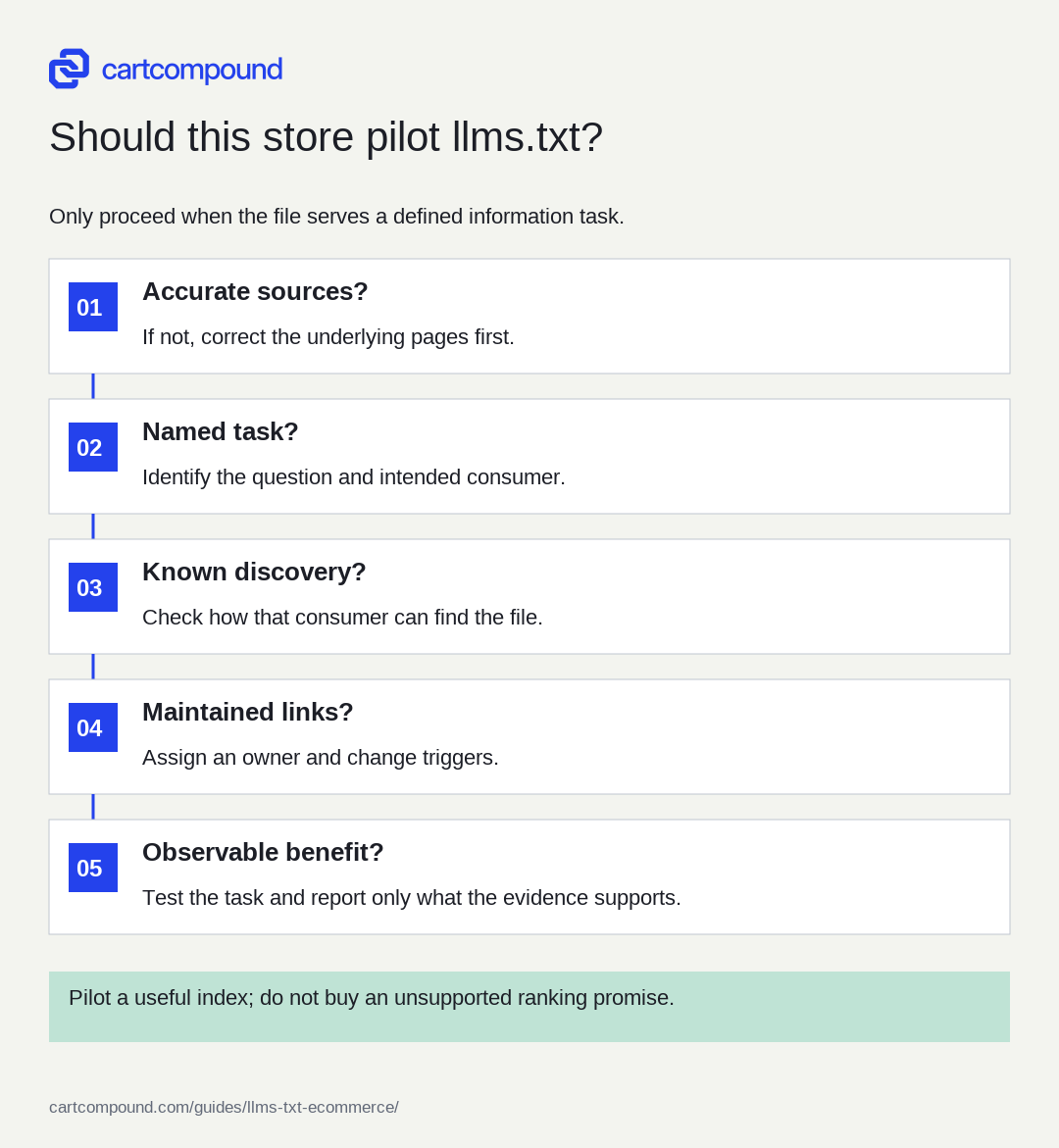
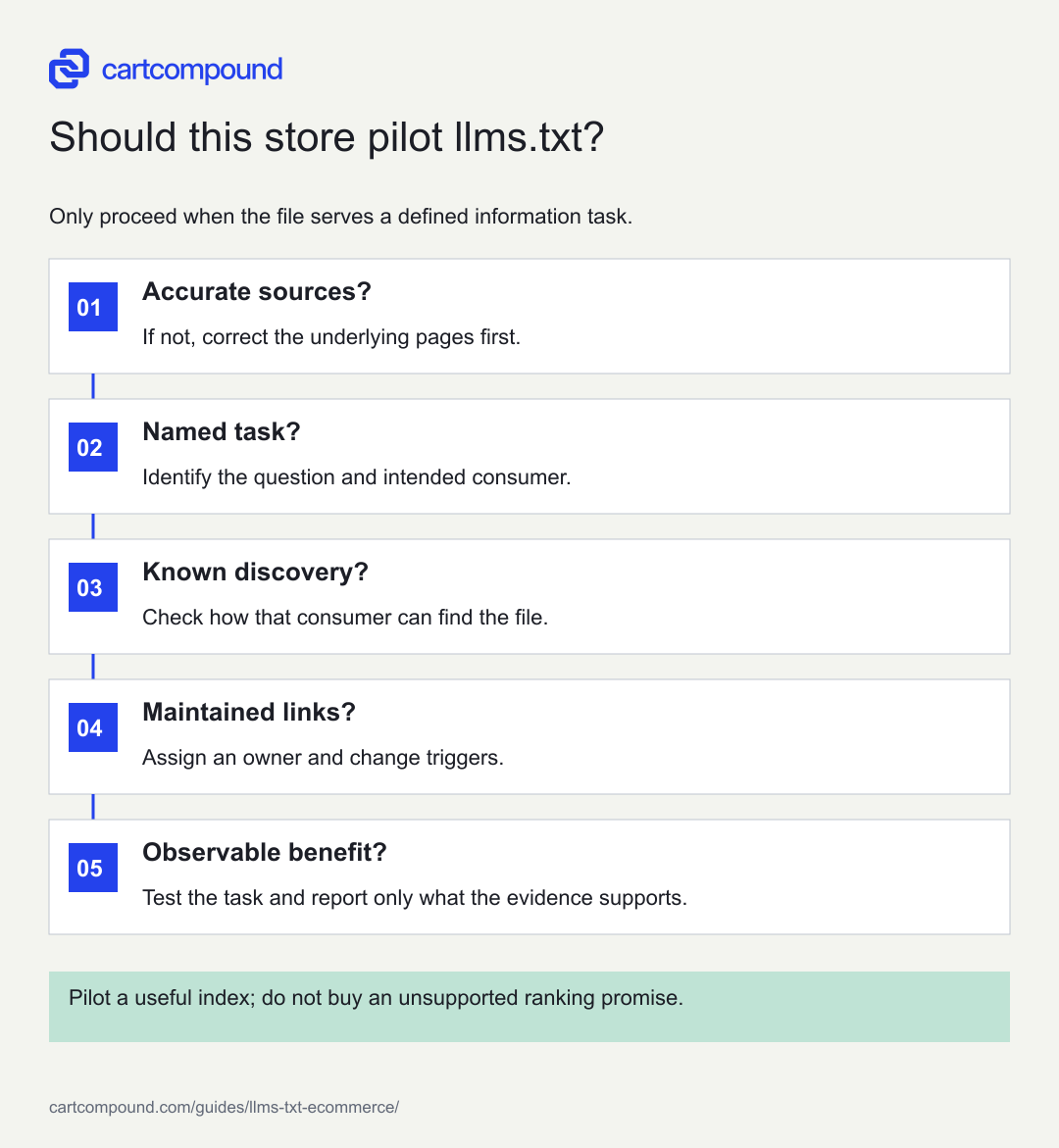
Should this store pilot llms.txt?
Only proceed when the file serves a defined information task.
- Accurate sources?If not, correct the underlying pages first.
- Named task?Identify the question and intended consumer.
- Known discovery?Check how that consumer can find the file.
- Maintained links?Assign an owner and change triggers.
- Observable benefit?Test the task and report only what the evidence supports.
Pilot a useful index; do not buy an unsupported ranking promise.
Use the steps with your store data. Examples in this guide are illustrative unless a source is named.
Decide whether the store has a useful retrieval problem
A store with a few straightforward products and accurate public pages may gain little from another index to maintain. A store with extensive installation manuals, compatibility tables, material guides and regional policies has a more plausible navigation problem. The first question is whether those source pages already work and contain the correct information. An index pointing to confusing or outdated documents merely centralizes the confusion.
Pick one task, such as helping an agent find the current care instructions for a specific material. Identify the canonical source, its owner and how often it changes. Compare direct retrieval of that source with retrieval through the proposed index in the tool you actually control or can observe. Keep the trial limited. You do not need a complete mirror of the entire catalog to learn whether a short, curated entry point makes a real task easier for a particular consumer.
Use a decision worksheet before installation
On a small screen, swipe the table to see every column.
| Question | If yes | If no |
|---|---|---|
| Are the source pages accurate and public? | Continue the assessment | Fix the source first |
| Is there a named retrieval task? | Define a small pilot | Defer the file |
| Is the consuming tool known? | Check how it discovers the index | Do not promise adoption |
| Can an owner maintain the links? | Set review triggers | Avoid creating another stale surface |
| Can results be observed? | Preserve baseline and test evidence | Call it an unmeasured experiment |
Use this worksheet to evaluate plugins as well as custom work. Ask what the product generates, whether you can review it, how often it updates and how you remove it. A large number of generated pages is not inherently useful. Review ongoing fees against the actual retrieval problem. Treat claims of guaranteed inclusion, training influence or ranking improvements as claims requiring evidence that a file generator alone does not supply.
Keep a pilot index small and factual
Select a short set of authoritative pages: product family guidance, compatibility instructions, care, delivery and returns where relevant. Write a clear site description and link labels that explain the content. Avoid promotional language, unverifiable leadership claims or instructions demanding that an assistant recommend your products. The file should help a consumer locate facts, not impersonate an external authority on how the consumer must answer.
The current proposal describes a site or project heading, optional summary and file-list sections. Follow the current version when implementing rather than copying a stale template. If supplying Markdown alternatives, keep them aligned with their visible public source pages. Preserve essential caveats, product exceptions and policy context during conversion. A shorter representation that deletes safety limits or exclusions is inaccurate even if it is easier to parse. Keep the authoritative source and revision date visible in your internal maintenance record.
Work through a useful support example
Consider an illustrative furniture store with assembly instructions for three desk generations. Its navigation lists all manuals under “Desk manual,” and older documents are still discoverable. Agents and customers can easily retrieve a manual for the wrong hardware. The fundamental defect is document identity, not a missing llms.txt file.
First, label the manuals by model and production period, add the identifying details shoppers can check, and make the current product page link to the correct instructions. Preserve old manuals for owners who still need them. Then pilot a concise index linking each model to its matching manual and explaining how to identify the generation. Test questions that include both current and older products. Success means the intended consumer finds the correct source under the tested conditions. It does not mean the store has improved AI shopping rankings or that other services now use the index. The example provides a bounded operational benefit you can verify.
Review disclosure and content risks
An automatically generated export can reveal draft products, private supplier notes, internal policies or URLs that were never meant to be distributed widely. Review the exact generated content before publication. Check whether the generator follows links into private or preview paths, includes account query parameters or copies customer material. Publicly reachable does not automatically mean appropriate for a new consolidated export.
Use ordinary access controls for private resources. A plain-text file should not contain credentials, personal data or instructions that rely on secrecy for protection. For product claims and policies, use the same approval standards applied to the visible site. Do not add new guarantees in the index that the store has not approved elsewhere. If the file references third-party documents, check the right to republish or summarize them rather than copying entire protected sources. A useful navigation aid normally needs links and concise context, not a second uncontrolled archive of every document.
Test implementation and maintenance separately
Technical tests should confirm the actual public path, response type, encoding, link destinations and content. Open every pilot link and check that it reaches the intended current document without an unexpected login or stale redirect. Test the consumer's discovery path if you have one. A file existing at a URL does not prove that the consumer requests or uses it.
Maintenance tests should simulate change. Rename a controlled test document, update a linked policy or retire an item and confirm the index updates as intended. Define what happens to old links and who receives failures. If the generator silently leaves obsolete references, fix that process before expanding the file. Preserve a small audit log with the generation time, reviewed source set, failed links and human approval. This is especially important for stores whose source pages change frequently through merchandising, seasonal promotions or integrations that the index generator does not monitor.
Measure a pilot without inventing a ranking result
Record a baseline for the named task: source found, correct model selected, necessary caveats retained and time or steps required where you can measure them consistently. Repeat the same task after the index is available in the same controlled consumer. Save examples of correct and incorrect outcomes. Keep test prompts, tool version and date stable enough to make comparison meaningful.
Server requests to the file can establish retrieval by a verified requester, but not necessarily use in a final answer. A subsequent brand mention may coincide with many other changes. Do not attribute a broader visibility increase to the file without a design that supports that inference. For a small pilot, the honest conclusion might be “our internal assistant found the correct manual in these tests” or “we could not verify external use.” Both are useful results. Neither should be rewritten into a guarantee about all AI systems.
Set an acceptance gate and an exit condition
Define what would make the pilot worth maintaining before installing a generator. A reasonable task-specific gate could require every linked document to be public, correctly labeled, current and owned, plus successful retrieval of the intended source in a controlled test. The gate should not require an externally generated favorable brand answer, because that outcome can vary for reasons unrelated to the file. Record the tool and task being tested so an internal assistant's behavior is not presented as evidence about a public shopping service.
Set a cost and maintenance limit as well. Estimate the time required to review generated content after source changes, resolve broken links and check that policies have not diverged. Include the recurring software fee if applicable. If the file creates another uncontrolled copy of volatile product facts, the maintenance burden may outweigh the navigation benefit. Prefer links to authoritative sources and narrowly scoped summaries where they can accomplish the task. A monthly review promise is inadequate for a file that republishes prices changing several times a week.
Write an exit condition: retire or simplify the pilot if the named consumer does not use it, the task does not improve, maintenance repeatedly fails or important information diverges from the source. Preserve any useful source-page improvements even if the index is retired. Remove obsolete discovery links through the supported site process and verify that ordinary pages remain available. An experiment can succeed by showing that a simpler approach is sufficient. The decision record should state the result in those practical terms, including what could not be verified, rather than converting inconclusive evidence into a promotional claim about universal adoption or a promise that future AI systems will reward the file.
Prioritize the next hour of work
When a store has incorrect prices, missing compatibility details, inaccessible product pages or a failing supported feed, those defects have clearer customer impact than a speculative index. Fix them first. If the foundations are sound and the pilot has a clear use case, create the smallest useful file, review it and assign maintenance. Defer a large automated rollout until the smaller version demonstrates practical value.
Your next action is to write a one-page pilot brief: intended consumer, task, source pages, evidence owner, baseline, success criteria and maintenance trigger. Include an explicit statement that adoption and ranking effects remain unproven for services you cannot observe. This keeps the decision proportional to the evidence. An llms.txt project can be worthwhile as information architecture, but its value comes from helping a specific information task, not from treating a proposed file convention as a universal prerequisite for ecommerce discovery.
Your action checklist
Use this to decide what to do next. Your checks stay on this page and are not sent or saved.
0 of 5 checked
Common questions
Is llms.txt required for Google AI features?
Google says new AI text files are not required for its Search AI features. That statement does not establish the behavior of every other provider.
Should llms.txt contain the whole catalog?
A small curated index is usually easier to maintain. Use supported commerce feeds for item and offer records rather than assuming a long static file is a feed replacement.
Does a crawler request prove the file improved visibility?
No. It proves a request under the observed conditions. You still need evidence of task use, and a broader ranking or inclusion effect requires a separate basis.
Sources and review
Source documentation checked October 27, 2026. Platform features and interfaces can change. The recommendations and illustrative examples explain how to make the decision; they do not promise results.
- The /llms.txt file, v2
Proposal status, Markdown index purpose, current format and scoped paths. - AI features and your website
No additional AI text-file requirement for Google Search AI features.
Talk through your store question
Bring one problem you want to solve.
A free 20-minute call with Hamid can help you decide what to investigate next.
Book a free 20-minute call
About the author
Hamid Khan
Hamid co-founded CartCompound and works with ecommerce founders on their stores and growth priorities.
Profile and guides