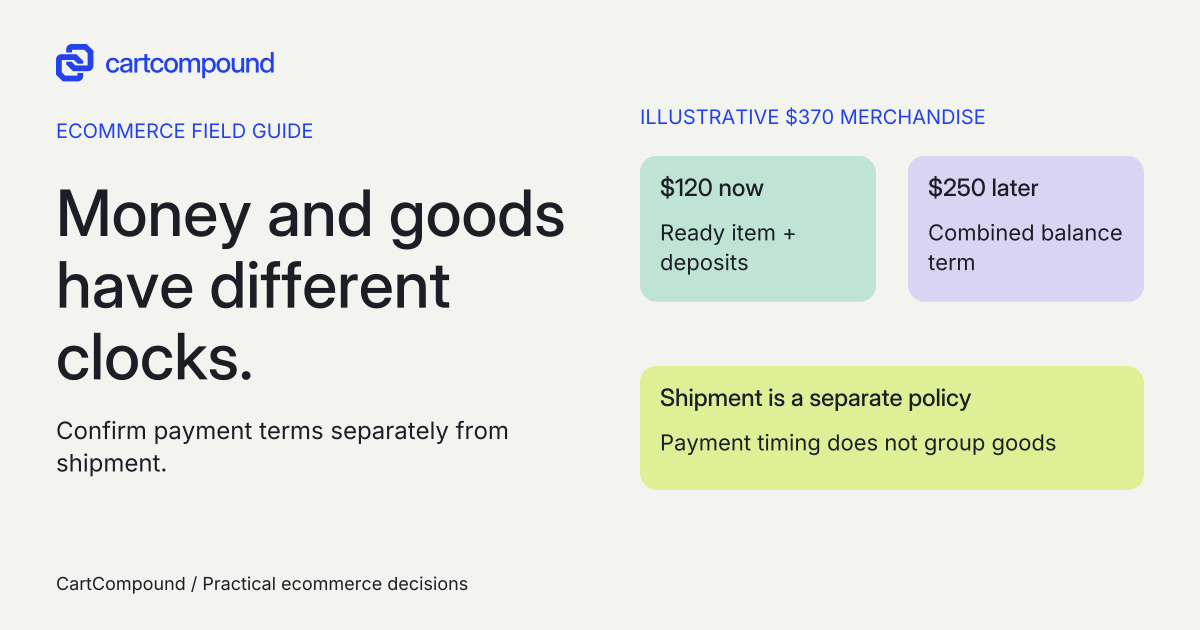
Choose the payment and fulfillment rules before adding a preorder button. Show what is due now, what remains and how multiple preorder terms combine. Verify the exact app, gateway and purchase routes, then state the shipment policy separately.
A buyer can add a ready-to-ship item and two preorders with different advertised dates. The merchant must explain more than “ships later”: the checkout amount, combined balance date and actual shipment arrangement all need to make sense together.
I recommend drawing two timelines before choosing an app: money and goods. Payment becoming due does not prove stock has arrived, and a product’s expected ship date does not necessarily remain its payment date in a mixed cart. This guide supplies a specification for that purchase, not a legal policy or a tested app recommendation.
Put it into practice
Theme change and launch QA pack
Preserve behavior through a theme change, compare expected and observed results, and plan recovery across shared dependencies.
Explore this resourceDefine the offer before changing stock settings
Record the product/variant, ready-stock or preorder status, evidence supporting its expected availability, app, gateway/country, deposit, remaining balance rule and approved cancellation/refund process. Identify who can revise the shipment promise and who can stop fulfillment when payment or stock is unresolved.
Allowing an out-of-stock variant to keep selling does not, by itself, specify deferred payment, buyer acknowledgment or an app-managed preorder. Shopify documents an installed preorder app and Shopify Payments or PayPal Express for its native purchase-option workflow. Depending on the option, payment at purchase can be full, partial or none. Review the preorder model and gateway requirement.
| Model to evaluate | Buyer needs to understand | Merchant dependency |
|---|---|---|
| Full payment | Full amount now; goods later | Approved delay/refund handling and fulfillment evidence |
| Deposit | Amount now and remaining balance rule | Supported later collection plus clear combined-cart terms |
| Deferred payment | What is owed later and when | Supported payment method, collection and failure process |
Choose from your real cash-flow, supplier and customer-service requirements. A deposit can reduce the initial charge while adding balance-collection work. Deferred collection does not remove the need for a price and commitment summary. Do not set a percentage simply because a widget offers a default.
Check the complete purchasing route
Current Shopify preorder setup lists Online Store/custom storefront channels, excludes Shop Pay, Apple Pay, Google Pay and local payment methods, and states that customized checkouts are unsupported. It also excludes Buy X Get Y and combining different purchase options on the same product in one checkout. Check current requirements and restrictions. Ask the implementation owner to confirm how the actual store’s checkout customizations affect eligibility.
Document the exact app, plan, gateway, country, currency, checkout, theme and offered purchase buttons. A supported gateway name does not make every wallet or local method supported. If the shopper’s normal shortcut is unavailable, provide a clear eligible purchase route without implying payment has already succeeded.
Do not assume a custom Function repairs an unsupported route. Shopify’s current preorder note limits Payment Customization Functions to non-preorder items in mixed carts. The 2026-10 Cart and Checkout Validation table excludes preorder/try-before-you-buy. Read the mixed-cart note and the validation compatibility table. Require a supported app/workflow to demonstrate the actual rule instead.
If a proposed offer also needs native bundles or recurring subscriptions, treat compatibility as a buying decision before design. “Preorder subscription bundle” combines separate requirements that must be qualified together, not three labels to add to a button.
Map each line, then apply combined-cart precedence
Create a row for every representative line: full price, due now, outstanding balance, specific due date or due-on-fulfillment term, and expected shipment. Show the same currency and identify whether shipping/tax are included or excluded in the calculation. Keep a separate observation field for the chosen app’s actual checkout result.
For multiple preorders, Shopify documents the earliest specific due date, priority for due-on-fulfillment over specific dates, and combined checkout deposits. Checkout also requires the buyer to acknowledge the purchase option. Read multiple due dates and deposits.
This means two independently reasonable product-page promises can create a different combined payment timeline. Show that effect before acceptance. Do not promise separate balance collections at each product’s displayed date unless the actual architecture supports that result and it has been demonstrated.
For ready items mixed with preorders, specify and verify when the ready line is paid. The worked example assumes full payment for that line at checkout; it is not evidence that every app handles the same basket identically. Do not label the entire outstanding order balance a preorder balance if some other payment arrangement is present.
Keep the payment rule separate from the goods promise
- Record each payment component. Separate ready-item payment, preorder deposits and remaining balances.
- Resolve combined due terms. Different specific dates use the earliest; due-on-fulfillment takes priority over specific dates under the documented multiple-preorder rule.
- Verify a separate shipment plan. Collection timing does not establish how goods are grouped, prepared or shipped.
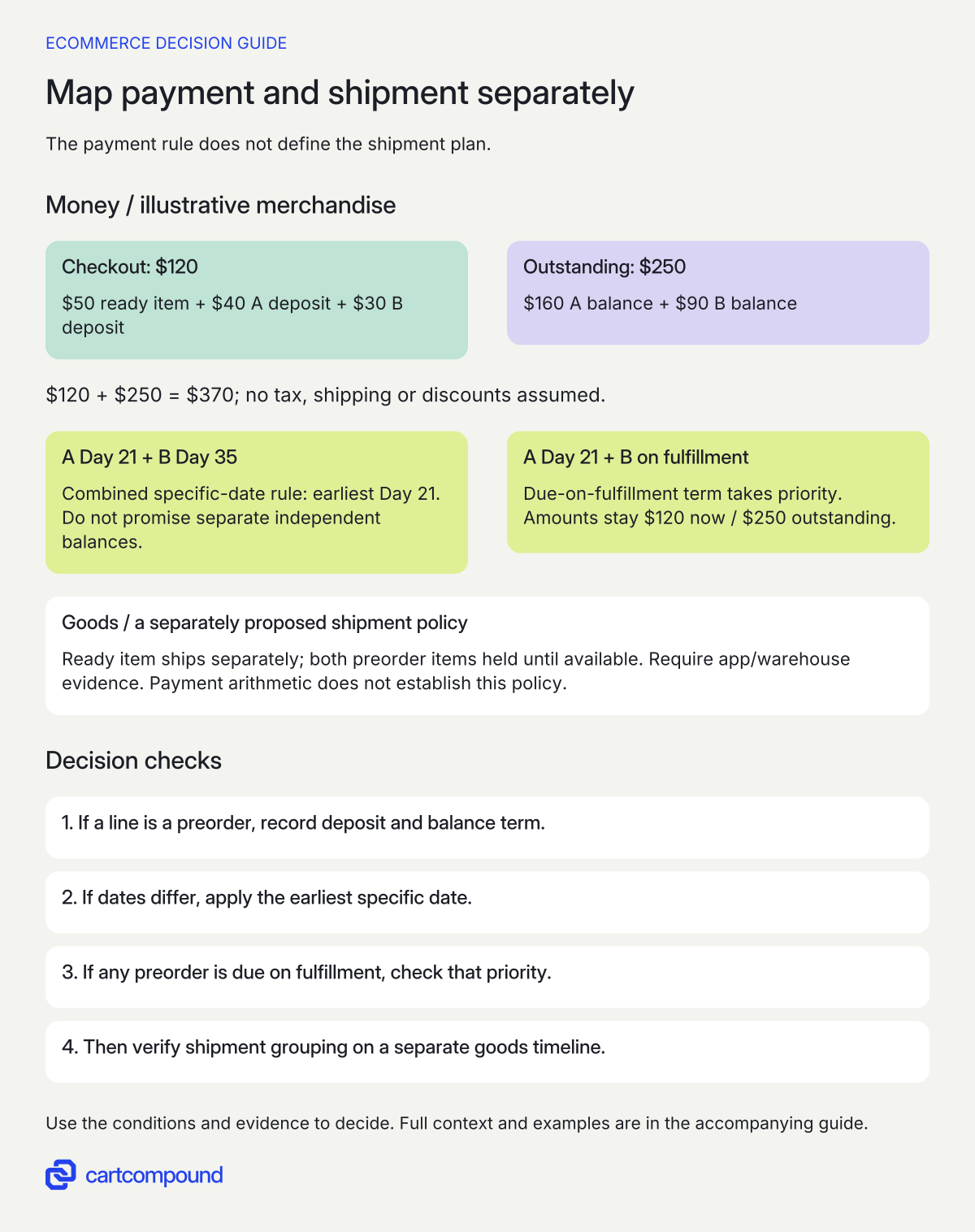
Illustrative example The assumed basket has $120 due now and $250 remaining, totaling $370. Preorder A on Day 21 plus B on Day 35 uses Day 21, not two independent balances. Change B to on fulfillment and that term takes priority.
Amounts stay unchanged. The app must demonstrate the collection trigger and buyer display. Tax, shipping and discounts are excluded.
Write shipment rules independently of collection rules
Decide whether the ready item ships separately or waits, who authorizes split fulfillment, what shipping charges apply and what happens if preorder products become ready on different days. Use the actual app and warehouse connector to show the result. A payment term named due on fulfillment does not explain which warehouse action triggers collection in a particular app.
Use supported supply and production information for promised dates, with an owner for changes. If a delay occurs, have the responsible team follow the approved customer-notification, cancellation and refund process. This guide does not turn a platform help page’s timing guidance into a universal US or UK legal rule.
Keep product/cart wording and support instructions aligned: expected shipment, payment timing and any “ships together” statement must describe the same order. If the cart cannot honor the intended split, choose an explicit supported alternative, such as a separately identified purchase route, rather than silently holding ready goods.
Reconcile the warehouse output with the financial state. A job should not appear ready to release merely because the initial deposit succeeded. Conversely, a balance-collection failure should have a named response so staff do not improvise a payment request or ship contrary to approved policy.
Test promises and exceptions with the same mixed basket
The following are recommended acceptance scenarios, not tests performed for this article. Use an approved environment and the provider’s supported payment process. Capture expected and observed due-now amount, remaining amount, due rule, acknowledged terms and warehouse output.
| Case | What must be demonstrated |
|---|---|
| Two preorders with different specific dates | Combined due rule matches checkout and explanation |
| One term changes to due on fulfillment | The resulting balance term is clear; shipment remains separately specified |
| Ready item plus preorder | Ready-line charge and shipment policy match the offer |
| Unsupported wallet/shortcut | Useful eligible recovery; no false success |
| Later collection fails | Visible state, owned follow-up and fulfillment decision |
| Delay or customer cancellation | Approved terms and operational process stay consistent |
| App replacement/removal | Existing balances and preorder records remain handled under a supported plan |
Compare a named preorder app and scoped custom integration against the same cases. Include setup, subscription/usage, payment processing, support, notification work and warehouse changes in actual quotes. Review data retention and restoration terms before removing a provider; do not assume reinstallation restores unpaid commitments.
Check long dates and messages on mobile, keyboard access and errors that retain valid buyer information. Inspect main form, quick add, sticky purchase bar, cart page, drawer and any custom storefront entry that can initiate the purchase. A successful ordinary card purchase does not validate every preorder path.
Diagnose timing mismatches without mixing money and goods
| Observation | Inspect first | Next action |
|---|---|---|
| Checkout shows an earlier balance date | All specific preorder due dates | Explain the combined earliest-date term |
| Specific dates disappear after another item is added | Presence of a due-on-fulfillment term | Confirm the priority rule and buyer summary |
| Ready stock waits unexpectedly | Warehouse split policy and connector output | Correct or clearly disclose the shipment arrangement |
| Deposit collected but job releases incorrectly | Financial-state to fulfillment mapping | Hold and repair the agreed release condition |
| Button exists but purchase route fails | App/gateway/channel/checkout eligibility | Demonstrate a supported route and recovery |
Your next action is to complete one mixed-cart payment sheet and a separate shipment sheet. Ask the supplier to reproduce both a different-date case and a due-on-fulfillment case before accepting the implementation. Approve when the buyer, checkout, order and operations team can all explain the same commitment.
Hypothetical worked example
A fictional $370 basket with $120 due now
These products, amounts and relative dates are hypothetical. No checkout or collection was tested. Assume no tax, shipping or discounts. A ready item costs $50 and is paid in full at checkout. Preorder A costs $200 with a $40 deposit and $160 balance due on Day 21. Preorder B costs $120 with a $30 deposit and $90 balance due on Day 35. Day numbers mean days after an assumed purchase, not published calendar promises.
| Line | Price | Checkout | Remaining | Term |
|---|---|---|---|---|
| Ready item | $50 | $50 | $0 | Fully paid now |
| Preorder A | $200 | $40 | $160 | Specific date, Day 21 |
| Preorder B | $120 | $30 | $90 | Specific date, Day 35 |
Merchandise totals $50 + $200 + $120 = $370. The combined preorder deposit is $40 + $30 = $70, and the assumed ready-item payment makes checkout $50 + $70 = $120. Remaining preorder balances total $160 + $90 = $250. Reconciliation: $120 + $250 = $370.
Under the documented multiple-preorder specific-date rule, Day 21 is the earlier date governing the preorder balance. Do not tell this buyer that A’s $160 is due on Day 21 and B’s $90 independently remains due on Day 35.
Now change B’s term to due on fulfillment, keeping all amounts unchanged. That term takes priority over the specific dates for the combined preorder payment rule. The arithmetic remains $120 now and $250 outstanding. The app must demonstrate the actual fulfillment/collection trigger and buyer display; this example does not assume two separate collections or a shipment event.
For the separate goods sheet, assume the merchant wants the ready item shipped separately and both preorder items held until available. That is a proposed operating policy requiring actual app/warehouse evidence, not a consequence of the payment calculation. If the implementation cannot demonstrate it, keep the offer unresolved rather than promising it.
Frequently asked questions
Does accepting a deposit prove a product is ready to ship?
No. A deposit records an initial payment under the chosen terms. Stock availability, fulfillment release and the promised shipment schedule need separate evidence and ownership.
Should each preorder have a separate checkout?
Use the intended buyer task and actual supported behavior to decide. If combined terms cannot honor the offer, evaluate an explicit separate-purchase route with its shipping and customer-service consequences. Do not create unexpected extra purchases just to conceal a limitation.
Can the product page keep its own date when another preorder is added?
Distinguish shipment expectations from the combined payment rule. Have the app demonstrate the final mixed-cart summary before you promise independently scheduled balance collections.
Sources and further reading
- Pre-orders
Source checked: October 31, 2026.
- Setting up pre-orders
Source checked: October 31, 2026.
- Cart and Checkout Validation Function API
Source checked: October 31, 2026.

About the author
Hamid Khan
Hamid co-founded CartCompound and works with ecommerce founders on their stores and growth priorities.
Profile and guides