A useful Shopify retainer defines the supported systems, task boundaries, delivery capacity, coverage hours, incident escalation, approval roles, reporting, and exit terms. Separate Shopify’s hosted services, theme-maker support, third-party app responsibility, and commissioned development. Normalize the offered terms before comparing fees or headline hours.
“Twenty hours of Shopify support” leaves several buying questions unanswered. Does a planning call use the allowance? Who can repair an app controlled by another vendor? Does priority support promise a reply, work starting, or a resolved incident?
Build a scope and capacity comparison before choosing a monthly arrangement. The objective is to buy the continuity and work your store needs, with a clear route when something falls outside the agreement.
Put it into practice
Store build decision pack
Turn a store requirement into comparable route evidence, explicit ownership and a cost model you can challenge.
Explore this resourceStart with the workload you actually need covered
Review recent requests and upcoming work over a period that represents your operation. Group tasks by the system involved, frequency, urgency, business effect, and person who approves them. Include seasonal campaigns and known update work so a quiet month does not become the entire buying assumption.
Separate three needs: keeping existing behavior working, making bounded improvements, and delivering a project with its own discovery and acceptance. Examples might be diagnosing a broken product template, adjusting an agreed campaign module, and rebuilding the navigation. Ask each supplier to classify those same examples as included, excluded, or separately estimated.
A retainer can suit recurring work and a need for continuing context or reserved availability. A defined project can suit a finite outcome. Ad hoc help can suit occasional tasks when waiting for availability is acceptable. Compare actual proposals and operating needs; no universal monthly-hours threshold makes one model cheapest.
Identify who can change each system
Shopify includes commerce hosting and a TLS/SSL certificate with its hosted plans, as described in its pricing FAQ. Ask a supplier to name the separate service behind any hosting or certificate charge. An external application, integration host, or headless frontend can have different operating costs and responsibilities.
Theme support depends on who made the theme. Distinguish a theme-maker support request from paid customization, compatibility work, and code commissioned from your developer. Ask who investigates an issue spanning those boundaries and who keeps the merchant informed.
Shopify’s app guidance assigns unsupported-app updates to the app’s developer and states that Shopify cannot update a third-party app for you. A support provider can own investigation and vendor coordination without controlling the vendor’s fix. State the available fallback and the person allowed to approve it rather than promising control that the provider does not have.
Use one row per task and dependency
| System or task | Who can make the underlying change? | Retainer role to confirm | Merchant decision |
|---|---|---|---|
| Hosted Shopify service issue | Shopify for its platform | Diagnose, document, escalate, and communicate within agreed scope | Escalation contact and permitted workaround |
| Paid theme base defect | Theme maker for its maintained base | Reproduce, open vendor request, test supplied fix | Accept wait, workaround, or paid alternative |
| Commissioned theme code | Developer with source/access and agreed scope | Diagnose and change owned or authorized code | Approve change and release |
| Third-party app failure | App vendor for its maintained code | Triage and coordinate; repair only code within the provider’s control | Approve configuration, replacement, or separate work |
| Custom integration | Named developer/operator with source and host access | Monitor or maintain only if explicitly included | Approve data effects and operating costs |
This is a procurement template, not a declaration that every supplier performs these tasks. Fill the support contact, included work, exclusion, evidence needed, and fallback for each row. Add an accountable coordinator when several vendors are involved. “Not our app” should not leave the merchant guessing who owns the next step.
For a custom integration, name the code repository, host, API dependency, alert recipient, and access owner without placing credentials in the workbook. Ask whether version compatibility, logs, deployment, and incident investigation are part of maintenance or separately priced. Include continuity when the original developer is unavailable.
Convert headline hours into planned delivery capacity
For an hours-based offer, list everything charged to the allowance: meetings, reporting, discovery, estimates, testing, reviews, release coordination, incident handling, and direct implementation. Ask about minimum billing increments, rounding, multiple people attending the same meeting, and whether project management is inside or outside the bank.
Use this planning identity: planned delivery allowance = nominal bank − charged overhead − agreed incident reserve. It allocates the bank before work is promised; it is not a productivity measure. Testing that is included inside delivery still consumes time. Do not compare a development-only estimate with an allowance that also has to cover review and release.
For a capacity-based or fixed-outcome offer, ask which requests can run concurrently, how the queue works, what sizes qualify, and how acceptance is defined. “Unlimited requests” is not a definition of throughput. Convert the terms into the same task examples and planning period used for the other offers, leaving unknowns visible.
Separate acknowledgment, work start, and resolution
Record coverage days, hours, time zone, holidays, request channel, and the condition that starts each clock. Translate the window into your team’s working hours and include daylight-saving changes where applicable. A supplier’s “same day” is ambiguous until both parties know which day and which cutoff.
- Acknowledgment: someone confirms receipt and identifies a next step.
- Triage or work start: someone begins investigating under the agreed priority.
- Workaround: a temporary, approved way to reduce the immediate effect.
- Resolution: the agreed behavior is restored and verified.
Ask whether the promise measures business hours or elapsed hours, what happens outside coverage, and how vendor delays are reported. Define incident severity using observed consequences. An inability to purchase needs different routing from a small spacing request. A low-severity label should not hide a serious operational effect.
For monitoring, name the actual checks, frequency, notification route, recipient, and actions after an alert. Ask which failures the checks cannot see. An alerting service needs an incident owner; it should not be described as proof that orders can never be lost.
Agree how incidents displace planned work
Give one merchant contact authority to reprioritize the queue and one provider contact responsibility for explaining the effect. When an incident uses reserved or additional capacity, record the work paused, remaining allowance, next checkpoint, and any cost approval needed. Avoid continuing the original delivery promise after its capacity has been consumed elsewhere.
Set the overage rule before an incident: who may authorize it, the rate or charging basis, any cap, and whether the provider stops or escalates when the bank is exhausted. Confirm whether after-hours work is available at all and under what separate terms. Do not infer emergency coverage from a priority-support label.
Ask what happens when the provider is unavailable, when an external vendor blocks progress, and when the incident outlasts the period. The answer should identify ownership and communication even when a resolution time cannot responsibly be promised.
Define acceptance and release authority for small work too
For each request, agree on the intended result, affected surfaces, expected states, and acceptance owner. The developer should describe the change and evidence. The merchant should confirm the business behavior and approved content. State who can publish, which changes require explicit approval, and how recovery is authorized.
A brief change record can include the request ID, candidate/version, source changes, test evidence, decision, release time, and recovery reference. Match the depth to the consequence. A text edit and an integration that writes order data need different review, but both need a recognizable owner.
For a customized theme update, agree the preservation scope and compatibility work separately. Shopify’s update documentation shows that the route depends on source and customization. A monthly allowance does not establish that a particular version upgrade is trivial or included. Ask the supplier to classify the actual update before scheduling it.
Resolve rollover, extra charges, and exit before comparing value
Record whether unused capacity expires or rolls over, the maximum balance, use order, validity period, and treatment on cancellation. Ask whether a rolled balance changes reserved availability or simply adds work to the same queue. Put a worked example into the proposed terms so both sides interpret the rule the same way.
Separate the service fee from app subscriptions, usage charges, paid tools, external hosting, and approved overage. Shopify notes that some third-party app charges are billed outside its invoice. Reconcile those vendor terms instead of assuming a maintenance payment includes them.
Write down billing currency and period, taxes as specified in the offer, notice and pause terms, unfinished work, refunds or credits if offered, and the exit handover. Request source and access continuity, open incidents, dependency contacts, current configuration references, and accepted/unaccepted work. Resolve unclear contract language with the relevant adviser rather than relying on a sales summary.
Ask for a report that closes the operating loop
The report should show the opening allowance, work and overhead charged, incident use, accepted outputs, remaining or expiring balance, blocked work, and next owner. For each completed task, include the acceptance reference. For a vendor-blocked issue, include the next follow-up and any merchant decision needed.
Compare the report with the original plan. Repeatedly unused capacity may mean the allowance or intake process needs changing. Repeatedly displaced improvements may mean more incident reserve, a separate remediation project, or a revised delivery promise. Do not equate hours consumed with business value: a correctly resolved dependency can matter more than a long list of minor edits.
Send the same responsibility and capacity table to each supplier and ask them to mark every cell with a term or “needs agreement.” Once the unknowns are closed, choose the arrangement that matches your workload and continuity needs. If the work is finite or infrequent, keep the project and ad hoc alternatives in the comparison.
Turn headline hours into planned capacity
- Subtract charged overhead. Find out whether planning, reporting and testing/release work consume the bank.
- Reserve incident capacity. Agree what happens when incidents displace planned work and who reprioritizes it.
- Then compare terms. Fees, coverage, responsibilities, expiry and overage still determine the comparison.
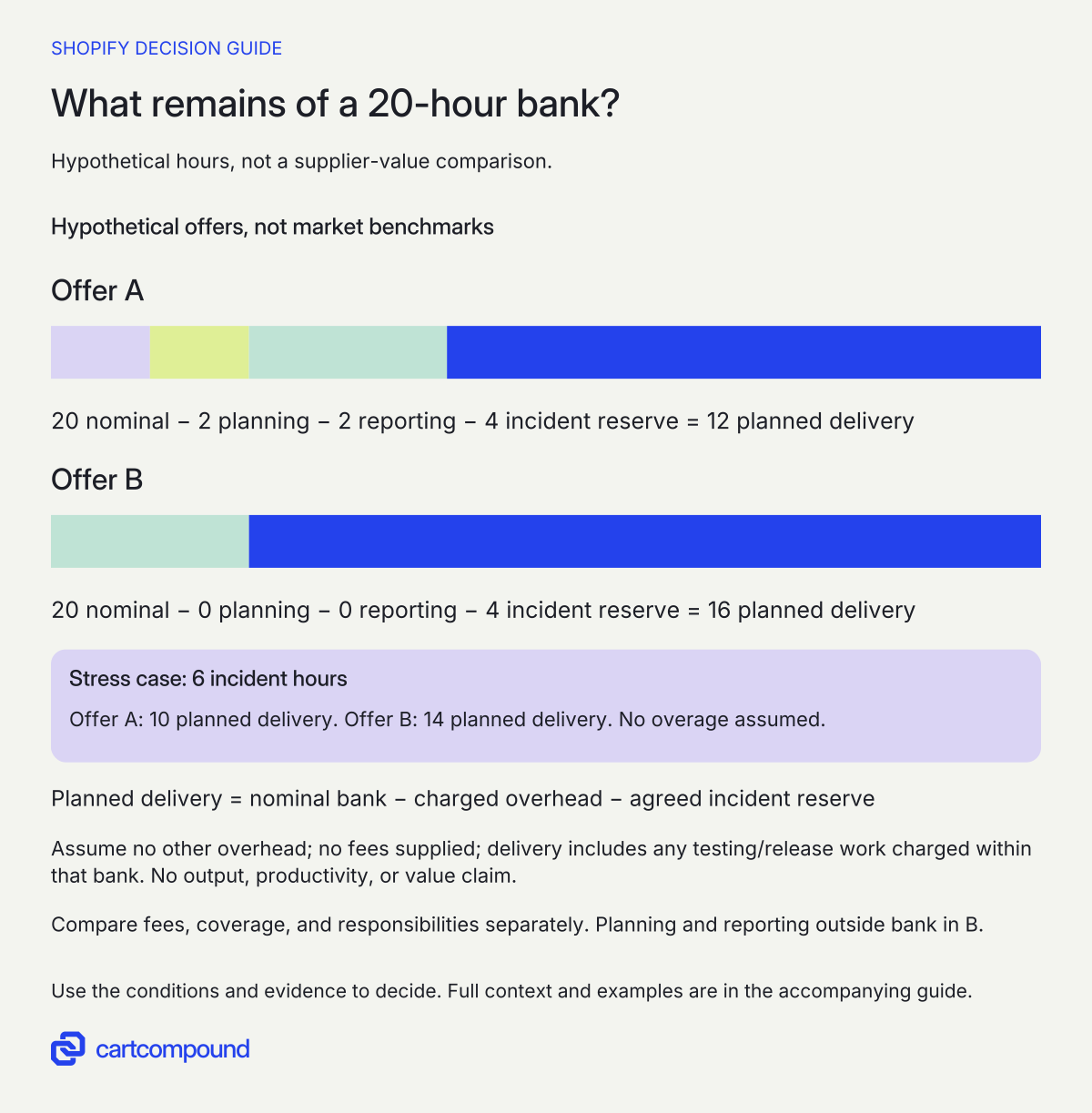
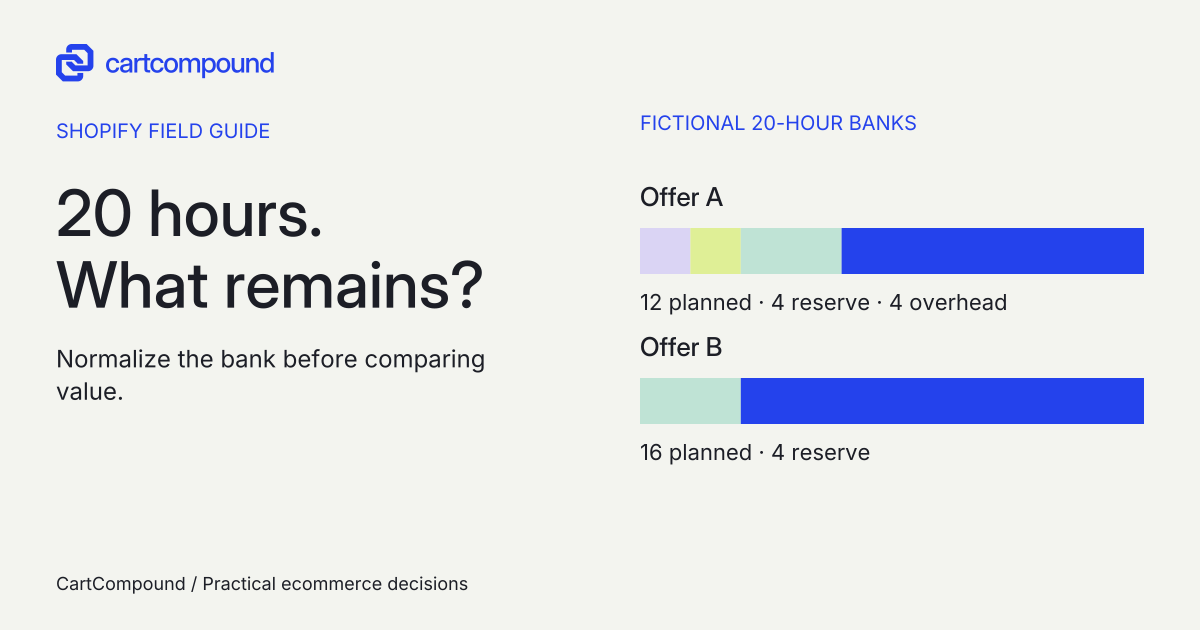
Illustrative example Both fictional offers start at 20 hours. A charges 2 planning, 2 reporting and 4 reserve: 20 − 2 − 2 − 4 = 12. B puts planning/reporting outside the bank: 20 − 4 = 16.
With 6 incident hours and no overage, planned capacity falls to 10 and 14 respectively. Assume no other overhead. More hours alone does not establish better value.
Hypothetical worked example
Illustrative capacity arithmetic, not a market benchmark, real proposal, or CartCompound offer. Assume two fictional offers each advertise a 20-hour monthly delivery bank. Offer A charges a two-hour planning call and a two-hour report to that bank. Offer B explicitly puts both outside it. The merchant reserves four bank hours for incidents in each offer. Assume no other charged overhead for this calculation; real terms may add it.
| Allocation | Offer A | Offer B |
|---|---|---|
| Nominal monthly delivery bank | 20 hours | 20 hours |
| Planning call charged to bank | 2 hours | 0 hours: assumed outside bank |
| Report charged to bank | 2 hours | 0 hours: assumed outside bank |
| Merchant’s incident reserve | 4 hours | 4 hours |
| Planned delivery before incidents | 12 hours | 16 hours |
| Coverage, expiry, overage, vendor role | Unknown until terms checked | Unknown until terms checked |
Under those assumptions, A has 20 − 2 − 2 − 4 = 12 hours available for planned delivery. B has 20 − 0 − 0 − 4 = 16. The four-hour difference follows from the stated charging rules. It does not mean B is cheaper, faster, or better: fees, coverage, skills, acceptance responsibilities, and contract terms have not been supplied.
Now stress the plan. Suppose an incident consumes six hours instead of the reserved four, and neither offer allows overage. A then has 20 − 2 − 2 − 6 = 10 hours for planned delivery; B has 20 − 6 = 14. Two hours of the original planned allowance must move in each case. The provider should identify which work is delayed, and the merchant should choose the revised priority rather than expect the original queue to fit unchanged.
If there is no incident, the four-hour reserve does not automatically become approved feature work. Agree on a checkpoint for releasing it and verify whether unused hours expire or roll over. If planning takes three hours rather than two, A’s allowance changes again. These questions turn a static comparison into a monthly operating rule.
The decision remains open until both suppliers confirm the missing commercial and coverage terms. Attach the same example requests to each offer: investigate a cart defect, update an agreed campaign module, and coordinate an app-vendor incident. Ask what consumes the bank, who can make the actual fix, and what evidence closes each task. Then compare the fee for that explicit arrangement.
Frequently asked questions
Does Shopify need the same maintenance as a self-hosted store?
Shopify includes commerce hosting and a TLS/SSL certificate. Define any additional commissioned work by system and task: theme changes, app coordination, custom integrations, or external hosting. Ask suppliers what their charge covers rather than importing a generic server-maintenance checklist.
Does priority support guarantee a fixed resolution time?
Use the offered terms. Ask whether the commitment covers acknowledgment, investigation, a workaround, or verified resolution, and record coverage hours and exclusions. Do not treat the word “priority” as a defined promise.
Who fixes a third-party app?
The app developer owns updates to its app. Your support provider may investigate, coordinate, or implement an approved workaround within its own control. Confirm both the vendor contact and the person responsible for keeping you informed.
Should unused hours roll over?
Compare the actual rule with your workload. Record expiry, balance cap, use order, scheduling availability, and exit treatment. A rollover balance is useful only if the agreement makes it usable for the work and period you need.
What if my store needs only one large change?
Request a project quote with a defined outcome, discovery, acceptance, and handover. Compare any ongoing support separately. A monthly agreement should solve a recurring operating need rather than hide the scope of a finite project.
Sources and further reading
- Shopify pricing: Do I get web hosting with Shopify?
Source checked: October 31, 2026.
- Shopify: Theme support
Source checked: October 31, 2026.
- Shopify: About apps
Source checked: October 31, 2026.
- Shopify: Updating themes
Source checked: October 31, 2026.

About the author
Hamid Khan
Hamid co-founded CartCompound and works with ecommerce founders on their stores and growth priorities.
Profile and guides