Write requirements as an actor, trigger and expected result; attach acceptance evidence, exclusions and dependency owners. Ask every supplier to respond against the same requirement IDs with included, excluded, assumed and unknown work plus separate one-time and recurring commercial inputs. Resolve gaps before comparing totals.
“Build an editable campaign page” can produce very different proposals. One supplier may mean changing text inside a shared template. Another may include product mapping, an acceptance session and documentation. The totals cannot tell you which work is present.
I would write the task and its protected boundaries first, then ask suppliers to explain their proposed route. The brief below is a planning method, with fictional proposals to show how normalization works. It is not a contract or a guarantee of quote accuracy.
Put it into practice
Store build decision pack
Turn a store requirement into comparable route evidence, explicit ownership and a cost model you can challenge.
Explore this resourceRecord the business task and current environment
Begin with the operator or buyer problem and the evidence available. For example: the merchandiser must publish a campaign using approved content without changing other pages. Attach the current workflow or a redacted recording when you have permission; otherwise describe what is known and who will confirm it.
Include the store URL if appropriate, plan, theme and version, relevant apps, product/variant patterns, markets, languages, currencies, integrations and operational constraints. Mark each as confirmed, supplier to inspect or owner to provide. Missing information should stay missing. If there is no reliable conversion or performance baseline, state that rather than inserting an industry number.
Shopify recommends preparing requirements, budget, timing and expected outcomes before contacting a Partner. State any genuine budget range and fixed deadline, explain the deadline's reason, and separate the commercial launch constraint from an unverified implementation estimate. See Shopify's preparation guidance.
Give each requirement an ID and an observable result
Use stable IDs so the brief, proposal, change record and acceptance evidence refer to the same thing. Separate must-have work from options and later phases. Write what the user needs to do before prescribing a theme, app or custom implementation unless that route is an actual constraint.
| Field | Fictional example |
|---|---|
| ID and priority | R-CAM-01 / must have |
| Actor and trigger | Merchandiser prepares the next campaign from an approved prior version |
| Expected result | Edit approved copy, select two product references and reorder FAQ for that campaign |
| Protected behavior | An unrelated page using the original shared template remains unchanged |
| Source rule | Price and availability use the agreed product source, not copied promotional text |
| Exclusions | Checkout, subscriptions and redesign of unrelated pages |
| Route | Supplier proposes approach; page-local/shared structure must be explained |
| Open dependency | Existing copied product text needs mapping decision before migration can be priced |
The protected behavior is material: Shopify template changes affect every assigned page. “Editable” needs to specify who edits, what changes and what stays unchanged. Avoid an implementation instruction such as “use a builder” unless the business already requires that particular dependency.
Compare the same obligations in both proposals
- Start with an observable task. Name the requirement, dependency, editor acceptance and source/configuration handover.
- Ask for an explicit response. Each obligation must be included, excluded, assumed or unknown. A video alone does not establish editor acceptance.
- Clarify before comparing totals. Resolve missing scope, design inputs, rights/licenses and support terms; then collect comparable commercial inputs.
Illustrative example A leaves product-data mapping unknown. B includes mapping but leaves population and exception scope open; B also includes an acceptance session. That is a scope difference, with no supplier winner.
Neither fictional proposal supplies prices, so no comparable total can be calculated.
Attach acceptance evidence and a decision owner
For R-CAM-01, require a demonstration by the intended editor role in an agreed safe environment. The editor changes the approved copy, replaces product references and changes the gift campaign's FAQ order. A reviewer compares the original campaign and an unrelated assigned page before and after. Then the implementer demonstrates the agreed product-price and unavailable-product behavior using agreed test data.
Save the brief version, environment, theme/page IDs, starting state, steps, expected result, observed result, evidence location and approver. Include an empty/missing selection and long text at actual mobile width. State which failure blocks acceptance and which cosmetic issue can enter a dated correction list. None of these planned checks has been executed in this fictional example.
For an integration, specify the event, source, destination, required fields, acceptable delay, duplicate/error handling, failure owner and recovery evidence. “Sync orders” does not establish real-time delivery or safe retries. If technical feasibility is unknown, request a bounded discovery deliverable and a decision checkpoint before committing to the implementation route.
Assign dependencies, protected areas and handover
Name who supplies approved copy, design assets, product mappings, app credentials or configuration, test data and review availability. Record due dates as dependencies, including the effect of late inputs. Keep access requests separate from content delivery.
Shopify recommends collaborator access scoped to the merchant's approved sections and prohibits using a merchant's password. Document required access, authorizer, purpose and removal point. Where a task cannot use collaborator access, verify an appropriate authorized alternative. Do not include credentials in the brief.
List protected areas such as checkout, existing enquiry delivery, order workflows and unrelated theme work. For any proposed checkout change, record the exact surface and plan to verify. Shopify restricts app customization of information, shipping and payment checkout pages to Plus; that does not make every other checkout change universally feasible.
Ask for an asset/source register, agreed rights and third-party license exceptions, repository and build instructions where applicable, configuration inventory, editor handover and named maintenance owner. Define how acceptance, defects, enhancements and support are recorded. A brief can identify these needs; rights, tax and legal terms require the applicable agreement.
Request the same response format from every supplier
Ask each supplier to return one row for every requirement ID. Use included, excluded, assumed or unknown, followed by the proposed route, deliverable, acceptance evidence, dependency and named owner. A phrase such as “full handover” should identify actual files, accounts, training and exceptions.
Separate one-time implementation, discovery, migration and optional work from subscriptions, platform/app charges, licenses and support. Record currency, tax treatment, billing party and change triggers as supplier inputs. Shopify states that Partners bill directly rather than through the Shopify bill, so keep supplier fees distinct from platform charges. Discuss collaboration tools and the decision path before work starts.
For unknown work, request the method to resolve it, who decides, any discovery cost and what changes afterward. Fixed-price and time-based proposals both need scope boundaries. Compare assumptions as carefully as line items: “merchant provides clean data” transfers work that an included migration line may cover elsewhere.
Compare complete scope, then decide what needs clarification
Normalize the response before comparing commercial totals. Where a requirement is split across proposal sections, record the exact paragraph or line as evidence. Do not convert silence into inclusion. Where the supplier uses an assumption, ask whether it is accepted and who will fulfill it.
I would return a short clarification list joined to the requirement IDs. Ask suppliers to revise their proposal version so resolved answers become reviewable scope. If a critical route remains uncertain, use discovery to establish feasibility and update the brief. Selecting a team for that work is a separate evidence question; the companion hiring guide covers contribution, access, rights and support.
A decision record should state the chosen proposal version, unresolved risks accepted by whom, dependency owners and any option deferred. The output is a comparable request and a visible uncertainty record, not proof that every quote is now accurate.
Hypothetical worked example
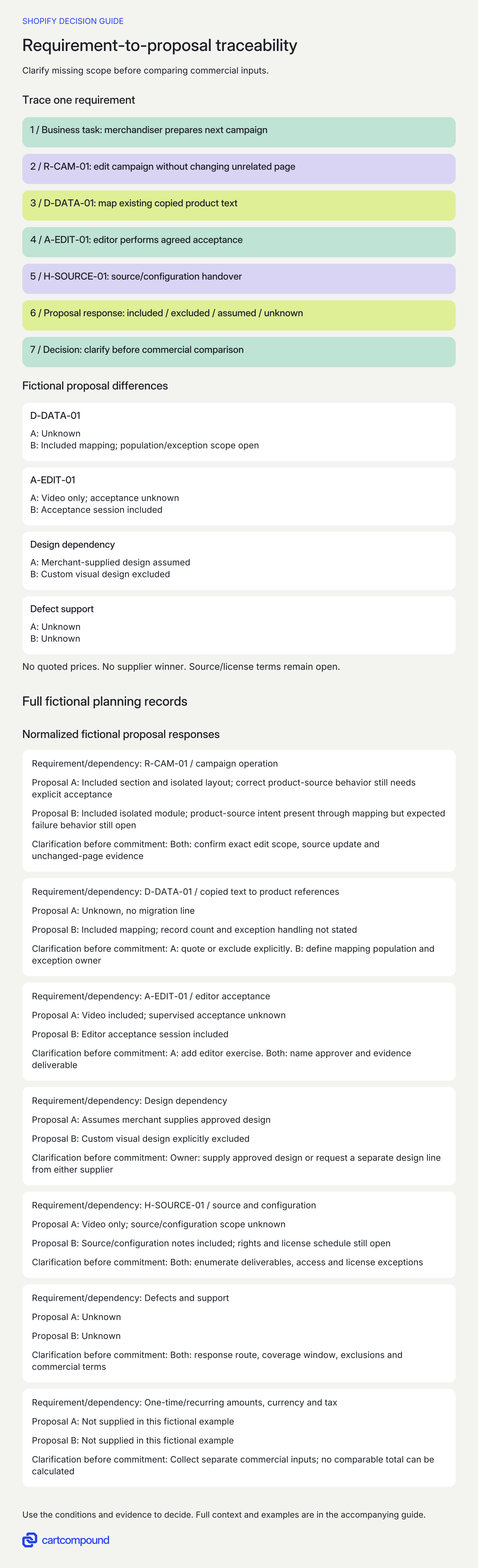
Two fictional proposals against one requirement. No real vendor, CartCompound package, quoted price or delivery result is represented. The fictional brief R-CAM-01 requires a merchandiser-editable campaign, correct selected product sources and no unintended change to an unrelated page. D-DATA-01 is its mapping dependency; A-EDIT-01 is its editor acceptance; H-SOURCE-01 is its handover obligation.
Proposal A says: “Build reusable campaign section, isolate campaign layout, provide a video handover; approved visual design supplied by merchant.” It says nothing about mapping the existing copied data, an editor acceptance session or defect support. Proposal B says: “Map product data, build an isolated campaign module, run an editor acceptance session, provide source/configuration notes; custom visual design excluded.” Its defect-support terms are also unspecified.
| Requirement/dependency | Proposal A | Proposal B | Clarification before commitment |
|---|---|---|---|
| R-CAM-01 / campaign operation | Included section and isolated layout; correct product-source behavior still needs explicit acceptance | Included isolated module; product-source intent present through mapping but expected failure behavior still open | Both: confirm exact edit scope, source update and unchanged-page evidence |
| D-DATA-01 / copied text to product references | Unknown, no migration line | Included mapping; record count and exception handling not stated | A: quote or exclude explicitly. B: define mapping population and exception owner |
| A-EDIT-01 / editor acceptance | Video included; supervised acceptance unknown | Editor acceptance session included | A: add editor exercise. Both: name approver and evidence deliverable |
| Design dependency | Assumes merchant supplies approved design | Custom visual design explicitly excluded | Owner: supply approved design or request a separate design line from either supplier |
| H-SOURCE-01 / source and configuration | Video only; source/configuration scope unknown | Source/configuration notes included; rights and license schedule still open | Both: enumerate deliverables, access and license exceptions |
| Defects and support | Unknown | Unknown | Both: response route, coverage window, exclusions and commercial terms |
| One-time/recurring amounts, currency and tax | Not supplied in this fictional example | Not supplied in this fictional example | Collect separate commercial inputs; no comparable total can be calculated |
Proposal B names mapping and acceptance that A leaves unknown. That is a scope difference, not a winner. Neither establishes the full product failure case, design ownership, rights schedule or support terms. Both depend on an approved design supplied or separately commissioned by the owner. Comparing headline totals now would conceal unfinished decisions.
The next action is a revised response against R-CAM-01, D-DATA-01, A-EDIT-01 and H-SOURCE-01, with the same acceptance evidence attached. There is no price arithmetic because no commercial values were supplied.
Frequently asked questions
Should the brief specify the app or technical approach?
Record fixed constraints when they exist. Otherwise define the required result and ask the supplier to propose and justify the route, including dependencies and exit behavior. Keep uncertain capabilities in discovery.
What if I do not know my theme version or plan?
Mark it unconfirmed and name who will inspect it with appropriate authority. Do not fill the gap with a typical plan or assume a feature is eligible.
Can a video handover count as acceptance?
It can explain a delivered workflow, but it does not by itself show that your intended editor can complete the agreed task. Specify the demonstration, evidence and approver separately.
When does paid discovery make sense?
Consider it when an unknown integration, data condition or platform capability prevents a credible implementation scope. Define the discovery questions, evidence, deliverables, cost input and next decision before commissioning it.
Sources and further reading
- Shopify Help: Hiring and working with Shopify Partners
Source checked: October 31, 2026.
- Shopify Help: Templates
Source checked: October 31, 2026.
- Shopify Help: Working on client stores
Source checked: October 31, 2026.
- Shopify Help: Checkout and account apps
Source checked: October 31, 2026.

About the author
Hamid Khan
Hamid co-founded CartCompound and works with ecommerce founders on their stores and growth priorities.
Profile and guides