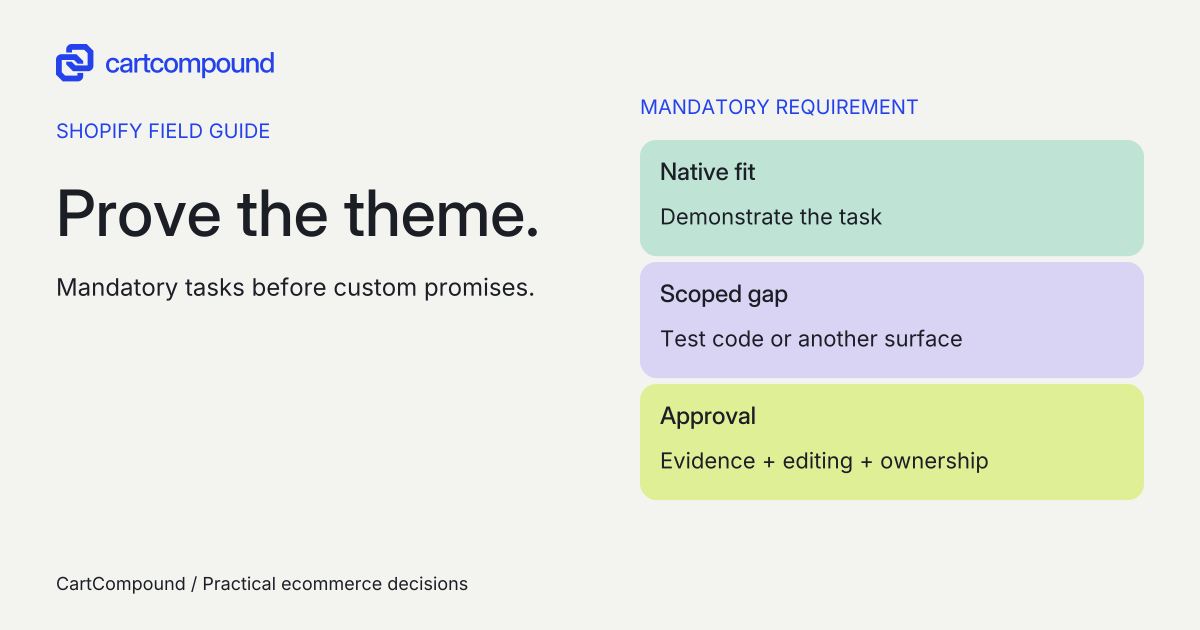
Choose the route that can demonstrate every mandatory shopping and editing task, with its dependencies and maintenance agreed. Trial a paid theme with representative products first. Commission custom work where a documented requirement needs it; an unproven custom proposal is still unproven.
A polished theme demo answers a narrow question: does this arrangement look appealing with the seller’s content? Your purchase decision needs a different answer: can your team run your store with it?
Start this comparison after deciding a theme project is needed. If that decision is still open, use the focused improvement or rebuild guide first. Here the deliverable is a theme-choice attachment you can send with a brief: requirements, evidence, gaps, ownership, and a decision.
Put it into practice
Store build decision pack
Turn a store requirement into comparable route evidence, explicit ownership and a cost model you can challenge.
Explore this resourceAsk what each offer actually includes
“Premium” usually describes a paid theme license. “Custom” describes commissioned work, but it does not identify the starting code. A custom proposal might modify a paid theme, adapt another licensed base, or supply a separately built theme. Ask the supplier to name the base, version, included components, third-party assets, and changed areas before comparing prices.
Separate the theme license from implementation, content entry, product-data setup, app configuration, testing, training, and ongoing support. Two proposals with the same headline can buy different deliverables. A complete comparison names what your team supplies as well: product photography, descriptions, approved policies, translations, or accessory mappings.
Keep three outcomes available: a paid theme with configuration, a paid theme with bounded development, or a custom theme project. Do not force the middle option into “off the shelf” if it has code you must maintain.
Write tasks that can fail a demonstration
Classify each requirement as mandatory or optional, with one person authorized to accept a tradeoff. A mandatory requirement should explain the user, action, relevant state, and expected result. “Flexible product page” is too broad. “The merchandising manager changes care information for one product without changing the rest of the catalog” is testable.
- Shopping task: choose the right variant, read a long title, inspect care information, or add a compatible accessory.
- Editing task: change that information through the agreed editor or data field without developer help.
- Exception: handle a missing value, unavailable variant, long translation, or product without accessories.
- Ownership: name who maintains the feature when the theme or dependency changes.
Use representative content. Include your longest realistic title, a product with several options, an empty optional field, and a campaign image with a different aspect ratio. A supplier can reasonably need discovery for complex work, but the quote should say what discovery resolves and what happens if it fails.
Use the trial to prove native fit, then isolate the code gap
Shopify lets you preview and configure a paid Theme Store theme before purchase. Trial themes do not permit theme-code edits. The license applies to the purchasing store, so confirm the arrangement for additional stores. See Shopify’s theme purchase guidance.
During the trial, record the theme name and version, the product used, the action performed, and the result. Let the future operator run the editing task. “The developer can change it” does not prove that the merchant can maintain it. A demo video can support an observation, but save the exact configuration and limitations in the requirement row.
If the remaining gap needs code, agree on a lawful prototype or discovery route, the cost or commitment it requires, and the consequence of failure before buying. Do not mark an untested customization as demonstrated simply because the supplier expects it to work.
Specify the editor as part of the product
The available settings depend on the theme’s architecture. Shopify also documents a separate Canvas editor: themes created or edited there cannot be edited in the theme editor. Confirm the intended surface rather than promising interchangeable controls. Shopify explains the editor distinction.
Have the operator replace a campaign image, change a heading, reorder the agreed modules, and update product-specific content. Then ask them to restore the prior values using the documented procedure. Write down which changes require code, where validation happens, and which choices the operator cannot safely make.
For custom work, request the actual controls in the proposal. “Three campaign modules with image, text, and link settings” is clearer than “easy content management.” Decide whether the merchant can create another instance, whether content is shared across templates, and who handles a new layout request later.
Give every requirement an honest status
Use five statuses: demonstrated natively, requires agreed code, requires another surface, unsupported, and not yet proven. Add the evidence location, date, version, owner, and next check. A planned implementation belongs under agreed code until its acceptance test passes.
Keep theme procurement separate from a feature’s technical route. For a checkout rule, account function, or external-system workflow, ask the supplier to identify the actual implementation surface, plan eligibility, and dependency. Hold that row until it is checked. A more expensive theme proposal does not itself establish the capability.
I would treat an unresolved mandatory row as a stop on approval, even if the alternative scores well on optional styling. A weighted total can hide the one missing capability that makes the store impractical to operate. Resolve the row, approve a documented requirement change, or reject the route.
Compare the cost of the same accepted scope
Request separate quote lines for the license and assets, discovery, configuration, custom components, data/content work, app integration, acceptance testing, operator training, release, and maintenance. State currency, tax treatment, payment milestones, dependencies, exclusions, and the period the quote covers. Use the actual proposals; a generic market range cannot tell you which one includes your work.
For recurring costs, record the billing basis and the review period. A useful planning calculation is initial agreed cost plus recurring costs over your chosen period plus separately estimated maintenance. Keep unpriced work visible as an unknown rather than entering zero. Do not turn a design preference into a revenue forecast to justify the difference.
Shopify distinguishes theme support by the maker and limits its own design assistance. Paid-theme support and commissioned customization are different responsibilities. Ask who investigates an issue that appears only after custom work, who contacts the theme maker, and who pays for compatibility work. Read the platform’s support boundaries alongside the supplier’s written terms.
Put acceptance and handover into the purchase
Agree on the representative products, browsers, devices, and states before development starts. Include keyboard operation of navigation and purchase controls, legible content at actual mobile sizes, error messages, and the relevant cart paths. For performance, agree on comparable conditions and affected pages; use the performance diagnosis guide for the measurement method. Theme type alone is not acceptance evidence.
For each mandatory row, require expected and observed results, a versioned candidate, the reviewer, and any accepted limitation. Separate visual approval from functional acceptance. A screenshot of the product page does not establish that its accessory mapping, selected variant, or editor task works.
At handover, request the source location and access, dependency list, licensed asset record, customization log, operator instructions, test evidence, known limits, and update owner. Ask the contract to explain rights to commissioned code and licensed material; the word “custom” is not an ownership clause. Do not accept a source archive as a substitute for knowing how the installed version is maintained.
Write a decision someone can revisit
Finish with the chosen route, the evidence that supports it, the alternatives rejected, unresolved dependencies, and the person accepting the tradeoffs. If approval is conditional, name the exact condition and who can close it. Avoid “premium now, custom later” unless you have also stated what change would trigger reconsideration.
Your next action is to choose one paid-theme candidate and test your hardest mandatory task with representative content. If it fails, turn that failure into the custom-work brief. If it passes, the remaining decision is whether the complete scope, editor controls, and maintenance terms are acceptable.
Choose a theme by the tasks it can prove
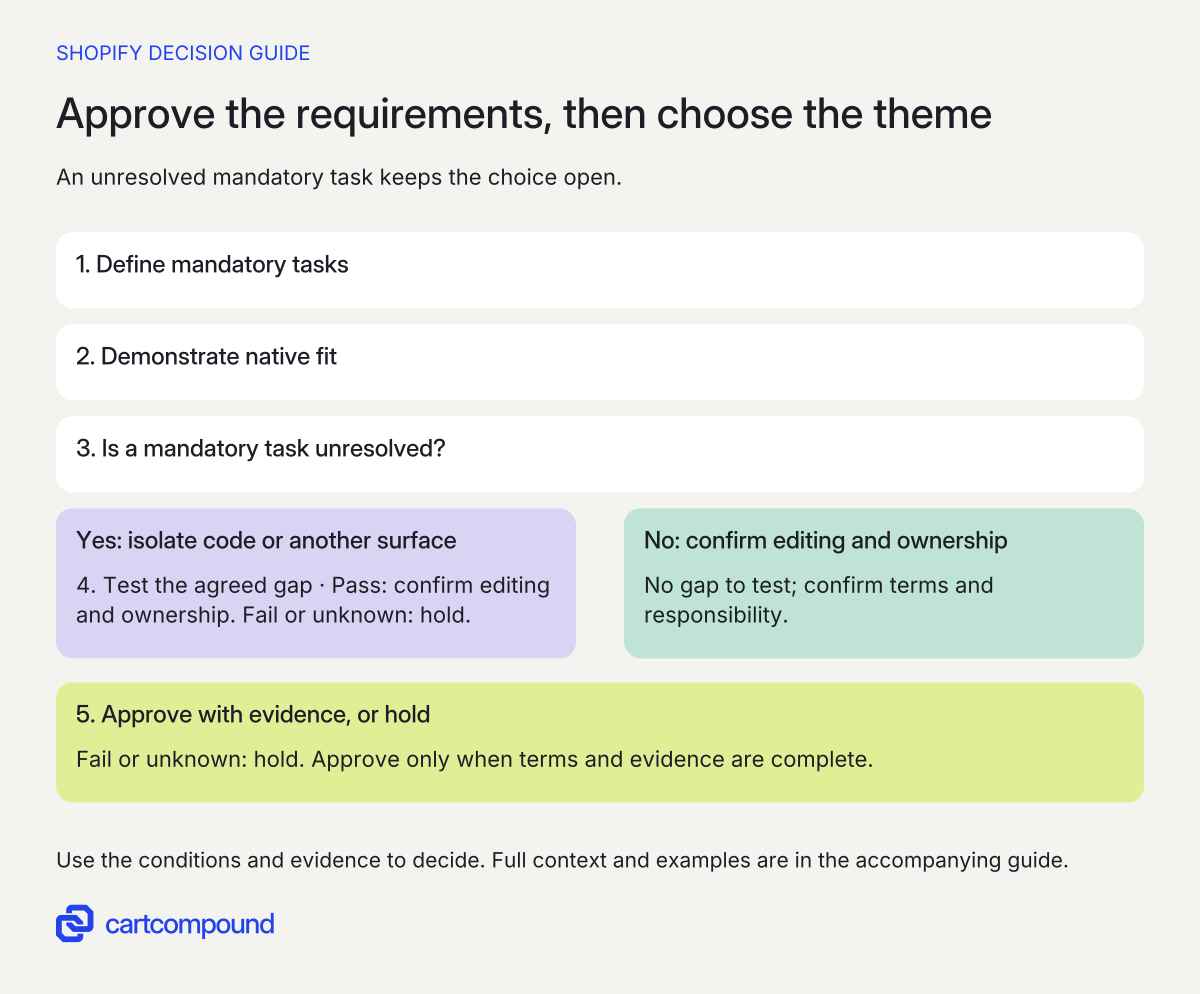
- Define the must-haves. Write mandatory shopping, editing and handover tasks before comparing themes.
- Try the native route. Demonstrate those tasks with representative products and content.
- If a task is unresolved, hold. Isolate the code or other-surface gap. Test it before approving the route.
- Before approval, confirm ownership. Agree editing controls, licenses and maintenance. Approve only when mandatory evidence and terms are complete.
Illustrative example Compatible accessories remain unproven in both fictional offers. Neither is approved. A paid-theme-plus-code route becomes acceptable only if its scoped prototype passes and maintenance is agreed.
Hypothetical worked example
Illustrative homewares store, not a client case or a tested theme comparison. Assume six mandatory tasks and three optional preferences. Paid Theme A and Custom Proposal B are fictional. Evidence labels E-A1 through E-A5 below describe assumed observations and terms for teaching; they are not real recordings or documents. No theme, code, app, or store was tested for this example.
| Requirement | Priority | Paid Theme A | Custom Proposal B | Other surface | Merchant task | Update owner | Decision |
|---|---|---|---|---|---|---|---|
| Product-specific care | Must | Native, assumed E-A1 | Agreed code; unproven | Product data | Edit one care value | Merchant/data; developer/display | A passes in scenario |
| Long product names | Must | Native, assumed E-A2 | Unproven | None identified | Change title | Theme maker + custom owner | A passes in scenario |
| Three campaign modules | Must | Native, assumed E-A3 | Agreed code; unproven | None identified | Replace/reorder modules | Merchant/content | A passes in scenario |
| Compatible accessories | Must | Agreed code; no evidence | Agreed code; no evidence | Mapping owner needed | Edit pairings | Developer + merchant | Both held |
| Keyboard cart task | Must | Native, assumed E-A4 | Unproven | Dependencies to check | No routine edit | Developer | A passes sampled states |
| Source/update handover | Must | Terms supplied, assumed E-A5 | Terms incomplete | Contract + source record | Find change log | Named developer | B held |
| Animated hero | Optional | Not selected | Optional code | None assessed | Enable only if approved | Developer | Defer |
| Alternate landing layout | Optional | Not yet proven | Optional code | None assessed | Choose layout | Developer | Defer |
| Decorative card treatment | Optional | Native option assumed | Optional code | None assessed | Choose preset | Merchant | Preference only |
The assumed evidence gives A a narrower unresolved gap: compatible accessories. B remains a proposal with several mandatory demonstrations and handover terms open. Neither is approved at this point. Choosing B because it says “custom” would replace a known gap with promises.
Write the accessory acceptance case before commissioning discovery: on two representative products, show only merchant-approved pairings; handle no pairing and an unavailable accessory; let the merchant change a pairing; add the intended accessory and variant to the cart. Ask where the mapping lives and who maintains it. A display-only suggestion and an enforced compatibility rule are different requirements, so specify which is needed.
Now assume, purely to continue the example, that A’s scoped prototype passes those checks and the supplier agrees to maintain it. A becomes an acceptable paid-theme-plus-code route if all other mandatory evidence and commercial terms remain acceptable. If the prototype fails, A stays held and B must prove the missing capability before it can replace A. The optional animation does not change either decision.
Attach the matrix to both quotes and update it after discovery. The useful output is a conditional decision with a falsifiable reason, rather than a blanket claim that one class of theme wins.
Frequently asked questions
Is a custom Shopify theme always faster?
Use comparable measurements and functional tests on the proposed implementation. Request the affected pages, devices, states, and evidence in acceptance. Do not pay a premium based solely on a “custom is faster” assertion.
Can I use the same paid theme on several stores?
The Theme Store license applies to the purchasing store. Confirm the license required for each intended store before accepting a multi-store quote.
What if a paid theme meets everything except one feature?
Price and test a bounded customization. Record its data source, editor controls, dependencies, update responsibility, and failure condition. That evidence can support a paid-theme-plus-code decision without commissioning an entire new theme.
Does custom development mean I own every part?
Ask the proposal to distinguish commissioned code from licensed base code, fonts, images, and other assets. Have the agreement state access, use rights, source handover, and maintenance responsibilities. Resolve unclear terms before purchase.
Sources and further reading
- Shopify: Adding, previewing, and buying themes
Source checked: October 31, 2026.
- Shopify: Customizing themes
Source checked: October 31, 2026.
- Shopify: Theme support
Source checked: October 31, 2026.

About the author
Hamid Khan
Hamid co-founded CartCompound and works with ecommerce founders on their stores and growth priorities.
Profile and guides