Choose Plus when a verified requirement or a defensible merchant-specific cost case justifies the commitment. Revenue alone does not establish either.
A proposal that says your store has outgrown Advanced should identify what is blocked. Is an operator running out of admin seats? Does a particular checkout app require Plus? Or is the argument based entirely on lower payment fees?
Those are different decisions. Start with a feature evidence sheet, then calculate the cost using your own quote and payment mix. You can finish with stay, defer, or upgrade without inventing a sales uplift.
Put it into practice
Store build decision pack
Turn a store requirement into comparable route evidence, explicit ownership and a cost model you can challenge.
Explore this resourceWrite the requirement before comparing plans
Use this sentence: When [actor] does [task], we need [observable result], but the present setup fails because [evidence]. Attach a screen recording, support answer, current app documentation, or a reproducible case. “More flexibility” is too broad to price.
Record the frequency, consequence, current workaround and person accountable for the result. An occasional manual step and a rule that must apply to every order deserve different treatment. Assign each requirement one state: supported on Advanced, verified Plus requirement, possible through another route, or unresolved.
I recommend rejecting any plan recommendation that cannot show its decisive row. A presentation label such as “enterprise” is not acceptance evidence. Nor does annual revenue tell you which page, data access, or staff limit is blocking the task.
Check the exact capability, including the exceptions
| Requested capability | Current documented distinction | Evidence to collect |
|---|---|---|
| B2B pricing | Basic, Grow and Advanced allow up to three active catalog assignments across active B2B markets. The limit does not apply on Plus; Plus also permits direct assignment to company locations. | Required active catalog-assignment count and assignment rules. B2B catalog documentation |
| Checkout interface | Apps on information, shipping and payment pages require Plus; some thank-you, order-status and account apps work below Plus. | Exact page, extension target, placement and app. Checkout app availability |
| Custom commerce rule | Custom apps using Function APIs require Plus. App Store public apps can provide Functions across plans, with additional capability restrictions. | Rule, Function API, distribution and public-app alternative. Functions availability |
| Staff and locations | Advanced: 15 admin users and 10 active locations. Plus: unlimited users and 200 active locations. | Separate seat and location counts; exclude exempt user types correctly. Deactivated locations and app/custom fulfillment locations do not count toward the active-location limit. User limits; location limits |
Count assignments, not distinct catalogs. In a hypothetical setup, assigning one active catalog to two active B2B markets uses two assignments. Adding that catalog to a third active market reaches three; a fourth would exceed the below-Plus limit even though only one catalog exists. Record every active catalog-to-active-market pairing in the evidence sheet. Direct assignment to company locations is a separate Plus capability.
Do not describe all B2B, all checkout changes, all custom development, or headless as a single Plus-only feature. A requested architecture needs its own current channel and feature checks. Plus eligibility also does not prove an app implements your exception cases.
Pass two gates before an upgrade
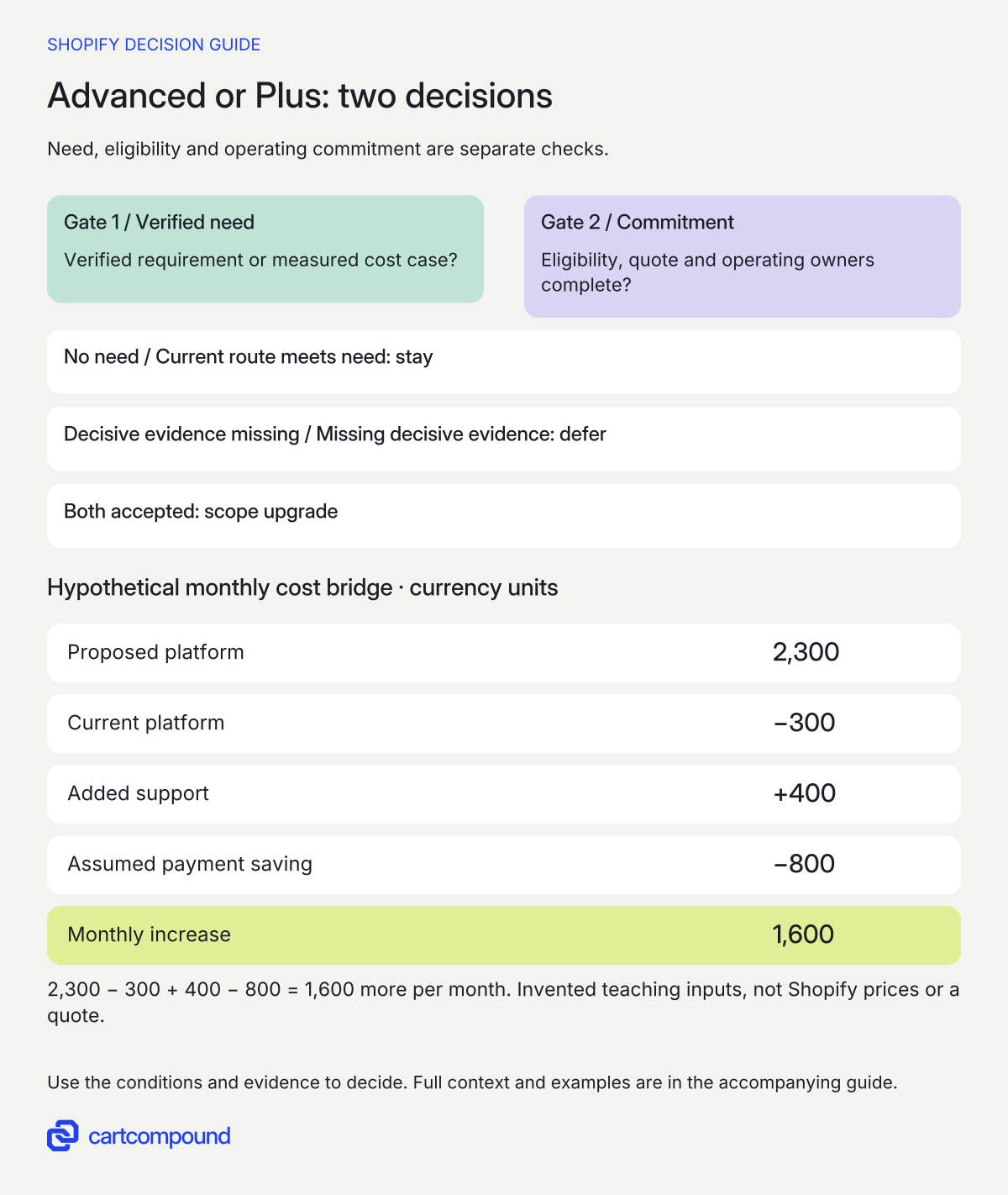
- Is there a verified need? Test the blocked task or merchant-specific cost case. If neither a blocker nor a verified cost case remains, stay.
- Is the commitment understood? Verify exact feature eligibility, the quote and operating owners. Missing decisive evidence means defer.
- Are both accepted? Scope the upgrade when the requirement, cost and responsibilities are accepted.
Illustrative example 2,300 − 300 + 400 − 800 = 1,600 more currency units per month. These are invented platform, support and payment-saving inputs, not Shopify prices.
The simplified bridge excludes taxes, fixed-fee differences and one-time costs. Payment savings alone do not close the assumed monthly gap.
Separate the public price snapshot from your quote
The following standard-price snapshot was checked October 31, 2026. It is a reference for asking better questions, not a quotation.
| Currency/market | Advanced, paid yearly | Plus, one-year term | Plus, three-year term |
|---|---|---|---|
| US / USD | $299 | $2,500 | $2,300 |
| UK / GBP | £259 | £1,950 | £1,800 |
Sources: US pricing, UK pricing, and Plus term and currency table. Keep currencies separate. An annual-billing equivalent does not describe a monthly-billing contract.
Some complex, higher-volume businesses may face a variable platform fee. Request the fee basis, minimums, B2B/D2C treatment, term, billing schedule and quote expiry in writing. Add taxes where applicable to your comparison; do not assume their treatment from this table. Review trial conversion, renewal and cancellation terms separately before accepting anything.
Build the monthly difference from merchant inputs
Use one currency and the same comparison period throughout:
Monthly difference = Plus platform charge − current platform charge + incremental recurring services − verified payment savings − removable recurring costs.
Keep implementation, migration, training and overlapping subscriptions in a separate one-time column. If you spread a setup cost across a planning period, label that allocation and show the cash payment separately. Do not silently turn a three-year agreement into a cancel-anytime monthly option.
For payment savings, create a row for each eligible payment group: volume × percentage-rate reduction, plus transaction count × fixed-fee reduction. Convert 0.2 percentage points to 0.002. Use statements and quoted rates for domestic, international, premium, alternative-payment and third-party-provider activity as applicable. Do not apply a headline “from” rate to total store revenue.
List only costs that can actually end: an app subscription still needed after the upgrade is not a saving. Put time savings in hours first, with the task and measurement method. If those hours do not reduce spending or release usable capacity, leave them outside the cash saving column. Keep unknown inputs blank and mark the result incomplete.
Count the operating work that the plan does not perform
For expansion plans, Shopify documents nine expansion stores on Plus and a theme license for each live expansion store. Check the Plus feature description. Write down which stores qualify, their languages, apps, product data, inventory responsibilities and support owners. An allowance is not a completed multi-store operation.
For custom checkout or Function work, request a scoped build and maintenance proposal. Require the behavior to be demonstrated using the store's actual shipping, payment and order scenarios. Record who monitors errors, reviews platform changes, supports the configuration and can recover a prior accepted version.
Compare staff, locations, expansion stores and POS requirements as separate lists. Fifteen admin seats is not fifteen total people touching the business. Exempt collaborators and qualifying POS-only staff can change a seat-based argument. A new platform subscription does not replace permission planning or app support.
Reach a decision with an ordered evidence check
- Verify the blocker. Reproduce the failing task and confirm its business consequence with the responsible operator.
- Verify eligibility. Match the exact feature to current official documentation and the proposed app/API. Resolve any contradictory page with Shopify or the app provider before signing.
- Test the alternative. Ask whether a current native setting, supported public app or bounded process change meets the same acceptance criteria.
- Normalize the quote. Use one currency, explicit term, payment groups and recurring/one-time costs. Check a lower-volume case as well as the current case.
- Accept the operation. Name build, support and business owners. Confirm the feature can be used by the people who need it.
- Record stay, defer or upgrade. Stay if the current route meets the need. Defer while a decisive input is missing. Upgrade when the requirement and cost commitment are both accepted.
Save a decision date and a trigger to revisit it, such as a confirmed catalog requirement or a changed merchant quote. That makes the decision reusable without treating a revenue threshold as policy.
Hypothetical worked example
Worked example: lower payment fees still leave a monthly gap
Illustrative assumptions only. A fictional merchant enters 300 currency units for the current monthly platform charge, 2,300 for the proposed charge and 400 for added recurring support. These are invented teaching inputs, not Shopify prices or a merchant quote. Both options use the same currency; taxes, fixed-fee differences and one-time costs are excluded from this simplified calculation.
| Input or result | Calculation |
|---|---|
| Eligible card volume | 400,000 currency units |
| Assumed rate reduction | 0.2 percentage points = 0.002 |
| Payment saving | 400,000 × 0.002 = 800 |
| Added platform and support | 2,300 − 300 + 400 = 2,400 |
| Remaining monthly increase | 2,400 − 800 = 1,600 |
At half that eligible volume, savings fall to 400 and the increase becomes 2,000. If the rate difference is only 0.1 percentage points at the original volume, the same 2,000 increase results. The fee-only break-even volume for these constant assumptions is 2,400 ÷ 0.002 = 1,200,000 per month. That is a mathematical sensitivity result, not an upgrade threshold: a real quote may use variable fees, different card groups and extra costs.
The fictional operator also needs direct company-location catalog assignment. That is a documented Plus distinction, so the feature can justify a separate operational case even though fee savings alone do not cover the assumed costs. The decision remains defer until the real quote, assignment test, implementation price and support owner are accepted. No extra sales or conversion improvement is assumed.
Frequently asked questions
Is there a revenue level where Plus automatically becomes worth it?
No universal threshold establishes that. Revenue is different from eligible payment volume, and neither proves a needed capability. Use your documented requirement, actual quote and operating costs.
Do we need Plus just to sell B2B?
Check the exact B2B task. Basic, Grow and Advanced permit up to three active catalog assignments across active B2B markets. Reusing one active catalog in two active markets counts as two assignments. Plus removes that limit and permits direct company-location assignment. Check current catalog eligibility.
Can a public app avoid a custom Function requirement?
Possibly. An App Store public app with Functions can serve stores across plans, but the exact Function capability and app behavior still need checking. Read Functions availability.
Sources and further reading
- Shopify pricing, US
Source checked: October 31, 2026.
- Shopify pricing, UK
Source checked: October 31, 2026.
- Shopify Plus plan
Source checked: October 31, 2026.
- Catalogs and pricing in B2B
Source checked: October 31, 2026.
- Checkout and customer-account apps
Source checked: October 31, 2026.
- About Shopify Functions
Source checked: October 31, 2026.
- Maximum users by plan
Source checked: October 31, 2026.
- Setting up and managing locations
Source checked: October 31, 2026.

About the author
Hamid Khan
Hamid co-founded CartCompound and works with ecommerce founders on their stores and growth priorities.
Profile and guides