The short answer
Define the markets and languages the store can actually serve, then give intended localized versions stable URLs. Verify visible language, currency, fulfillment, self-referencing canonicals and equivalent-page hreflang relationships. Shopify provides built-in market SEO features, but custom themes and apps still require output checks.
Start with a market readiness matrix
International SEO begins with the ability to serve the customer, not the choice of a country flag. List each intended country, language, currency, assortment, delivery coverage, returns information and support capacity. Distinguish a translated page from a fully supported market. A visitor can read a page perfectly and still be unable to buy the product in that country.
Create one row per country-language experience rather than assuming every country needs a unique site. Some regions may share a language and assortment, while others require different offers. Record the owner of translations, product availability and fulfillment facts. Avoid launching versions the team cannot maintain when prices or product specifications change.
Shopify's International SEO for markets describes its international SEO features when markets, domains, languages and localized content are configured. Use that platform behavior as a starting point, then inspect the actual storefront. The existence of a market in an admin screen does not prove that every equivalent product URL is published, accurately translated and reachable by search systems.
Choose URLs for a maintainable market structure
Shopify supports international approaches using subfolders, subdomains and separate domains, subject to the actual store configuration. Evaluate operational ownership, existing domain history, language needs, routing and maintenance before choosing. Do not buy a collection of domains solely because they look locally relevant without a plan to operate and retain them.
A subfolder can keep versions under one host, while separate domains create additional domain and measurement responsibilities. These are implementation tradeoffs, not a universal ranking contest. Document the reason for the selected structure and the mapping between markets and public URLs. If all markets use one unchanged URL with no language or region distinction, there are no distinct alternate addresses for hreflang to reference, as Shopify's guidance explains.
Test representative direct entry URLs from a fresh session. Confirm the requested version remains accessible and displays the expected language and offer. Customer location detection should help navigation without making another version impossible to view. Review any automatic redirection, country selector or geolocation app with both user access and crawler access in mind. A routing system that works only with remembered cookies is difficult to verify and maintain.
 Keep this framework
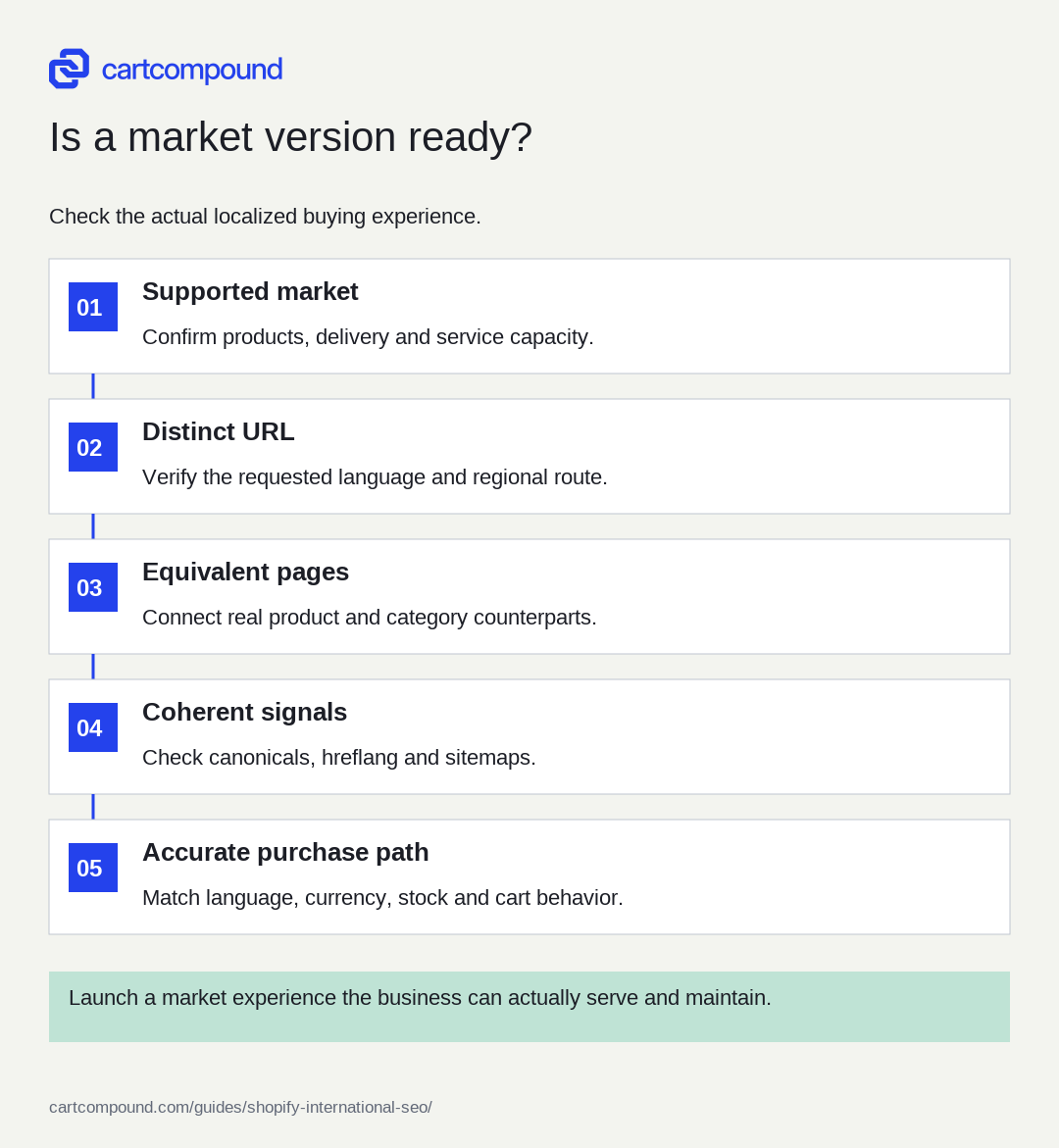
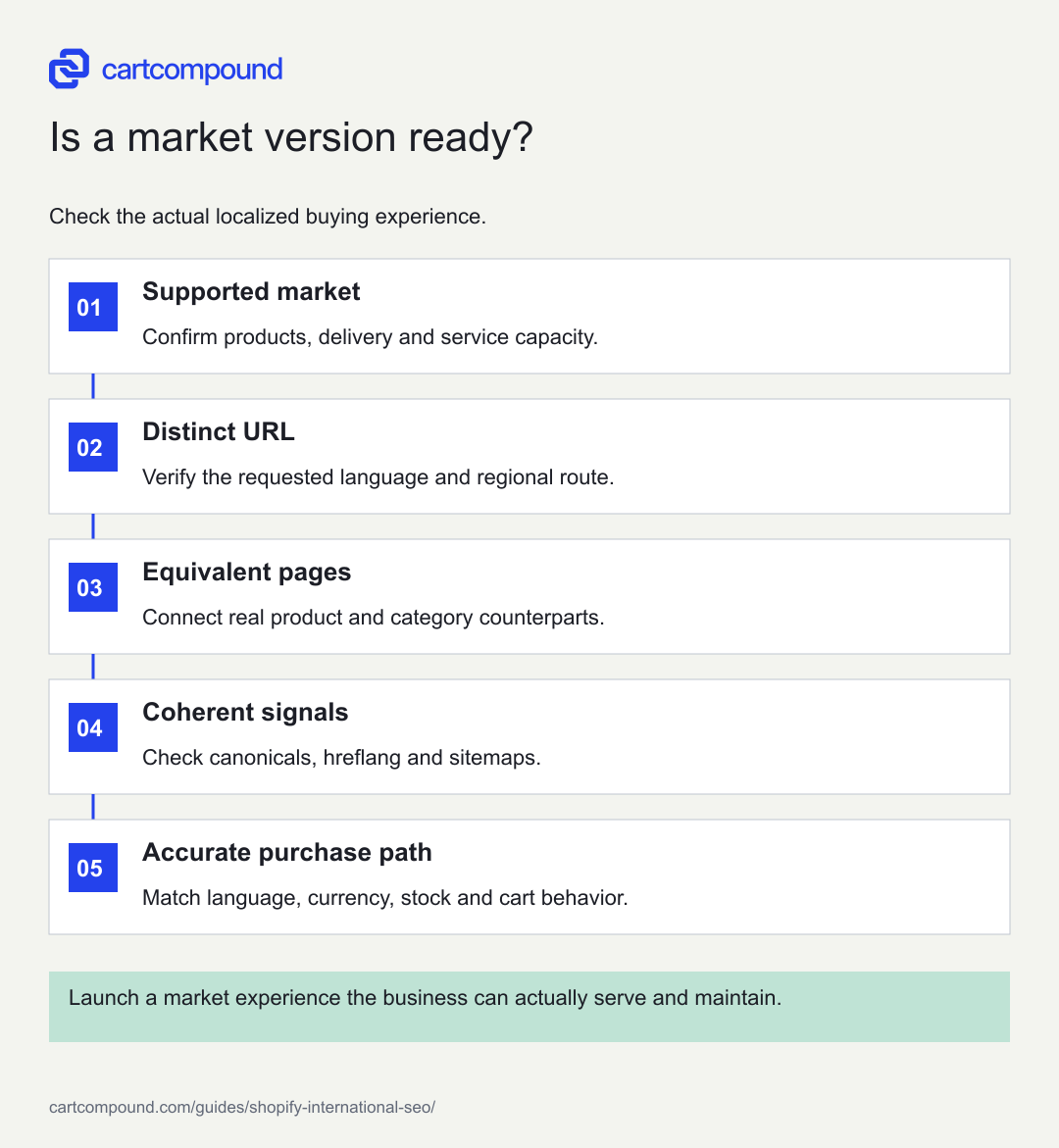
Is a market version ready?
Check the actual localized buying experience.
- Supported marketConfirm products, delivery and service capacity.
- Distinct URLVerify the requested language and regional route.
- Equivalent pagesConnect real product and category counterparts.
- Coherent signalsCheck canonicals, hreflang and sitemaps.
- Accurate purchase pathMatch language, currency, stock and cart behavior.
Launch a market experience the business can actually serve and maintain.
Use the steps with your store data. Examples in this guide are illustrative unless a source is named.
Understand what hreflang expresses and what it cannot fix
Hreflang identifies related language or regional versions of equivalent pages. It does not translate content, correct prices or make a market commercially available. A tag pointing to a homepage is not an adequate substitute for a missing equivalent product simply because both pages belong to the same country site.
Shopify currently documents automatic hreflang generation based on market and language configuration, including distinct domain, subdomain or subfolder requirements; see International SEO for markets. Before adding an app or custom implementation, inspect whether Shopify already supplies the needed relationships. Two systems can create conflicting or duplicated tags.
Use a page-family worksheet: primary product, each intended market equivalent, language-region code, response status, canonical and return references. Include the current product on every relevant version and confirm the relationships are reciprocal and valid. Check unsupported or mistyped codes with the primary documentation used by the implementer. Do not disable automatic behavior merely because a tool reports a warning without understanding the resulting output and which system will replace it.
Keep canonicals and alternate versions coherent
Market pages should have a consistent canonical strategy that preserves legitimate localized destinations. Do not point all translated product pages to the primary-language product merely because the photographs and specifications overlap. Shopify's current international guidance describes self-referencing canonicals for market-specific versions alongside hreflang relationships.
Inspect the actual canonical on several products, categories and editorial pages in every market. Check the full host and path, especially after a domain or language change. A custom theme may construct targets from a default host, while a translation app may add another layer of signals. Identify the owner before correcting the output.
Google's How to specify a canonical URL explains canonical methods and recommends canonicals in the same language when hreflang is used, or the best available substitute. The practical objective is that an intended French product page remains a coherent French destination, rather than contradicting its alternate-page relationships with an unrelated canonical. Keep the intended behavior written down so later cleanup does not collapse regional pages indiscriminately.
Validate localized content and buying information together
Translate the parts that affect the buying decision: product names where appropriate, measurements, compatibility language, delivery expectations, returns explanations and interface labels. Keep manufacturer names and identifiers accurate rather than translating them mechanically. Localize units and terminology carefully, and verify the underlying conversion where dimensions are presented differently.
Separate currency display from the actual checkout offer. Confirm that the price, selected variant, taxes or duties information where applicable and delivery coverage remain consistent through the purchase path. Do not imply legal or tax treatment without approved market-specific records. Operational guidance should identify the need for qualified review instead of inventing jurisdictional rules.
On a small screen, swipe the table to see every column.
| Market check | Evidence to capture | Failure example |
|---|---|---|
| Language | Product and buying controls | Translated description with default-language size help |
| Offer | Selected item through cart | Currency or variant changes unexpectedly |
| Fulfillment | Supported destination and delivery information | Product appears available but cannot ship |
| Equivalence | Alternate URL family | Product alternate points to a market homepage |
Handle missing products and partial market coverage
A product may be available in one country but restricted, unsupported or temporarily absent in another. Do not create an apparently purchasable localized equivalent simply to complete a tag matrix. Determine the actual market policy and the best customer destination. Equivalent-page relationships should reflect real public versions.
In an illustrative store, a US lamp is sold in the United States and Canada, while a different electrical version is sold elsewhere. The pages may need distinct factual explanations and product identities rather than a simple translation. Ask the product owner whether the versions are true market equivalents, variants or separate products with different compatibility. SEO implementation should follow that answer.
Review category parity too. A localized collection containing only a small subset can still be useful if the promise matches its assortment. A translated guide recommending products unavailable in the market needs editing or clear alternatives. Keep a market exception list with owner and review trigger. The objective is accurate shopping information in each version, not an artificially symmetrical website.
Check sitemaps, links and measurement by market
Shopify documents automatic international sitemap generation when relevant market URLs are configured. Inspect the actual sitemap and representative entries, especially after adding or removing a language or domain. Confirm that intended URLs are public and that canonical and alternate references agree with the chosen architecture. Submit relevant sitemaps through the appropriate verified Search Console properties as applicable.
Check language selectors and internal links at page level. Switching markets from a product should reach the equivalent item when one exists, not silently discard the shopper's context. Review guide-to-product links and navigation generated by apps. A localized page can output the right hreflang while every useful internal link sends the customer back to the primary market.
Measure discovery by country, landing version and query group. Pair that with actual orders and fulfillment constraints. A rise in visits from a country does not prove that the correct local pages are being served, and a decline may reflect stock differences rather than a technical tag defect. Keep domain and attribution configuration changes documented so a market launch does not become an unexplained break in reporting.
Check alternate-page families at the page level
A correct homepage language cluster does not prove that the product and category relationships are correct. Choose equivalent pages with different slugs or translated handles, then inspect the exact alternate destinations. Confirm the target exists, matches the subject and returns directly to a usable page. A redirecting or missing alternate can indicate that the configuration and published catalog have drifted apart.
Keep an exception for pages without a genuine counterpart. If a guide exists only in English, do not label a different French guide as equivalent merely to fill a matrix. If a product has different specifications in another market, have the product owner decide whether it belongs in the same page family before implementing the relationship. The SEO annotation should express an editorial and product relationship the business can explain.
Repeat the test after changing a market domain, publishing a language or renaming localized handles. Compare expected and actual families by stable content or product ID, not just similar-looking URL text. Retain the results with the market release record. This catches a class of errors that visual translation checks miss: every individual page can look polished while the cross-market relationships quietly point to unrelated destinations.
Run a market acceptance test before expanding
Choose one product family, one category and one guide for each intended experience. Test fresh entry, language selection, currency, available variants, cart behavior, canonical, alternate relationships and sitemap presence. Add a product missing from one market to test the exception path. Record actual results and the time of the check.
Search Console's URL Inspection tool can help assess the indexed and current accessibility states of individual URLs. Keep crawl dates visible and do not mistake a successful live test for guaranteed indexing or correct regional selection in every search. Investigate the exact page family when a wrong-country result appears rather than rebuilding every market tag at once.
The next action is to complete the readiness and URL-family matrix for the two most important markets. Fix factual and purchase-path gaps before adding more languages. Then verify one coherent owner for automatic or custom hreflang generation. A maintainable international system makes it clear which product a customer can buy, through which version and under which supported terms.
Your action checklist
Use this to decide what to do next. Your checks stay on this page and are not sent or saved.
0 of 6 checked
Common questions
Does Shopify automatically add hreflang?
Its current documentation describes automatic generation based on configured markets and languages with distinct URLs. Inspect the actual output and custom integrations before adding another system.
Should translated pages canonicalize to the main language?
Legitimate localized versions generally need a coherent localized canonical strategy. Shopify documents self-referencing market canonicals with hreflang connections; verify that your implementation preserves the intended versions.
Does every country require a separate domain?
No. Choose among supported URL approaches based on market needs, operations and existing architecture. A separate domain adds responsibilities and does not itself guarantee search performance.
Sources and review
Source documentation checked October 27, 2026. Platform features and interfaces can change. The recommendations and illustrative examples explain how to make the decision; they do not promise results.
- International SEO for markets
Shopify Markets localized URLs, hreflang, canonicals and sitemap behavior. - How to specify a canonical URL
Canonical signals, consistent internal links, and limits of canonical declarations. - URL Inspection tool
Indexed data versus live tests, canonical inspection and indexing requests.
Talk through your store question
Bring one problem you want to solve.
A free 20-minute call with Hamid can help you decide what to investigate next.
Book a free 20-minute call
About the author
Hamid Khan
Hamid co-founded CartCompound and works with ecommerce founders on their stores and growth priorities.
Profile and guides