The short answer
Answer eligibility, timing, item condition, costs, refund method, and how to start. Put a short accurate summary near the purchase decision and link to full terms. Align every summary with the approved policy and actual return process, including product and market exceptions.
Treat the policy as a customer decision system
Shoppers need to understand what happens if an item does not suit them. A returns policy is therefore part of product choice as well as an operational document. Clear wording can reduce uncertainty, but it must accurately represent what the business can do. A generous-sounding summary that hides fees or exceptions creates a new problem when the customer asks for a return.
Begin with the approved policy and the actual process. Identify the owner who can confirm terms, market differences, product exclusions, costs, and refund handling. Do not rewrite commercial conditions during a visual or readability pass. If the existing policy is ambiguous, raise the specific ambiguity for the authorized business or legal owner rather than silently choosing an interpretation.
Map the moments where the policy is used: product evaluation, cart review, checkout, order confirmation, delivery, return request, and refund follow-up. Each moment needs a different amount of detail. Before buying, the customer needs the important conditions and costs. After delivery, they need eligibility and a clear way to act. A single dense page cannot do all of that well without supporting summaries and process messages.
Answer the six practical questions
Start with eligibility: which products can be returned and which exceptions apply? Then explain the time window and what starts it, such as delivery or another approved reference point. Clarify whether the customer must request a return or have the package received within that period. These are different rules and should not be left to inference.
State the required item condition, packaging, tags, accessories, and proof of purchase only as the policy actually requires. Explain return shipping, original shipping charges, restocking fees, and any deductions. Make clear whether the customer receives a refund to the original payment method, store credit, an exchange, or a choice. Avoid broad “free returns” language if a material fee remains.
Finally, explain how to start and what happens next. Give the supported account, portal, form, or support route and the information needed. Describe approval, label, packaging, shipment, inspection, and refund stages where applicable. Use verified operational timing and distinguish the store's processing time from a payment provider's posting time. If timing varies, state the relevant uncertainty rather than promising a fixed result the team cannot control.
 Keep this framework
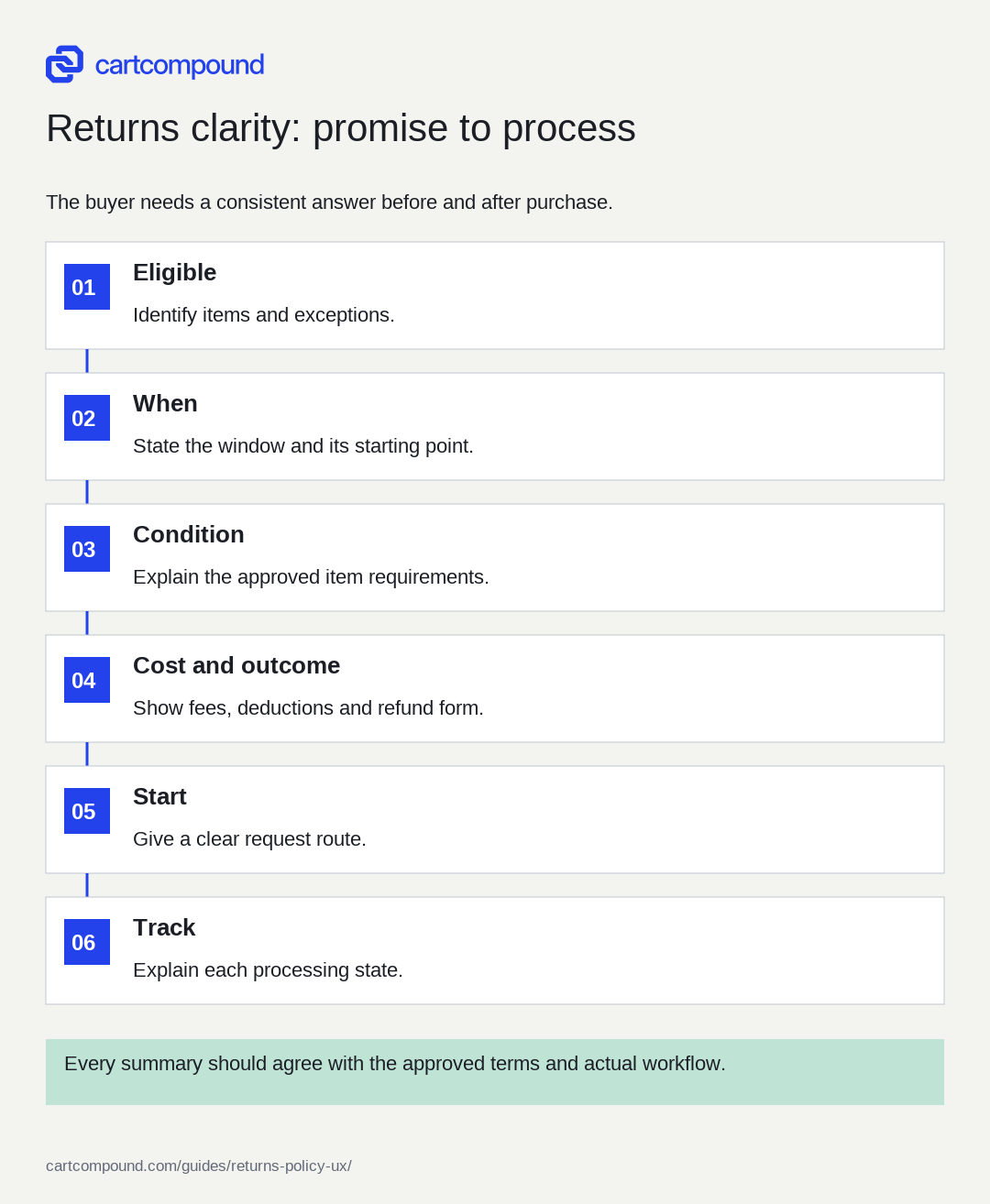
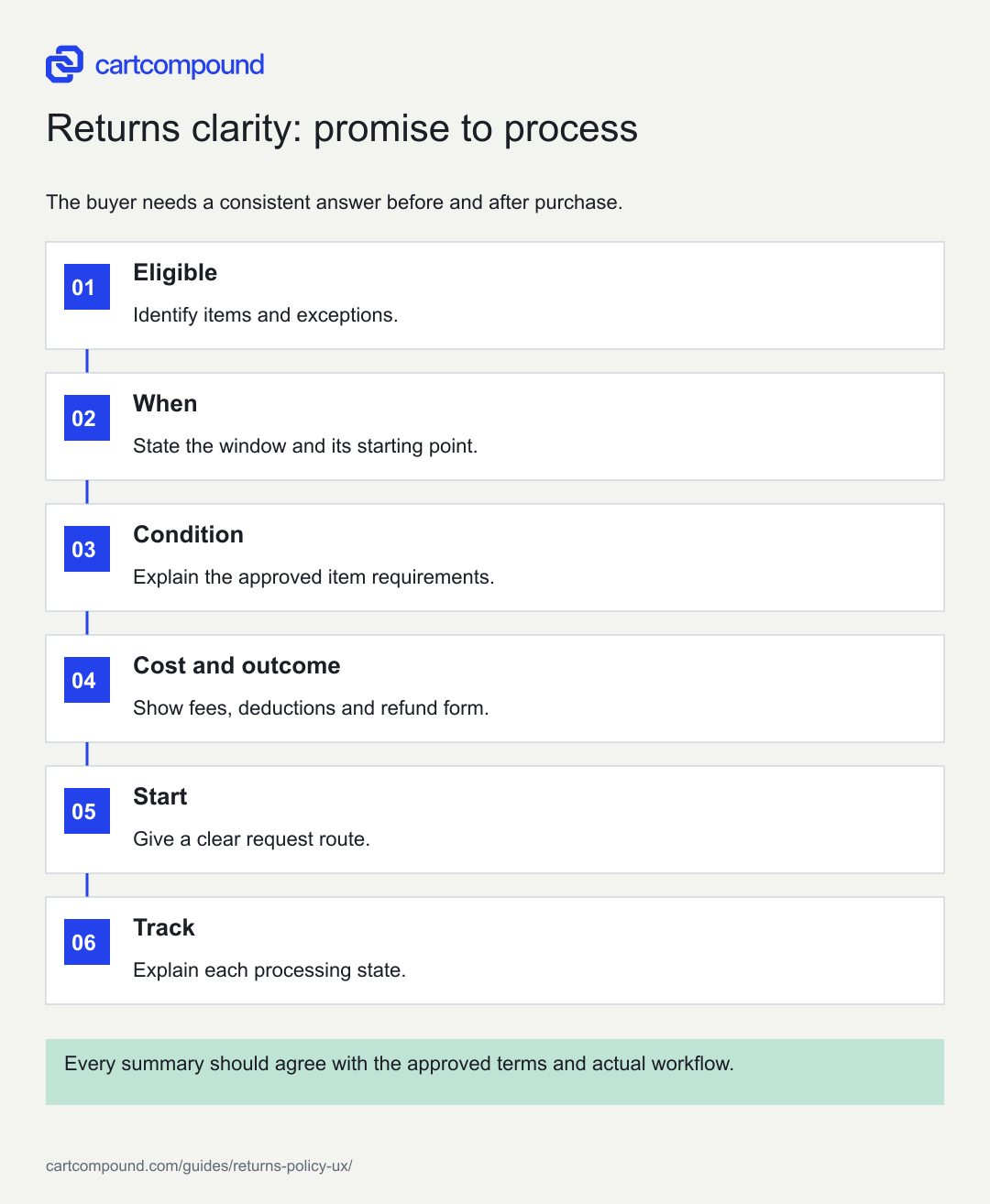
Returns clarity: promise to process
The buyer needs a consistent answer before and after purchase.
- EligibleIdentify items and exceptions.
- WhenState the window and its starting point.
- ConditionExplain the approved item requirements.
- Cost and outcomeShow fees, deductions and refund form.
- StartGive a clear request route.
- TrackExplain each processing state.
Every summary should agree with the approved terms and actual workflow.
Use the steps with your store data. Examples in this guide are illustrative unless a source is named.
Create a policy matrix before writing summaries
On a small screen, swipe the table to see every column.
| Condition | What the reader needs | Where to verify it |
|---|---|---|
| Standard item | Eligibility, window and condition | Approved general policy |
| Final-sale item | Specific exception before purchase | Product or collection rule |
| Damaged or wrong item | Distinct reporting and support route | Operations-approved process |
| Different market | Applicable local policy and fees | Authorized market terms |
| Gift purchase | Proof and refund or exchange options | Gift policy |
| Mixed order | Rules for each relevant item | Order and product-level conditions |
Use the matrix to find contradictions. A product badge may say final sale while the generic accordion says every item can be returned. A cart banner may say free returns while the policy charges a label fee. Record each mismatch, the controlling source, and the owner who must resolve it. Do not assume the longest document is automatically the correct one.
Keep the matrix internal as a source of truth for content and QA. Add a version date and note which policy applies to existing orders when terms change. This avoids presenting today's rules as though they necessarily governed a purchase made months earlier. The public copy should remain concise, but the operating record needs enough detail for consistent decisions.
Place accurate summaries near the purchase decision
A product page should give the reader a useful return summary and a clear link to details. Baymard's product-page research highlights the importance of understandable return information on the product page. Use that as a reason to inspect your own page placement, not as a promise of a specific conversion increase.
Prioritize the conditions most likely to change the buying decision: eligibility, window, costs, and meaningful exceptions. A generic “easy returns” label communicates little. A concise approved summary can explain the actual rule more clearly. Keep it readable on mobile and accessible without a precise hover action. If an accordion contains the detail, its label should describe what the reader will find.
Use product-specific exceptions where they apply. A final-sale product should not inherit a reassuring general summary that contradicts its terms. The same applies to personalized, bulky, or other specially handled items when the approved policy differs. Check product cards and promotional pages as well as the main product template. A customer can enter through a campaign and miss a condition that appears only on another page.
Align the words with the return system
Inspect the platform configuration and support workflow. Shopify's return-rule documentation distinguishes written policy, rule settings, and self-service behavior. Its rules can include windows, fees, and final-sale exceptions, and changes apply to future orders. Confirm the store's actual configuration rather than assuming that editing policy text changes operational eligibility.
Test whether the account or return portal shows the same conditions as the product-page summary. Check a standard item, an excluded item, a mixed order, and an order near the window boundary. Verify the displayed fee and estimated refund. If support must handle an exception manually, the customer should have a clear route and the team should have approved instructions.
Avoid turning platform defaults into business policy without review. The correct terms come from the authorized policy owner and applicable requirements. This guide covers communication and operational consistency, not a universal legal return standard. Obtain jurisdiction-appropriate review for the markets and product categories the store serves, especially when introducing new exceptions or changing customer rights.
Work through an illustrative summary failure
Imagine a store's approved policy allows eligible unused items to be requested for return within 30 days of delivery and deducts a $7 label fee. A product-page badge says “Free 30-day returns.” The badge conflicts with the actual fee and may also fail to explain the item-condition requirement. These terms are illustrative, not a suggested policy.
The content correction should use an approved concise statement that accurately describes eligibility, timing, and cost. The full policy should explain the request process, exclusions, and refund stages. The return portal should show the same label deduction before confirmation. If a particular product is final sale under the approved terms, that exception needs to be visible where the item is evaluated.
Now test a mixed order containing one eligible item and one final-sale item. The customer should be able to identify which item can be returned and what fee applies. If the interface only shows a general refusal, the operational process may need work as well as the copy. The lesson is to test an actual scenario rather than proofreading the policy in isolation.
Make post-purchase instructions usable
After delivery, write instructions in the order the customer can follow. Explain how to identify the order, choose the item, describe the reason, review fees, and submit the request. State whether approval is required before shipping. If a label or authorization is needed, explain where it will appear and what to do if it does not arrive.
Use status messages that distinguish stages. Requested, approved, in transit, received, inspected, and refunded are different states. A customer who sees “complete” may assume the money has reached their account when only inspection is complete. Use the exact meaning and supported timing. Give a route for problems such as a missing label or incorrect item record without asking for unnecessary sensitive information.
Review forms and messages on mobile, including errors and empty states. Keep required fields understandable and avoid deleting valid information after an error. Confirm that the process works for guest purchasers under the store's supported account model. A clear policy is undermined if the only initiation route requires an account the shopper cannot access.
Keep exchanges and damaged-item support distinct
A change-of-mind return, a size exchange, a damaged delivery, and an incorrect shipment can require different handling. Use the approved process for each rather than routing every customer through a generic return reason. A customer reporting the wrong item should not have to guess which standard eligibility condition applies.
Explain whether an exchange reserves replacement stock, creates a new order, or requires another step under the actual system. Do not promise a replacement is held unless the process really does that. If stock changes before approval, the customer needs a clear explanation of the available alternatives. Check price differences and fees through the policy owner.
Test the messages with an order that contains several items and more than one issue. The customer should be able to identify the affected item and understand the next step without losing the rest of the request. Support should see the relevant status and approved terms. A clear exception route can reduce confusion while keeping the general policy concise and accurate.
Measure confusion and maintain consistency
Use support contacts, failed return requests, fee disputes, wrong-reason selections, and policy-related purchase questions to evaluate clarity. Pair those with return rate and contribution, but avoid assuming that a lower return rate automatically means a better experience. Customers may be unable to complete a legitimate request. Inspect the process before celebrating a decline.
Maintain an inventory of every place the policy is summarized: product pages, cart, checkout, help center, order emails, return portal, campaign pages, and support templates. Assign an owner and a version reference. When terms change, update the relevant surfaces together and retain the policy needed for older orders. Check translations and market-specific conditions through the appropriate reviewers.
The next action is to compare the approved policy, one product summary, and one real supported return scenario. Document contradictions and resolve them with the policy owner. Then test standard, excluded, mixed, and boundary cases. The result should be an accurate decision before purchase and an understandable action after delivery.
Your action checklist
Use this to decide what to do next. Your checks stay on this page and are not sent or saved.
0 of 8 checked
Common questions
Should the full returns policy appear on every product page?
Usually a concise accurate summary and clear link are more usable. Show meaningful product-specific exceptions directly, and make the full details easy to reach before purchase.
Can I write free returns if the customer pays for a label?
Use language that accurately reflects the approved costs. A material label fee conflicts with an unqualified free-returns promise and should be made clear before the decision.
Does changing the policy text update self-service rules?
Do not assume so. Verify the platform configuration, portal behavior, support instructions, and the terms applicable to existing orders separately.
Sources and review
Source documentation checked October 27, 2026. Platform features and interfaces can change. The recommendations and illustrative examples explain how to make the decision; they do not promise results.
- Product Page UX Best Practices
Return information discoverability and clarity on product pages. - Setting up return and cancellation rules
Shopify return settings, self-service distinction, and future-order application of changes.
Talk through your store question
Bring one problem you want to solve.
A free 20-minute call with Hamid can help you decide what to investigate next.
Book a free 20-minute call
About the author
Hamid Khan
Hamid co-founded CartCompound and works with ecommerce founders on their stores and growth priorities.
Profile and guides