The short answer
Define the business problem, implementation capacity, and required outcomes first. Evaluate agencies on diagnosis, relevant work, delivery responsibility, evidence, and account ownership. Use a bounded initial scope and inspect the actual work before expanding the commitment.
Decide what you need to buy
Hiring begins with a problem statement, not a list of agency logos. Write down what is currently difficult: product pages cannot be found, category demand reaches the wrong pages, a migration needs safeguards, useful guides are missing, or reporting cannot explain commercial performance. Each problem calls for different expertise and delivery capacity. A team that writes well may still need a technical partner for a complex theme or international storefront.
Document the store context in a brief. Include platform, target markets, catalog size, product availability constraints, recent site changes, key categories, seasonality, and the role of organic search in acquisition. Provide a realistic account of internal resources. If no developer can implement recommendations, an audit-only proposal may create a backlog with no business effect. Ask whether the supplier can deliver the fixes or coordinate them with a named development owner.
State the boundary of the engagement. A technical diagnosis, an ongoing content program, and a full implementation retainer should not be compared as equivalent purchases. Identify what must happen in the first phase, what requires a separate estimate, and what depends on your team. This allows a smaller specialist to compete fairly with a larger agency instead of rewarding whichever proposal includes the most deliverable names.
Create one brief for every shortlisted agency
Give each candidate the same decision context and ask for the same response structure. Request their understanding of the problem, first investigation, proposed outputs, implementation method, team roles, dependencies, cost, and review criteria. State the budget range if it is fixed. A proposal that fits the budget by excluding editing or development should make that tradeoff explicit.
Use sanitized evidence where possible during selection. Provide representative URLs, a summary of performance, and a list of known constraints. When an audit genuinely requires account access, agree on the minimum access needed and the purpose. Keep company ownership of the domain, storefront, analytics, Search Console, and commissioned work. Grant access to named users through the service's supported permissions rather than sharing administrator passwords in a sales call.
Ask for an implementation example rather than a free comprehensive strategy. A paid, bounded diagnostic can be sensible when the problem requires substantial analysis. Define its output so it remains useful even if you hire another supplier: issue evidence, affected URLs, proposed fix, acceptance check, dependencies, and a prioritized plan. A slide deck of generic best practices is not an equivalent substitute.
 Keep this framework
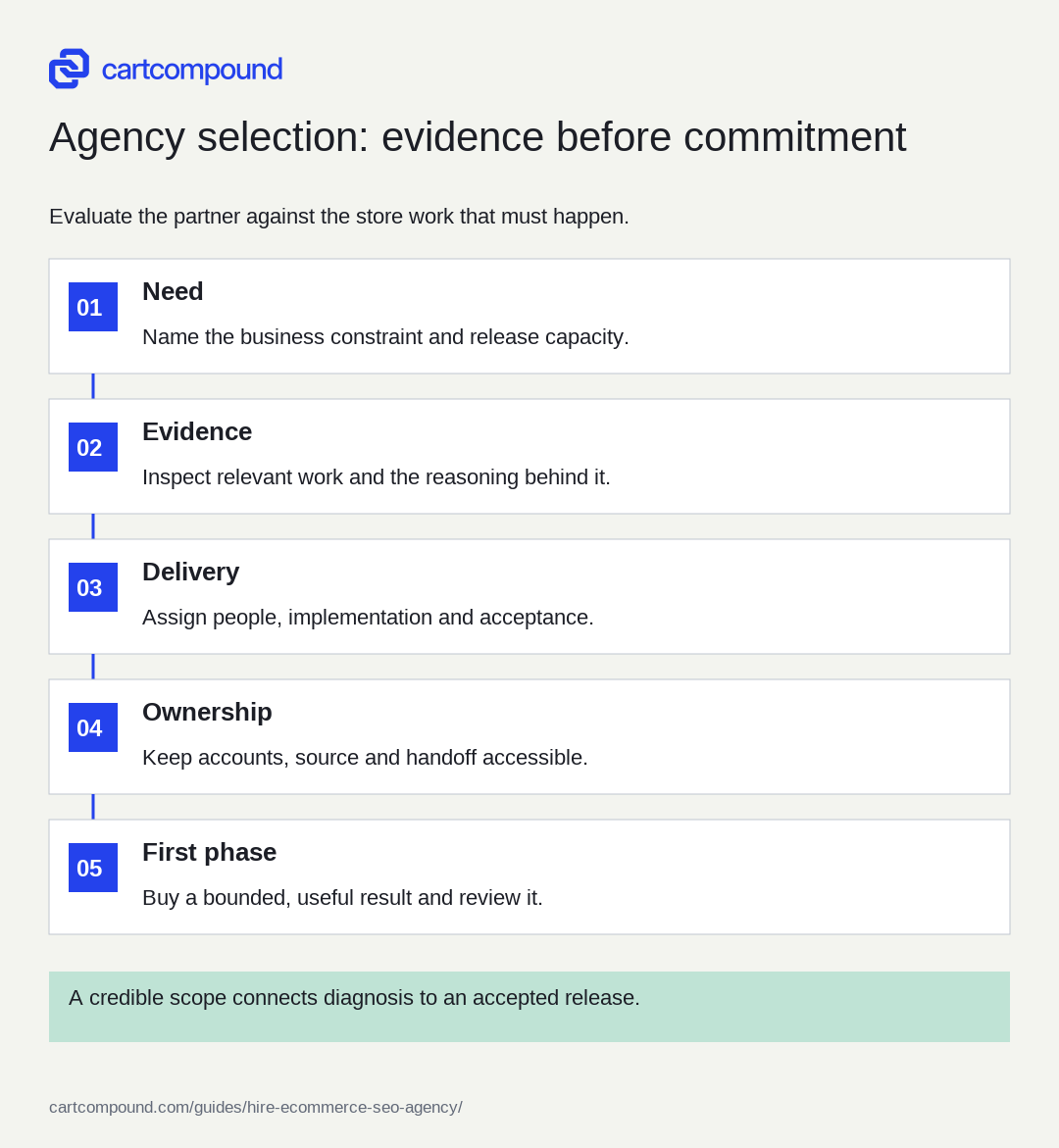
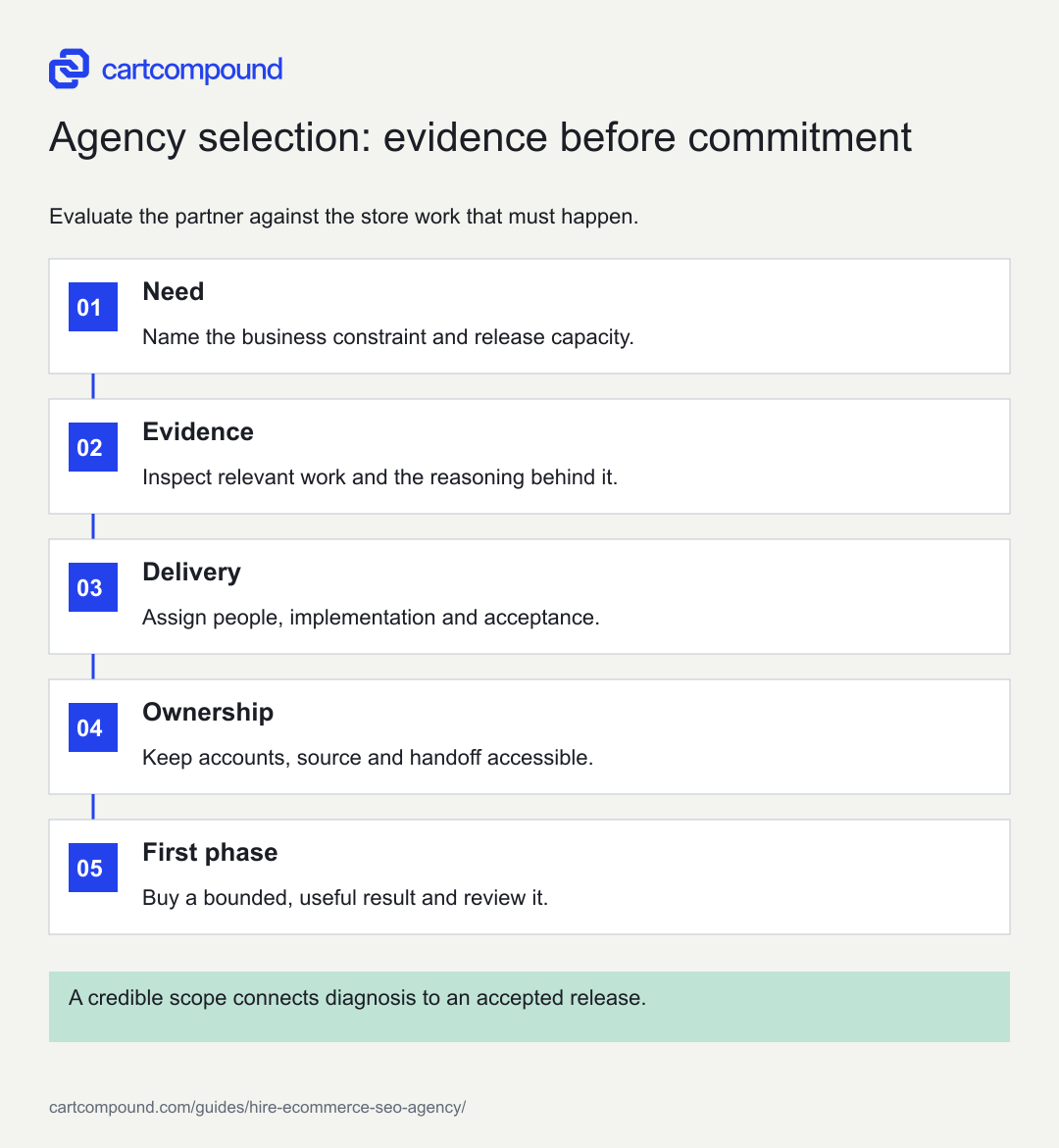
Agency selection: evidence before commitment
Evaluate the partner against the store work that must happen.
- NeedName the business constraint and release capacity.
- EvidenceInspect relevant work and the reasoning behind it.
- DeliveryAssign people, implementation and acceptance.
- OwnershipKeep accounts, source and handoff accessible.
- First phaseBuy a bounded, useful result and review it.
A credible scope connects diagnosis to an accepted release.
Use the steps with your store data. Examples in this guide are illustrative unless a source is named.
Interview for reasoning and ecommerce judgment
A capable agency should ask about margins, stock, buyers, competitors, and the way work gets released. Google's guidance on hiring an SEO recommends discussing experience, expected results, measurement, communication, and references, and warns against guaranteed top rankings. Use that guidance as a starting point, then make the conversation specific to your storefront.
Ask the candidate to describe a diagnosis they revised after inspecting evidence. What did they first suspect? Which observation changed their view? What did they avoid changing? This reveals more than a polished claim about a proprietary process. For ecommerce, ask how they handle discontinued products, variants, filters, international catalogs, and links from guides to products. They should be able to explain tradeoffs in plain language without pretending every store needs the same treatment.
Ask who actually does the work. Identify the strategist, editor, technical implementer, and reviewer, including any subcontractors. Clarify senior involvement after the sale, response expectations, and cover during absence. A named lead is useful only if that person has time and authority to move the work forward. Evaluate whether you can understand their recommendations well enough to make an informed business decision.
Examine evidence without turning a case study into proof
A case study should identify the starting condition, scope, timeframe, changes, and outcome definition. Ask whether reported revenue includes branded demand, promotions, stock recovery, or paid activity. Look for a baseline and disclosure of other changes. A traffic chart can show a trend, but it cannot prove that one agency action caused the whole increase. Do not demand confidential customer data; a redacted example or reference conversation can still establish how the agency works.
Inspect a real deliverable. For a technical agency, look for reproducible issues, proposed fixes, and retest results. For content work, ask for a brief, source evidence, editing process, and finished page. For implementation, inspect how acceptance and rollback were documented. Screenshots of tool scores are much less useful when the underlying problem and release cannot be explained.
References should answer operational questions: were changes documented, did the team meet commitments, how were disagreements handled, and what remained difficult? Ask permission to contact a reference through the offered route. Evaluate the match to your situation. Experience with a large catalog can matter, but a large brand name alone does not show that the candidate handled the same platform, constraints, or delivery responsibility.
Compare proposals with a decision table
On a small screen, swipe the table to see every column.
| Criterion | Evidence to request | Warning sign |
|---|---|---|
| Diagnosis | Specific questions and a bounded first investigation | Same fixed plan for every catalog |
| Execution | Named owner for each implementation step | Recommendations have no release path |
| Content quality | Brief, source checks and editorial acceptance | Only a word or article quota |
| Measurement | Baseline, revenue definition and limitations | Guaranteed ranking or revenue claim |
| Ownership | Accounts and deliverables remain accessible | Supplier-controlled access or unclear IP |
| Exit | Export, documentation and transition scope | Handoff is undefined or punitive |
Give each criterion a simple written judgment: meets the need, unresolved, or does not meet the need. Avoid turning a subjective scoring system into false precision. If technical execution is essential, make it a required condition rather than allowing excellent presentation skills to average away its absence. Keep notes tied to evidence so a colleague can understand the selection.
Normalize price to scope. Compare the same period, implementation allowance, editorial volume, review depth, and meeting expectations. Note optional tool charges and work billed separately. A lower monthly fee can cost more when it excludes the activity that removes the main bottleneck. Equally, a large retainer may be unnecessary if the immediate requirement is a focused migration review with clear acceptance criteria.
Write delivery and ownership into the agreement
Describe deliverables in inspectable terms. A category improvement should name the affected templates or page group, evidence requirements, content approval, implementation ownership, and acceptance checks. A content program should specify product fact verification, source handling, image rights, originality review, and maintenance responsibilities. Article quantity alone cannot define quality.
Clarify what requires approval and who can authorize live changes. Set a change log, version control or equivalent release record, testing expectations, and rollback method. Ask how the team handles a discovered checkout issue, an accidental noindex change, or conflicting product facts. Urgent work needs a practical escalation route, not a vague promise to be proactive. The supplier should also explain what they are not equipped to fix.
Review commercial terms with the appropriate business or legal owner. Resolve minimum term, notice, billing timing, pause arrangements, work ownership, subcontracting, data access, confidentiality, and exit assistance. Record the tools and documents that must be transferred at the end. The goal is a relationship that can continue because it works and can end without losing institutional knowledge. This is operational procurement guidance; the enforceability of specific contract language requires jurisdiction-appropriate review.
Plan the first phase around decisions and release capacity
A useful initial phase establishes measurement, investigates the main constraint, and delivers a small amount of completed work. For example, a store with unclear collection performance might reconcile organic reporting, inspect one representative category, implement a bounded change, and document the result. Another store approaching migration may need URL mapping, staging checks, and launch QA first. Do not require the same first-month activity from both.
Agree on a plan with dependencies. If product experts must approve claims, put their review dates on the schedule. If a developer has only a few hours available, prioritize work that can be safely delivered within that capacity. Ask the agency to show how new discoveries change the backlog. A reasonable plan can adapt, but each change should explain the evidence and the tradeoff.
Set separate checks for delivery and commercial outcomes. The agency can commit to completing a scoped investigation and accepted release. Search visibility and sales depend on additional factors and should be forecast as uncertain. Use milestones such as verified issue, approved solution, completed implementation, and observed result. This prevents a delay on your side from being disguised as completed value while also avoiding promises the supplier cannot control.
Resolve a stalled implementation before renewing
A review can reveal that the agency produced accurate recommendations but the store could not release them. Treat this as a delivery-system problem. List the blocked items, required skills, approval owner, and estimated release capacity. Decide whether to purchase implementation, reduce the recommendation scope, or pause work that would only enlarge the queue.
Do the same when the bottleneck is product evidence. If writers repeatedly wait for specifications or claim approval, assign a product reviewer and a source process before increasing article volume. More output is not a remedy for an unresolved dependency. Ask the agency to price and schedule the work the business can actually approve and implement.
At renewal, inspect a sample of completed releases rather than only the backlog and meeting notes. Confirm what reached customers, what passed QA, and what remains uncertain. A clear account of blocked work can support a constructive scope change. It should not be quietly represented as delivered commercial value.
Make the hiring decision and retain an exit path
Before signing, assemble the proposal, scope, unresolved questions, reference notes, sample deliverable, access plan, and full expected cost. Choose the candidate who can address the actual constraint with a credible path to implementation. If all proposals remain vague, narrow the brief and purchase a bounded diagnostic rather than extending the sales process indefinitely.
Schedule a review of the first completed work. Check whether the original issue is reproducible, the fix was implemented as agreed, and the retest actually supports acceptance. Review communication and internal workload as well as search metrics. If your team spends more time correcting unsupported product claims than using the output, that is a delivery problem even when the article count is on target.
The next action is to write the one-page brief and send the same evaluation questions to your shortlist through your approved procurement process. Keep account ownership and working documentation under the business's control from the beginning. At renewal, review what was shipped, what was learned, what remains blocked, and whether the next scope still fits the store's priorities.
Your action checklist
Use this to decide what to do next. Your checks stay on this page and are not sent or saved.
0 of 8 checked
Common questions
Should I hire an agency or a freelancer?
Choose around the work and coordination required. A specialist can suit a focused problem. A broader team may help when strategy, editing, development, and measurement must move together. Verify who owns each dependency in either arrangement.
How many months should the first contract cover?
There is no universal term. Match the initial commitment to the diagnosis, implementation cycle, and review horizon. Include a useful handoff and clarify what happens if the needed internal resources are unavailable.
Is an audit enough?
An audit is useful when it leads to decisions and implementation. Ask who will make the changes, how they will be tested, and what the audit includes if another team must deliver them.
Sources and review
Source documentation checked October 27, 2026. Platform features and interfaces can change. The recommendations and illustrative examples explain how to make the decision; they do not promise results.
- Do you need an SEO?
Google hiring guidance, references, communication, expected outcomes and ranking-guarantee warning.
Talk through your store question
Bring one problem you want to solve.
A free 20-minute call with Hamid can help you decide what to investigate next.
Book a free 20-minute call
About the author
Hamid Khan
Hamid co-founded CartCompound and works with ecommerce founders on their stores and growth priorities.
Profile and guides