The short answer
Inventory the URLs your filters generate, then choose a small, deliberate set of search landing pages. Use crawl controls for unneeded combinations and keep valuable destinations accessible through stable links. Canonical tags, noindex and robots rules solve different problems, so test each treatment against the intended outcome.
Separate the shopping interface from the search architecture
Facets let customers narrow an assortment by attributes such as size, material, compatibility or price. That shopping function can be valuable even when the resulting address should never become a search landing page. The SEO decision is about which combinations deserve discovery, crawling and indexing. Treating those three stages as interchangeable leads to rules that look tidy in a spreadsheet but damage the actual site.
Start with a route map: unfiltered category, one-filter state, multiple-filter state, sort state, pagination and empty result. Record whether each changes the URL, whether the order of selections changes the address and whether removing a selection creates another variant. Google describes how parameter-based facets can generate extremely large URL spaces in Managing crawling of faceted navigation URLs. The risk grows with combinations, not merely the number of visible filter controls.
Keep customer requirements explicit. Customers may need to share a filtered result or return to it from the back button. Those requirements affect the interface design but do not require every state to be indexed. Decide the desired user behavior first, then define the small set of destinations that deserve search visibility and the technical controls for everything else.
Inventory the URL space before adding rules
Use a representative category with realistic products. Apply filters in different orders, choose and remove several values, change sorting and move through later pages. Save the generated addresses and inspect their response and canonical behavior. Repeat on a category with different attributes because a global rule based on one product type may miss another parameter convention.
Create columns for parameter name, allowed values, order sensitivity, duplicate forms, visible content change and current index state. Distinguish descriptive filters from session, tracking and interface parameters. Check whether invalid combinations are normalized or continue creating new addresses. Search Console samples and a crawler can reveal patterns, but neither should be assumed to enumerate an unlimited space completely.
An illustrative store offers 8 colors, 6 sizes and 5 materials. Selecting exactly one value from each already permits 240 combinations, before price ranges, sorting or pagination. That arithmetic is a simple illustration, not a count of useful search pages. Many combinations may have no stock, overlap heavily or lack a distinct shopping purpose. The inventory makes the scale understandable and helps engineers test the actual parameter grammar rather than copying a rule from another platform.
 Keep this framework
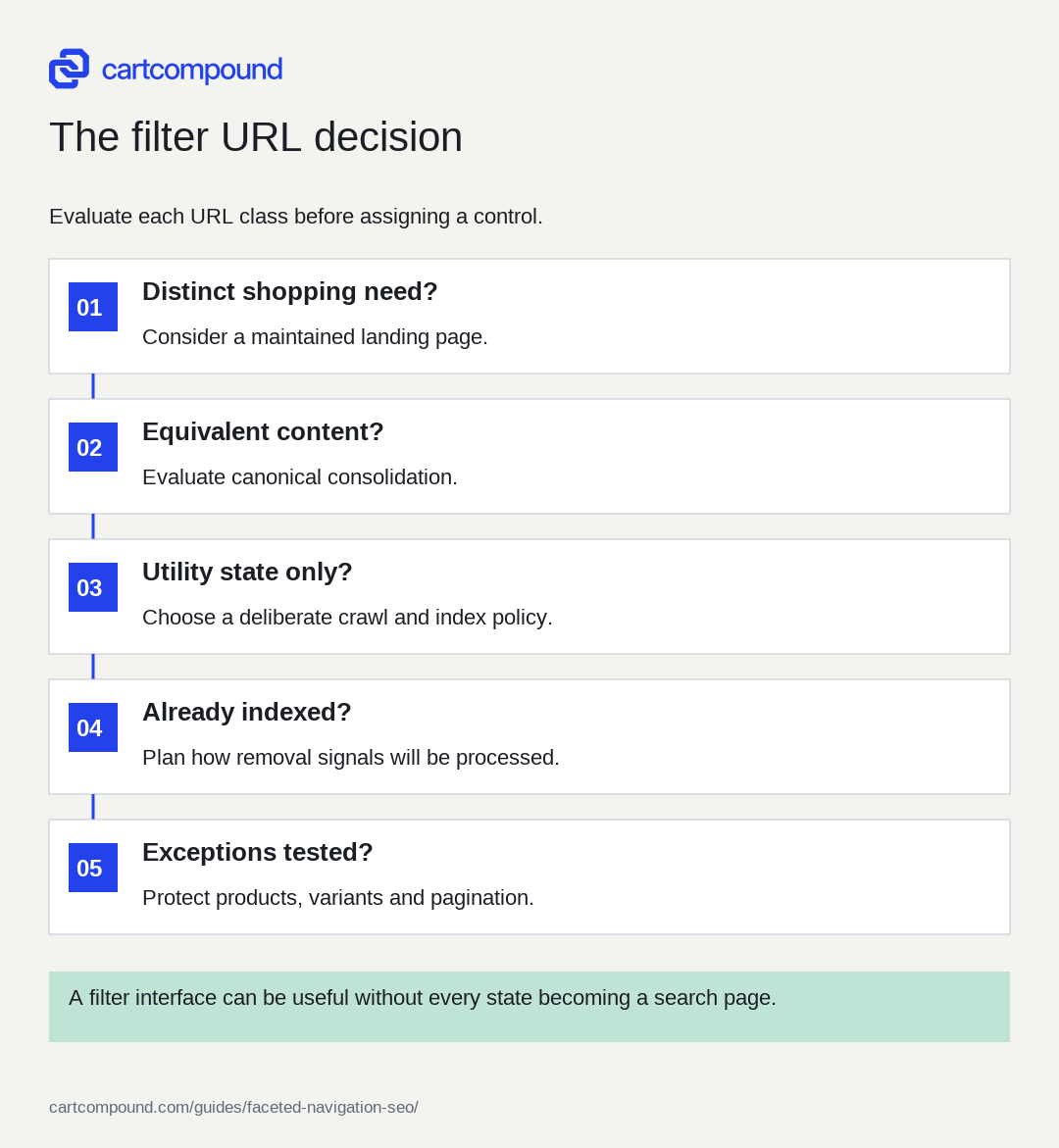
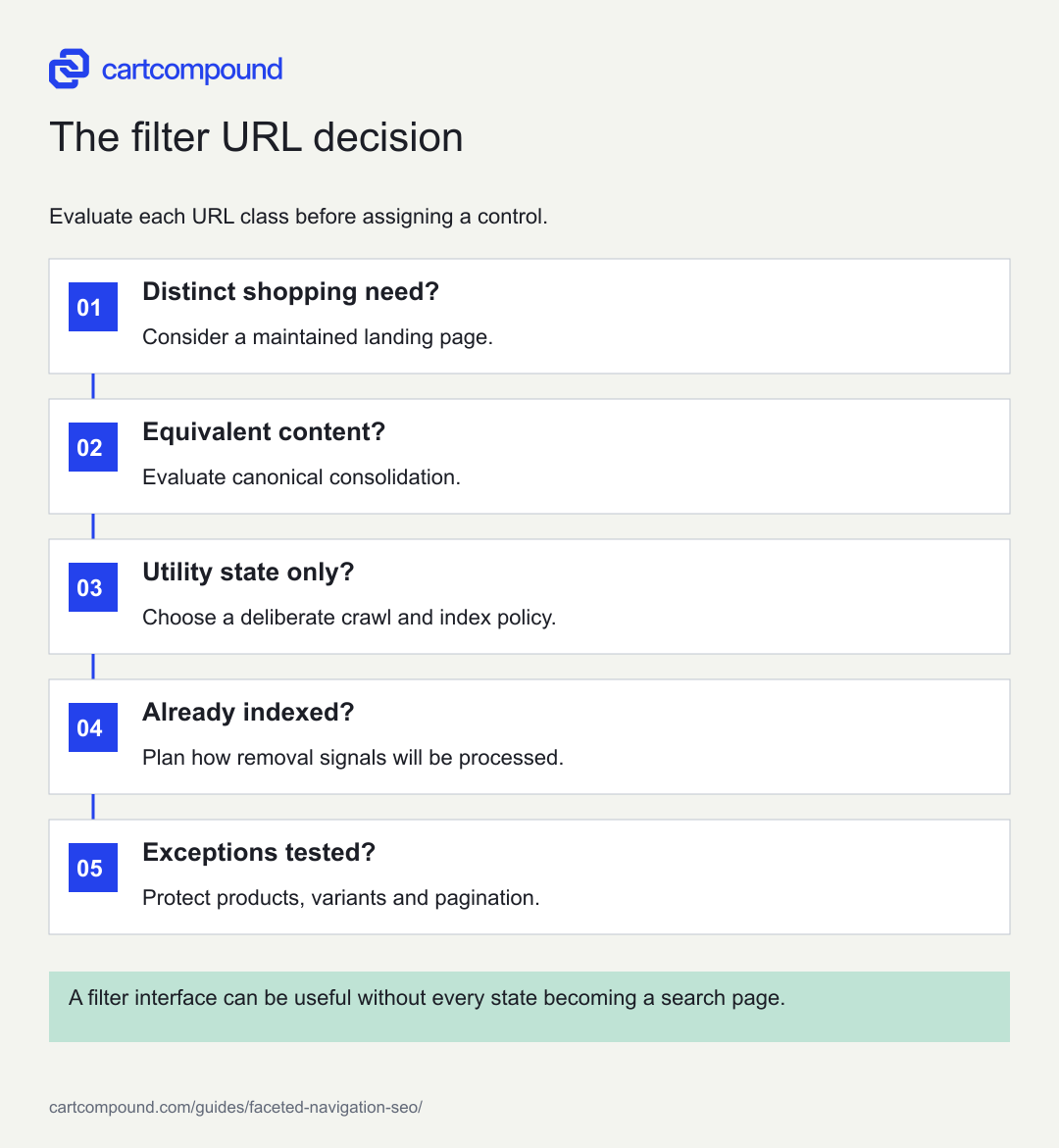
The filter URL decision
Evaluate each URL class before assigning a control.
- Distinct shopping need?Consider a maintained landing page.
- Equivalent content?Evaluate canonical consolidation.
- Utility state only?Choose a deliberate crawl and index policy.
- Already indexed?Plan how removal signals will be processed.
- Exceptions tested?Protect products, variants and pagination.
A filter interface can be useful without every state becoming a search page.
Use the steps with your store data. Examples in this guide are illustrative unless a source is named.
Choose which combinations deserve a destination
Evaluate a prospective landing page against five practical questions: does the need recur, is the constraint meaningful, does the store have a relevant assortment, can the URL remain stable and can someone maintain the promise? Search results, store queries and customer questions provide qualitative evidence. Existing impressions can strengthen the case, but a page does not become useful merely because a keyword tool lists a phrase.
A curated 'wide hiking boots' category may justify a separate destination if width is a normalized attribute and the assortment supports comparison. 'Wide hiking boots, olive, size 11, sorted by discount' is usually a temporary state rather than an enduring entry point. Exceptions are possible, but they require evidence and maintenance capacity. Keep the decision at the shopping-task level.
Use an allowlist of approved landing pages with owner, parent category, inclusion rule and review trigger. Provide normal incoming links and relevant explanatory content. A dedicated collection can be easier to govern than trying to make selected parameter combinations indexable within an otherwise blocked pattern. The implementation choice depends on the platform, but the editorial standard is the same: the page should answer a distinct need with products that actually satisfy it.
Choose controls according to the outcome you need
Robots rules regulate crawling. A noindex directive regulates indexing when the crawler can retrieve and read it. A canonical indicates a representative page for duplicate or very similar content. These are different jobs. Blocking a URL before Google can read its noindex or canonical can prevent the intended page-level instruction from being processed. Write the required outcome before selecting the control.
For filter URLs with no search purpose, Google's faceted navigation guidance discusses robots disallow rules and fragment-based filtering as options to prevent unnecessary crawling. It also explains that canonical and nofollow approaches can be less effective crawl controls. Do not copy a broad rule without testing which valuable addresses match it. A product feed or a selected variant may use parameters for a different reason.
On a small screen, swipe the table to see every column.
| Goal | Control to evaluate | Key limitation |
|---|---|---|
| Reduce crawling of unneeded filters | Targeted robots rule or different interface URL design | Must not match needed product or landing URLs |
| Exclude a crawlable utility page from search | Noindex | Requires access to read the directive |
| Consolidate near-identical representations | Canonical | A signal, not a crawl stop or guarantee |
| Retire an actual duplicate destination | Relevant permanent redirect | Must preserve the intended customer task |
Handle empty combinations, ordering and pagination
Define one consistent representation for equivalent combinations. If 'red then medium' and 'medium then red' create two equivalent URLs, normalize ordering rather than inviting every sequence to become another discovery path. Keep separators conventional and reject nonsensical combinations. Google's faceted guidance recommends consistent ordering and a 404 for combinations with no results rather than redirecting every empty state to a generic page.
A helpful empty-state interface can still explain the problem, show removable selections and link back to a useful category while returning the appropriate response. Do not confuse the HTTP status with the quality of the error design. Shoppers need recovery options, and crawlers need an honest representation of the missing result set.
Pagination deserves its own tests. Later pages of a valid category expose different products; a filter rule should not accidentally remove their only discovery path. Google's Pagination and incremental page loading explains discoverable sequences and separate page URLs. Test unfiltered later pages as well as approved filtered destinations. If a filter state has only one page of products, requests for impossible later pages should not produce endless empty successes.
Plan a transition for URLs already known to Google
A new store can implement the intended architecture before large numbers of filter URLs are discovered. An established store needs a transition plan. Identify which filter destinations currently receive traffic, have meaningful external links or support campaigns. Review them before introducing a rule that blocks the entire parameter family.
If previously indexed URLs should be removed, select the appropriate mechanism and allow required signals to be processed. Do not assume a robots disallow instantly deletes a URL from search. Coordinate the sequence of cleanup, page-level directives where appropriate and longer-term crawl control with the implementer. Keep valuable landing pages outside broad blocks or provide explicit, tested exceptions.
Inspect canonicals only where equivalence makes sense. A narrow, useful category is not necessarily a duplicate of the broad parent just because it shares some products. Google's How to specify a canonical URL is about duplicate or very similar pages. Using a parent canonical as a universal disposal bin can conflict with the decision to build a distinct landing page. Document the intended status of each approved destination so future theme changes do not silently reverse it.
Use a release test matrix instead of a single URL check
Prepare examples before changing rules: plain category, approved narrow category, one unneeded filter, multiple filters, tracking parameter, variant parameter, page two, empty result and invalid value. Test each against the proposed configuration. Include order variations and encoded characters if the platform accepts them. A rule is ready only when these examples behave as intended.
For an illustrative footwear store, the wide-boots collection stays crawlable and linked from the parent. Utility combinations using price and sort parameters are controlled separately. Variant selection links on product pages continue working. The acceptance record contains each example, expected crawl permission, expected index treatment and actual result. This lets reviewers see the business consequences of a compact technical rule.
Retest the shopping interface as well. Back navigation, shared filtered links, zero-result recovery and screen-reader labels can break during URL normalization. Ask the engineer to verify both the request behavior and the rendered page. The SEO release should not pass merely because a testing tool reports that one filter URL is blocked.
Monitor whether the system stays bounded
After release, monitor representative crawl patterns, Search Console exclusion reasons and the discovery of new products. If server logs are available, compare requests to approved pages and unwanted patterns over a comparable period. Verify crawler identity before interpreting bot behavior. A smaller known-URL count alone is not proof that valuable products became easier to discover.
Keep an inventory-change review. New filters, renamed attributes and app updates can introduce a second parameter convention or bypass existing rules. An allowlist also needs maintenance when stock disappears or a shopping need changes. Review whether approved destinations still have relevant products and whether their incoming links remain useful.
The next action is to build the nine-example release matrix for one category and name its approved landing pages. Do that before writing a robots rule. The resulting plan should explain the intended shopping behavior, each URL class, its control and the verification method. This turns faceted navigation from an emergency cleanup into a governed part of the catalog, with exceptions that can be reviewed instead of guessed.
Your action checklist
Use this to decide what to do next. Your checks stay on this page and are not sent or saved.
0 of 6 checked
Common questions
Does a canonical stop Google crawling filters?
No. It communicates a representative page, and Google still needs to discover and process it. Use the dedicated faceted-navigation guidance when the actual goal is controlling unnecessary crawling.
Can I block URLs that already appear in search?
A block alone is not an instant removal mechanism. Plan how the relevant removal or page-level signals will be processed before introducing longer-term crawl restrictions.
Should I use URL fragments for filters?
They can be appropriate when filter states do not need search discovery, but the interface still needs sharing, history and accessibility checks. Do not use fragments for product variants that must be individually accessible to product systems.
Sources and review
Source documentation checked October 27, 2026. Platform features and interfaces can change. The recommendations and illustrative examples explain how to make the decision; they do not promise results.
- Managing crawling of faceted navigation URLs
Crawl control options and consistent handling of empty or nonsensical filters. - Pagination and incremental page loading
Discoverable paginated URLs and distinct canonical pages in sequences. - How to specify a canonical URL
Canonical signals, consistent internal links, and limits of canonical declarations.
Talk through your store question
Bring one problem you want to solve.
A free 20-minute call with Hamid can help you decide what to investigate next.
Book a free 20-minute call
About the author
Hamid Khan
Hamid co-founded CartCompound and works with ecommerce founders on their stores and growth priorities.
Profile and guides