The short answer
Deliver what the signup promised, help the subscriber make one useful product decision, and adapt later messages when a purchase occurs. Verify confirmed entry, suppression and offer terms before launch. The number of emails and timing should follow the signup context and purchase process, not a universal template.
Start with the promise made at signup
Copy the actual signup wording into the welcome-series brief. A person requesting a sizing guide, a discount, launch notifications or a regular newsletter has different immediate expectations. The first message should fulfill that expectation before introducing a broader sequence. If several forms promise different things, preserve the source or preference needed to deliver the correct response.
Audit the path from form submission to confirmation, list membership and first message. A “thanks for joining” page does not prove the email was sent or that the right consent state was recorded. Check the visible promise on desktop and mobile, including any eligibility, expiry or minimum purchase terms. If the form and email disagree, correct the promise or the fulfillment before optimizing subject lines. The welcome flow is the first practical test of whether the brand does what it says, so a broken download or unusable code deserves higher priority than decorative design.
Define entry and permission explicitly
Document which event starts the sequence and what permission it represents. A purchase, imported customer record or checkout email address should not automatically be treated as a new marketing subscription. Keep the source, timestamp and channel permission where the team can inspect them. Use the relevant owner to review applicable requirements instead of assuming one platform setting resolves every regional obligation.
Klaviyo's welcome-series guide describes list entry and the double-opt-in sequence, where confirmation precedes list addition and the welcome flow. If your platform uses a different model, verify that model rather than copying labels. Test new signup, unconfirmed signup, existing subscriber, unsubscribed profile and resubscription separately. Each can behave differently. Be particularly careful with imports and manual list additions, since they can trigger messages unexpectedly if the team assumes only website forms create entrants.
 Keep this framework
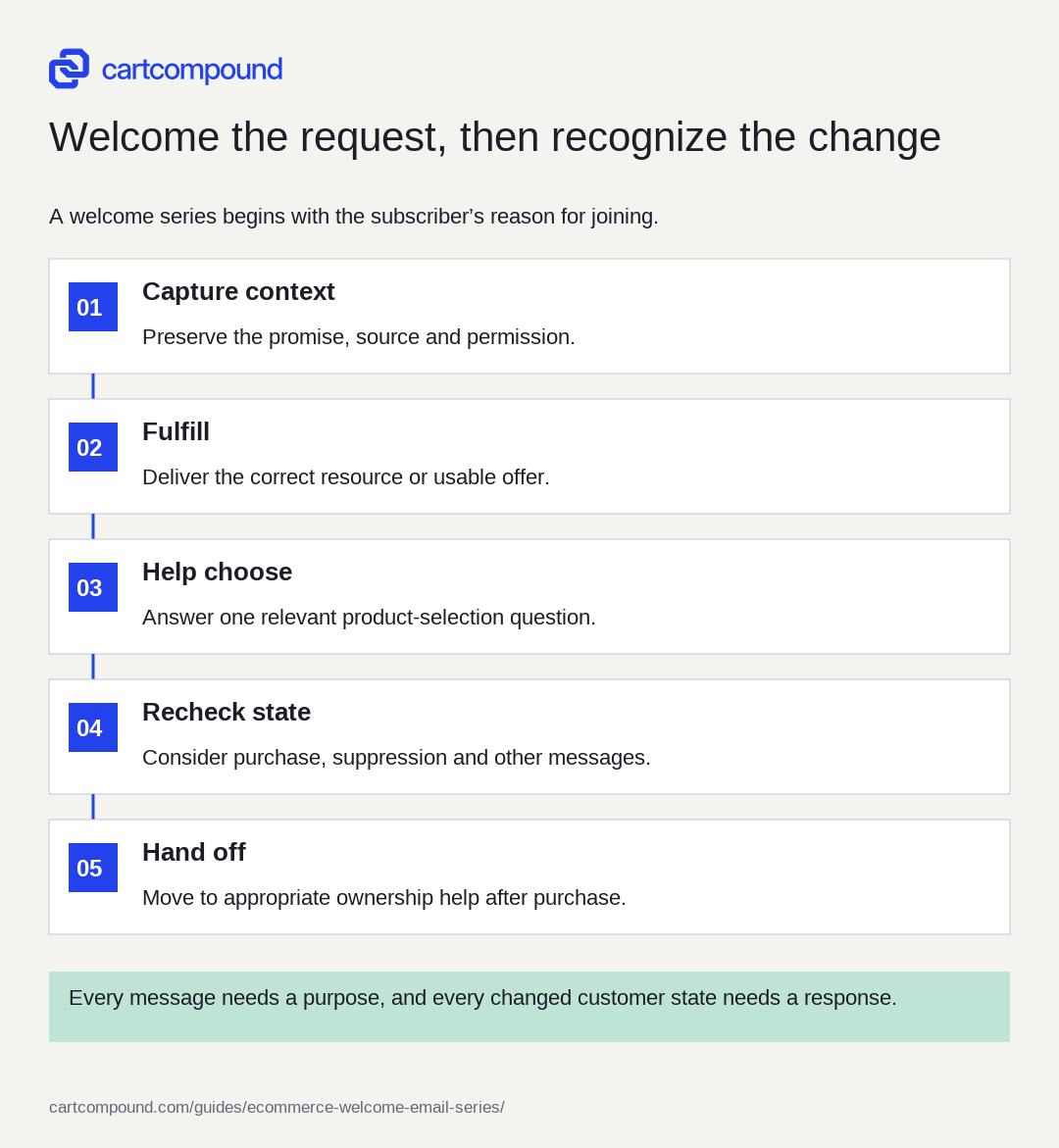
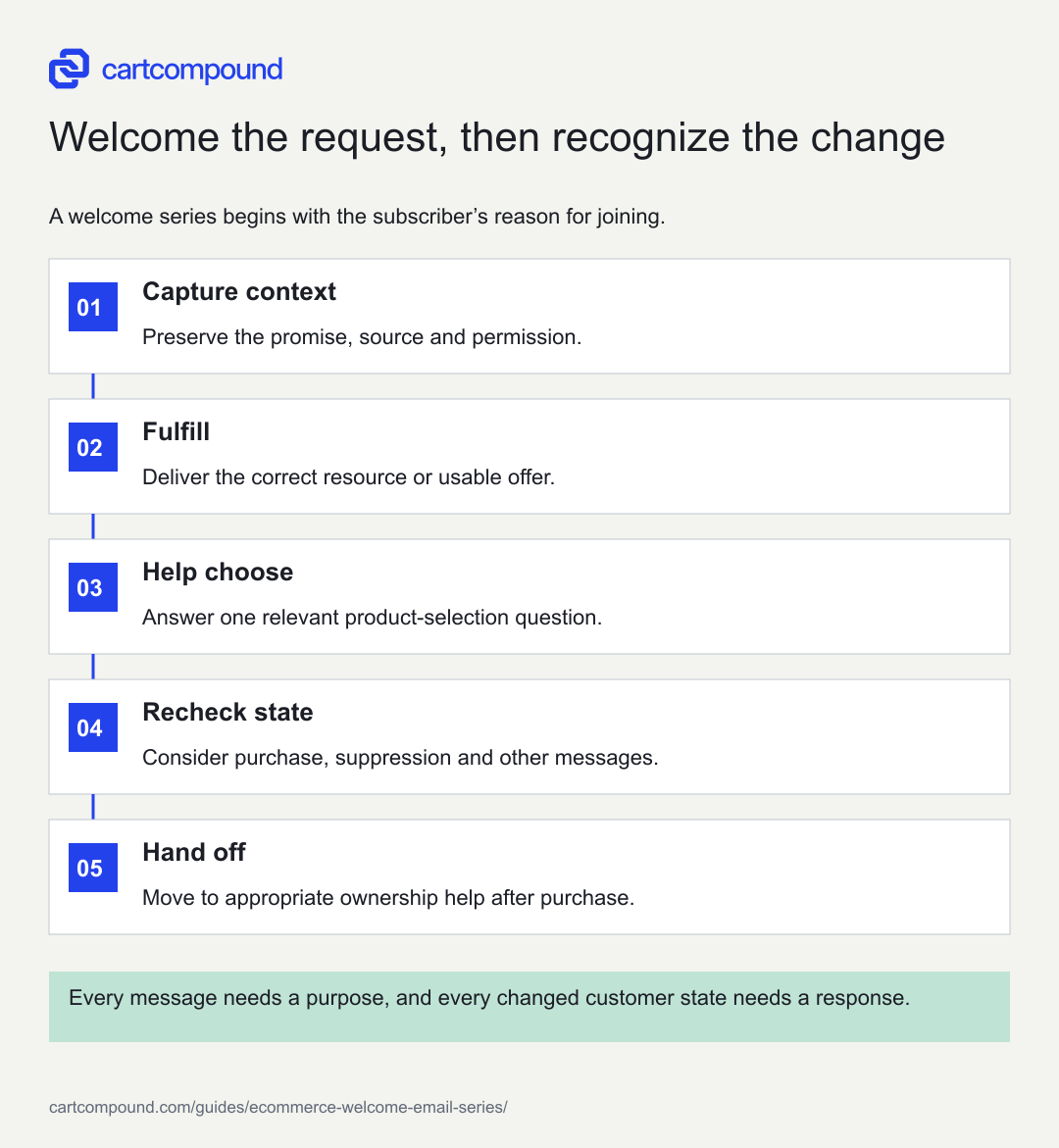
Welcome the request, then recognize the change
A welcome series begins with the subscriber’s reason for joining.
- Capture contextPreserve the promise, source and permission.
- FulfillDeliver the correct resource or usable offer.
- Help chooseAnswer one relevant product-selection question.
- Recheck stateConsider purchase, suppression and other messages.
- Hand offMove to appropriate ownership help after purchase.
Every message needs a purpose, and every changed customer state needs a response.
Use the steps with your store data. Examples in this guide are illustrative unless a source is named.
Give every message a different job
A useful initial sequence might contain fulfillment, product-choice help and an answer to a major purchase objection. These are jobs, not mandatory email counts. The first message delivers the promised guide or offer. A second can help select the right product family, size or material. A third can explain verified delivery, return or compatibility information that commonly blocks a decision.
Write a one-sentence purpose for each message before drafting it. “Introduce our story” is only useful if the story provides evidence relevant to the subscriber's choice. Keep each message focused enough that a phone reader can identify the next action quickly. If no new question is answered, remove the step. Do not add manufactured urgency simply because the sequence is ending. A real offer deadline can be explained accurately, but an evergreen sequence should not pretend that a unique opportunity is disappearing when it will be offered again tomorrow.
Map the journey as a worksheet
On a small screen, swipe the table to see every column.
| Stage | Subscriber need | Content and rule |
|---|---|---|
| Promise fulfillment | Get the requested resource or offer | Correct link or code with real terms |
| Product orientation | Know where to start | One useful choice framework |
| Objection resolution | Understand a material buying constraint | Verified sizing, delivery or returns explanation |
| Purchase handoff | Receive relevant ownership help | Stop prospect-only messages and enter the appropriate journey |
Add timing, eligibility, supporting evidence and an owner beside each row in the working version. Identify whether the message applies to both previous customers and new prospects. A returning customer who signs up for a guide does not need to be told they have never purchased. Keep personalization conditional on reliable data. If the platform cannot verify a purchase state or preference, use accurate general wording rather than pretending to know the person's situation.
Branch after purchase instead of treating everyone alike
A purchase changes the recipient's needs. A prospect-only coupon reminder can become confusing after an order, especially if it implies the customer should have waited. Decide which welcome messages should stop and which useful resource messages can still be delivered. Do not apply one broad purchase-exclusion rule without considering whether it prevents fulfillment of the original signup promise.
Klaviyo's trigger and filter documentation distinguishes entry conditions from profile conditions checked around flow actions. Use the platform's supported logic to express the intended behavior, and test the exact sequence. A customer can subscribe, start checkout, buy and unsubscribe while messages are waiting. Your flow must react to those changes where appropriate. Keep essential order communications owned separately so a welcome-series filter cannot accidentally prevent a receipt or shipping update from reaching the customer.
Work through two signup contexts
Consider an illustrative skincare store with a “find your routine” guide and a separate first-order discount form. The guide subscriber has asked for selection help; the offer subscriber has asked for usable offer terms. Sending the same first email to both can disappoint one group. The store does not need two large independent programs if it can preserve signup context and deliver the appropriate first content.
For the guide path, deliver the guide and explain how to choose among supported product types without inventing medical claims. For the offer path, provide the code, exclusions and redemption route. A later message can share a common product-choice framework if relevant to both groups. If the person has already ordered, replace prospect-only urgency with appropriate use or care information where permission allows. The point is not endless personalization. It is preserving the concrete reason the person entrusted the store with an email address.
Coordinate welcome, abandonment and campaigns
Create a simple message-priority policy. Transactional notifications, requested resources, checkout recovery, onboarding and general promotions can otherwise compete. Decide how close together discretionary messages may arrive and which journeys should pause or skip when a more relevant action occurs. A platform's frequency setting may help, but verify what it counts and what it skips in your configuration.
Inspect a test profile's complete message history, not just the welcome flow. One platform may contain a correct sequence while a native store automation sends additional emails. Document ownership and overlaps. Avoid solving pressure by silently skipping the email that delivers the promised resource or code. The subscriber should still receive what they requested. Where the platform's global settings create conflicts, adjust the specific workflow design and test the customer outcome rather than assuming a default “smart” setting understands your business priorities.
Test content, offers and accessibility together
Preview long names, missing names, multiple currencies, unavailable products and absent preference data. Use a sensible fallback greeting. Check the resource URL and product links on a phone, including the destination after redirects. Confirm important information remains understandable with images blocked and that the message is not one large image. Use readable text, descriptive links and sufficient contrast.
Test offer mechanics in the actual supported checkout environment with approved test orders. Check minimum spend, exclusions, first-order qualification, stacking and expiry against the visible email terms. A code that technically works for the wrong audience can be as problematic as a broken code. Record who owns the promotion and how it will be retired. If using unique codes or dynamic blocks, test what happens when generation fails or a field is missing. The fallback should not make a promise the store cannot fulfill.
Measure the full entry-to-purchase path
Track form submissions, confirmations where applicable, eligible flow entrants, successful first-message delivery, resource or offer clicks, validated purchases and harm signals such as complaints or unsubscribes. Keep the denominators clear. A low flow-entry rate may reflect confirmation friction or incorrect form routing rather than weak welcome copy. Investigate the path before changing the email sequence.
Email opens are imperfect evidence of human attention, and platform-attributed orders are not automatically incremental. Use clicks, verified downstream actions and customer feedback together. Compare cohorts by signup source because a discount-focused form and an educational guide can attract different intent. Do not declare one series superior using a handful of purchases or revenue per recipient alone. Include discount cost, contribution and customer quality where the data supports those measures. The welcome flow should create a useful relationship, not merely assign revenue to messages that happened to precede an order.
Handle existing customers and multiple signup promises
A subscriber can be a first-time prospect, an existing customer who has never subscribed or a previous subscriber returning for a different resource. Keep the requested fulfillment separate from assumptions about purchase history. An existing customer requesting a care guide should receive the guide where appropriate, but not a message falsely introducing them as someone who has never tried the product. Preserve enough context to use accurate wording without building a complex profile from unreliable clues.
Create an approved test profile that signs up through two forms with different promises. Verify whether the person receives both requested resources, enters the welcome sequence once or twice, and inherits the correct permission state. Test the reverse order as well. A list-based entry rule can behave differently from an event-based resource delivery rule. Do not assume resubmitting a form retriggers the entire welcome flow. Use the platform's documented behavior and an explicit design for resource requests so fulfillment does not depend on an unintended reentry loophole.
Review incentive eligibility for existing customers. If the form advertises a first-order offer, make the restriction visible before submission and confirm that checkout enforces it consistently. Do not tell a previous buyer that the code is usable and then reject it without explanation. If that audience needs another signup reason, offer a genuine resource or preference choice rather than silently changing the promotion. Keep the offer owner and signup owner aligned whenever terms change. This scenario review gives the flow a more reliable foundation than treating every email address as a new prospect, and it prevents a welcome program from creating avoidable support work through contradictory promises.
Launch the smallest complete sequence
Release a short sequence after entry, suppression, promise fulfillment, purchase behavior and overlap tests pass. Record the audience, source rules, message purposes, offer terms and handoff behavior. Review actual recipient activity shortly after release, including skipped messages and failed links. Assign a person to maintain the flow after signup forms, promotions, products or platform integrations change.
For the next work session, choose one signup promise and follow it from mobile form to the first useful action. Fix any mismatch before adding later messages. Then write the purpose and exit condition of each remaining step. A well-maintained welcome series can be brief. Its strength comes from fulfilling the specific request, providing relevant help and recognizing when the subscriber's situation has changed, including when they have already bought or no longer want marketing messages.
Your action checklist
Use this to decide what to do next. Your checks stay on this page and are not sent or saved.
0 of 5 checked
Common questions
How many welcome emails should I send?
Use as many as you need to fulfill the promise and answer distinct buying questions without unnecessary pressure. Start with a short sequence and add steps only when they perform a clear job.
Should purchasers leave the welcome flow?
Stop prospect-only content when appropriate, but preserve fulfillment of requested resources. Define the behavior message by message and test the purchase handoff.
Why are new signups missing from the flow?
Check confirmation requirements, form routing, list membership, suppressions and trigger behavior before changing the copy or adding contacts manually.
Sources and review
Source documentation checked October 27, 2026. Platform features and interfaces can change. The recommendations and illustrative examples explain how to make the decision; they do not promise results.
- How to create an email welcome series
List entry, opt-in confirmation and welcome-flow concepts. - Understanding flow triggers and filters
Entry versus action-time profile checks. - Email sender guidelines
Wanted messages, clear sender identity and accurate message content.
Talk through your store question
Bring one problem you want to solve.
A free 20-minute call with Hamid can help you decide what to investigate next.
Book a free 20-minute call
About the author
Hamid Khan
Hamid co-founded CartCompound and works with ecommerce founders on their stores and growth priorities.
Profile and guides