The short answer
Define the order population, lookback period and monetary basis first. Calculate days since the last qualifying order, distinct qualifying orders and comparable spend for each customer. Choose transparent thresholds suited to the purchase cycle, then combine RFM with permission and current customer state before taking action.
Start with a customer decision
RFM summarizes purchasing history using recency, frequency and monetary value. It can help distinguish recent first-time buyers, established repeat customers and previously valuable customers who have not returned. It does not explain why a person bought, whether they are profitable or whether they want marketing. Begin with the action you want to improve, such as selecting a useful replenishment audience or reducing indiscriminate discounts.
Avoid creating dozens of segments without an operating plan. Choose a few groups that need different treatment and define what will change for each. If every segment receives the same promotion, the scoring work has not yet created much practical value. Keep purchase behavior separate from email engagement and consent. A frequent buyer can be unsubscribed, and a new subscriber can have no purchase history. Those conditions should not be forced into the same score or assumed to authorize the same communication.
Define qualifying orders and the analysis window
Decide which records count before calculating anything. Specify treatment of test orders, canceled orders, unpaid orders, fully refunded purchases, exchanges, gift cards and zero-value transactions. Use distinct order identifiers so multiple item rows do not inflate frequency. Pick a fixed observation date and a lookback window that includes enough of the normal purchase cycle to be useful.
Define monetary value consistently. It might be comparable net product spend under a documented business definition, but it should not quietly mix taxes, shipping and different refund treatments. Normalize currencies using an explicit method if the analysis spans markets, or analyze markets separately. Record any historical data gaps. A platform migration that imported only the last six months can make longstanding customers look like new buyers. The model should describe the dataset available rather than pretending missing history means no previous relationship.
 Keep this framework
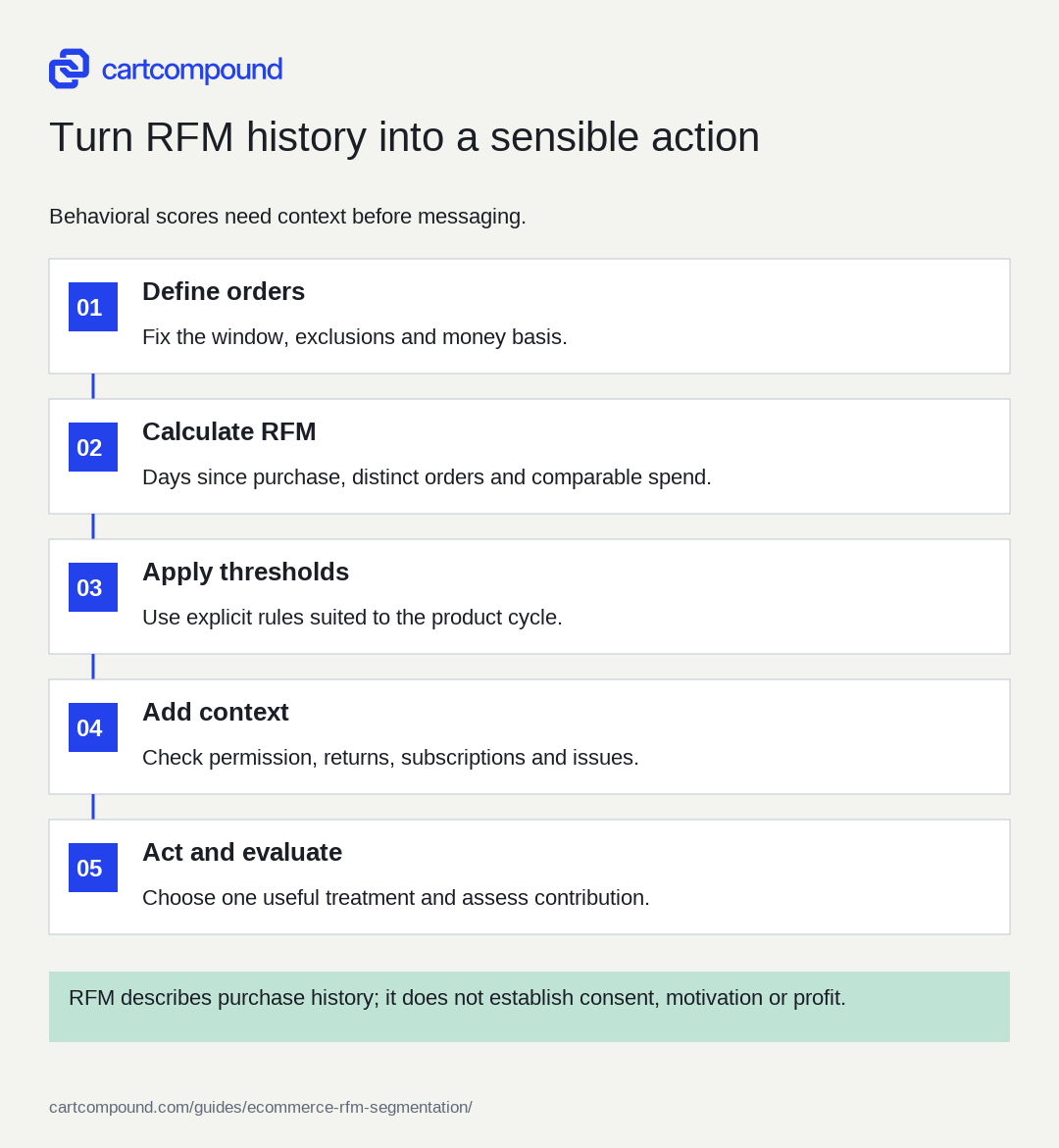
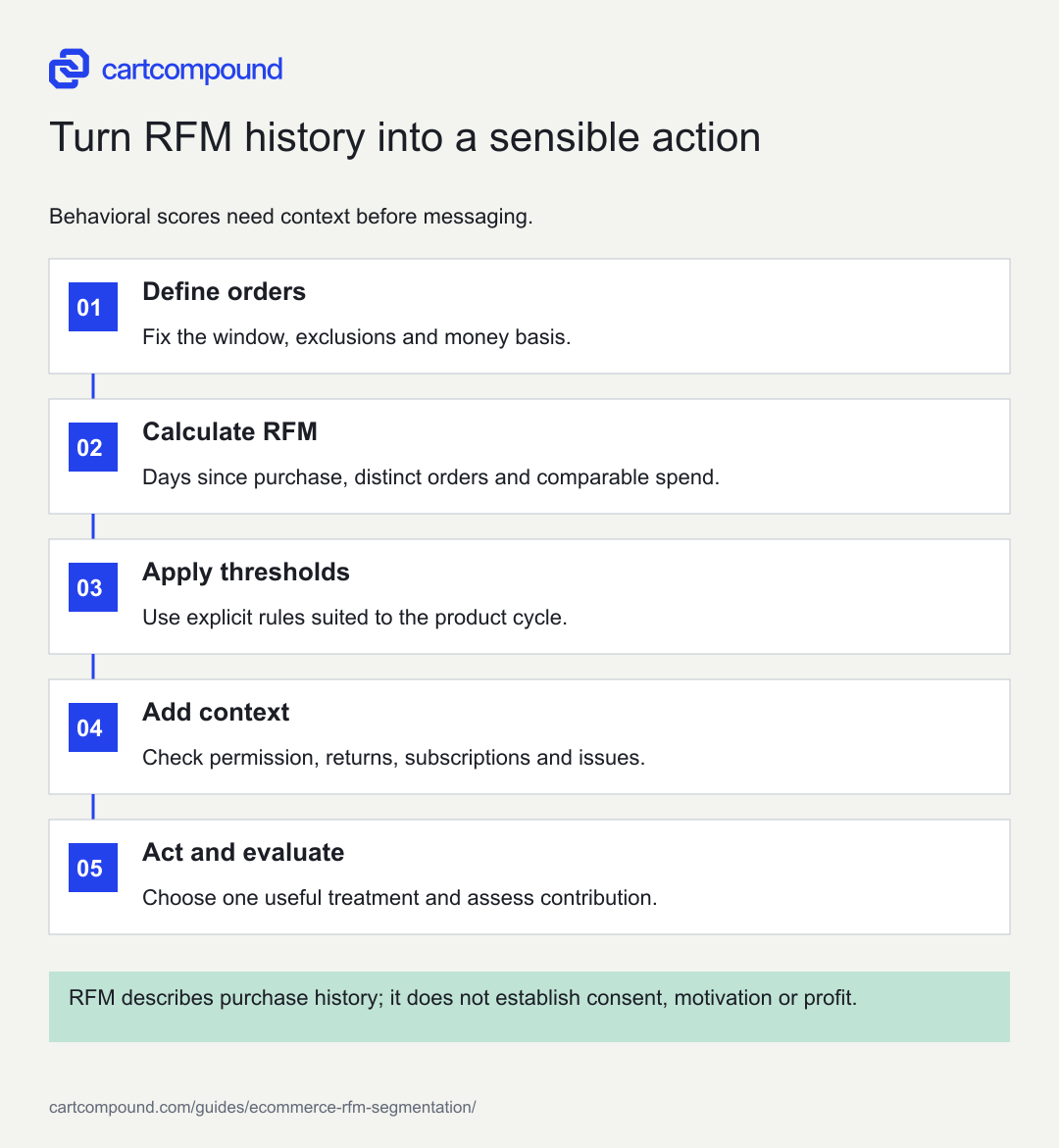
Turn RFM history into a sensible action
Behavioral scores need context before messaging.
- Define ordersFix the window, exclusions and money basis.
- Calculate RFMDays since purchase, distinct orders and comparable spend.
- Apply thresholdsUse explicit rules suited to the product cycle.
- Add contextCheck permission, returns, subscriptions and issues.
- Act and evaluateChoose one useful treatment and assess contribution.
RFM describes purchase history; it does not establish consent, motivation or profit.
Use the steps with your store data. Examples in this guide are illustrative unless a source is named.
Calculate a transparent customer table
On a small screen, swipe the table to see every column.
| Field | Calculation | Quality check |
|---|---|---|
| Recency | Observation date minus latest qualifying purchase date | Recent purchase means fewer elapsed days |
| Frequency | Distinct qualifying orders within the window | Do not count line items as orders |
| Monetary | Sum of the defined comparable order value | Apply currency and refund policy consistently |
| Identity | Stable customer identifier with approved matching rules | Inspect duplicate guest and account profiles |
Keep the unscored values alongside any score so the model remains understandable. Investigate negative recency, implausible order counts and extreme spend values. These often indicate timezone, duplication or currency problems. Do not merge customer identities merely because names look similar. Use the business's approved identity process and preserve an audit trail. A segmentation export should include only data needed for the intended use, with access limited to the people operating the program.
Choose thresholds around the purchase cycle
You can use business thresholds, quantiles or a platform's configurable model. Business thresholds are often easiest to explain when the normal reorder interval is known. Quantiles can distribute customers across relative groups, but ties and small datasets can produce uneven or unstable groups. A high frequency score only means frequent relative to the selected model; it does not establish that the person buys often in an absolute sense.
Klaviyo's RFM scoring documentation describes its own three-level model and customizable thresholds. Do not assume every system uses five scores or the same default dates. Record the model, window and thresholds beside every segment export. Revisit them when the assortment or buying cycle changes, but avoid changing them so frequently that movement becomes impossible to interpret. A customer can change groups because the rules changed rather than because their behavior changed.
Work a small illustrative example
Assume an illustrative 365-day window ending on a fixed observation date. Define recent as within 60 days, repeat as at least three qualifying orders and high monetary value as at least $300 in comparable spend. These are planning examples, not recommended universal thresholds. Customer A last bought 20 days ago, has four orders and spent $360. Customer B last bought 200 days ago, has four orders and spent $420. Customer C last bought 10 days ago, has one order and spent $70.
A is an active repeat customer under these rules. B is a previously valuable customer with a long gap who merits investigation before a winback offer. C is a recent first-time buyer who may need onboarding, not a lapsed-customer discount. A score can summarize these differences, but the raw facts are already actionable. If B bought a durable product designed to last years, the long gap may be perfectly normal. Apply product context before interpreting a segment label as evidence of dissatisfaction.
Add context before choosing treatment
Layer permission, product type, subscription status, support state, returns and recent campaigns onto the behavioral group. A high-spend customer with costly returns may have low contribution. A subscriber may reorder automatically and need service information rather than a replenishment discount. A customer with an unresolved delivery problem should not receive a cheerful winback message that ignores the issue.
Use the smallest number of additional rules needed for a meaningful decision. Too many intersections create tiny audiences that are difficult to maintain and evaluate. Keep the segment logic documented in plain language. An operator should be able to explain why a customer entered and what would make them leave. Test edge cases around threshold dates, refunds and a new order arriving just before a send. The audience should be refreshed according to the purpose and the platform's actual update behavior, not an assumed real-time model.
Assign actions to a few useful groups
On a small screen, swipe the table to see every column.
| Behavioral group | Useful starting action | Guardrail |
|---|---|---|
| Recent first purchase | Product use and first ownership help | Do not label them inactive |
| Active repeat | Relevant new products or preference collection | Avoid unnecessary blanket discounts |
| Previously valuable, long gap | Investigate product cycle and invite a relevant return | Check unresolved issues and permission |
| Low-engagement, old purchase | Limited reactivation assessment | Protect reputation; do not send indefinitely |
Treat these as hypotheses to adapt, not a fixed universal playbook. Write the customer need, offer logic, expected contribution and stop condition for each action. If the team cannot operate a separate journey responsibly, keep the segment as an analysis group until it can. Segmentation does not require immediate messaging to every category. Sometimes the useful outcome is learning which product cohort needs better onboarding or which customer group should receive fewer promotions.
Check platform availability and refresh behavior
A vendor's RFM dashboard may depend on a specific product, subscription or model configuration. Klaviyo's RFM report guide explains its product access and profile properties. Confirm your account's entitlement and actual refresh timing before designing time-sensitive automation around the group. A model displayed in analytics is not automatically a real-time trigger.
If calculating RFM independently, keep a versioned process with the observation date, source export, exclusions and formulas. Reconcile totals to the intended order population. Decide how often to rebuild and how audiences are updated in the sending system. Check suppression again at send time. An exported list can become stale while queued, and a consent change must not be overwritten by the next model refresh. Avoid using destructive imports that replace unrelated profile properties or restore people who were intentionally suppressed.
Evaluate actions with contribution and guardrails
Track eligible audience size, delivered messages, meaningful clicks, validated orders, contribution after incentives, returns and complaint signals. Explain the attribution rule. A high conversion rate among an already loyal group does not establish that the message created those orders. Where volume permits, a properly designed holdout can help assess an incremental effect. Keep treatment and comparison groups comparable and prevent overlapping campaigns from obscuring the test.
For small groups, use counts, customer outcomes and operational learning before declaring winners. A segment with two purchases out of twenty recipients has a 10% observed purchase ratio, but two orders are a fragile basis for a strategic claim. Do not use platform benchmark revenue as the store's expected outcome. Review whether the segment action actually answers the customer need and whether margin supports continuing it. An RFM program should improve decisions about attention and offers, not just generate attractive labels for historical spending.
Keep observation dates and cohorts consistent
A model built for a past date should use information available at that date when evaluating a historical campaign or decision. If later purchases leak into the earlier score, the analysis can make the model appear more predictive than it was. Save a dated snapshot or reconstruct the historical qualifying-order population carefully. Do not compare a campaign audience chosen in January with a score recalculated after the campaign's February purchases and claim that the original classification identified those buyers.
Use an illustrative boundary check. Under a rule defining recent as no more than 60 elapsed days, a customer at 60 days qualifies and one at 61 days does not. State the inclusivity explicitly and calculate elapsed time with the agreed timezone and date method. Check purchases around midnight and the observation cutoff. Small implementation differences can move people between groups, especially when a large campaign produced many orders on the same date. This is a rule-consistency issue, not evidence that one day suddenly transforms customer intent.
For evaluation, track segment transitions and outcomes using fixed definitions. A recent first-time buyer who becomes a repeat buyer has changed behavior; a customer moved by a revised threshold has changed classification. Separate those cases in the reporting notes. Review whether the time allowed for a repeat purchase matches the product cycle and whether every compared group had a similar observation opportunity. Keep nonbuyers, incomplete-history profiles and unresolved identities visible as separate populations. This approach makes the model's practical limits clear and reduces the risk that a tidy RFM chart conceals inconsistent dates, future information or customer groups that were never comparable.
Maintain the model and its interpretation
Save the model version, thresholds, qualifying-order rules and refresh schedule with the dashboard. When changing a rule, compare old and new classifications on the same data so the team understands the difference. Watch for data imports, currency changes, subscription launches and assortment shifts that can alter the meaning of frequency or recency.
Your next action is to build a customer table for one complete analysis window and inspect ten profiles manually, including a repeat buyer, refund-heavy buyer, new buyer and apparently lapsed durable-goods buyer. Resolve calculation defects before launching messages. Then choose one group and one action with clear permission and stop conditions. RFM is most useful when it remains a transparent summary of observed behavior, enriched with product and customer context, rather than a label that pretends to explain a person's motivations or future value with certainty.
Your action checklist
Use this to decide what to do next. Your checks stay on this page and are not sent or saved.
0 of 5 checked
Common questions
Should I use three or five RFM scores?
Choose a model the team can interpret and operate. Score count matters less than consistent input definitions, useful thresholds and distinct actions for the resulting groups.
Does high monetary value mean high profit?
No. Spend can ignore discounts, returns, shipping subsidies and service costs. Add contribution context before making expensive retention offers.
Should nonbuyers receive an RFM score?
Keep them as a separate prospect population. Purchase-based recency and frequency are not meaningful when no qualifying order exists.
Sources and review
Source documentation checked October 27, 2026. Platform features and interfaces can change. The recommendations and illustrative examples explain how to make the decision; they do not promise results.
- Understanding RFM scoring and customer groups
Platform-specific scoring, thresholds and qualifying positive-value orders. - Getting started with the RFM analysis report
Product entitlement, model operation and profile property refresh context. - Shopify sales reports
Sales definitions and order-population considerations.
Talk through your store question
Bring one problem you want to solve.
A free 20-minute call with Hamid can help you decide what to investigate next.
Book a free 20-minute call
About the author
Hamid Khan
Hamid co-founded CartCompound and works with ecommerce founders on their stores and growth priorities.
Profile and guides