The short answer
Confirm permanent retirement first. Keep an explicit archive when the original page still provides useful support or product information, redirect when a genuinely relevant replacement fulfills the same need, and return an appropriate missing-page status when the page has no continuing purpose or equivalent destination. Traffic alone does not decide the treatment.
Confirm retirement and identify who still needs the page
A discontinued product is not simply an item whose inventory is currently zero. Ask purchasing or product management to confirm that the business will no longer sell it, including any regional or variant exceptions. Record the decision date and authority. This prevents a delayed shipment from triggering a permanent redirect that must be reversed later.
Then identify the remaining audiences. Existing owners may need manuals, spare parts, dimensions or compatibility details. New customers may be comparing a previous model with its successor. People following an old campaign link may need to understand why the item is unavailable. These needs can justify different content and navigation even after the purchase offer ends.
Gather evidence from customer questions, landing-page queries, external references and product documentation. Do not equate all traffic with purchase demand. A retired appliance page may attract owners looking for maintenance information rather than potential buyers. Conversely, a page with little current traffic may contain essential instructions linked from packaging. Retirement is a product-information decision with SEO consequences, so include the team that owns support as well as merchandising.
Use three treatments with explicit acceptance criteria
There are three broad choices: retain useful information with clear discontinued status, redirect to a genuinely relevant replacement, or remove the page with an appropriate status. None is universally correct. Google's How HTTP status codes affect Google crawlers explains how response codes affect crawling, while its Site moves with URL changes explains mapping and redirects when URLs change. Apply those mechanisms to a defensible customer decision.
On a small screen, swipe the table to see every column.
| Continuing need | Treatment to evaluate | Acceptance criterion |
|---|---|---|
| Owners need original specifications or instructions | Accessible archive | Original item clearly identified and retirement stated |
| A true successor fulfills the same task | Relevant permanent redirect | Destination satisfies the old request without misleading substitutions |
| No useful information or equivalent destination remains | 404 or 410 as appropriate | Honest status and helpful recovery links |
Write why the selected treatment serves the remaining audience. If the only reason is 'keep SEO value,' examine the customer outcome again. A redirect is not a way to transfer every old product's history to an unrelated bestseller. An archive is not useful merely because it still returns 200. The content needs a continuing job, and the business needs an owner for maintaining it.
 Keep this framework
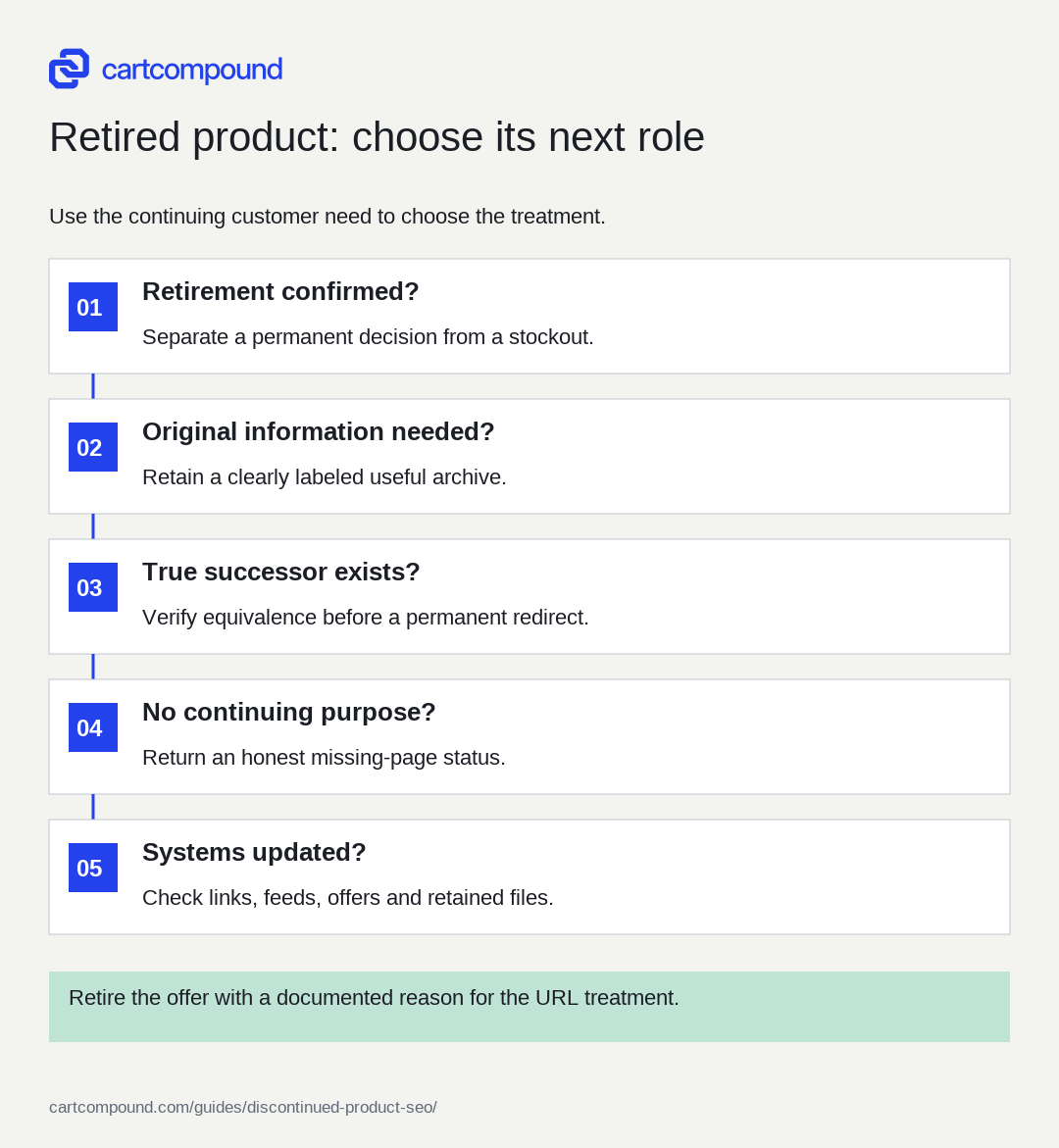
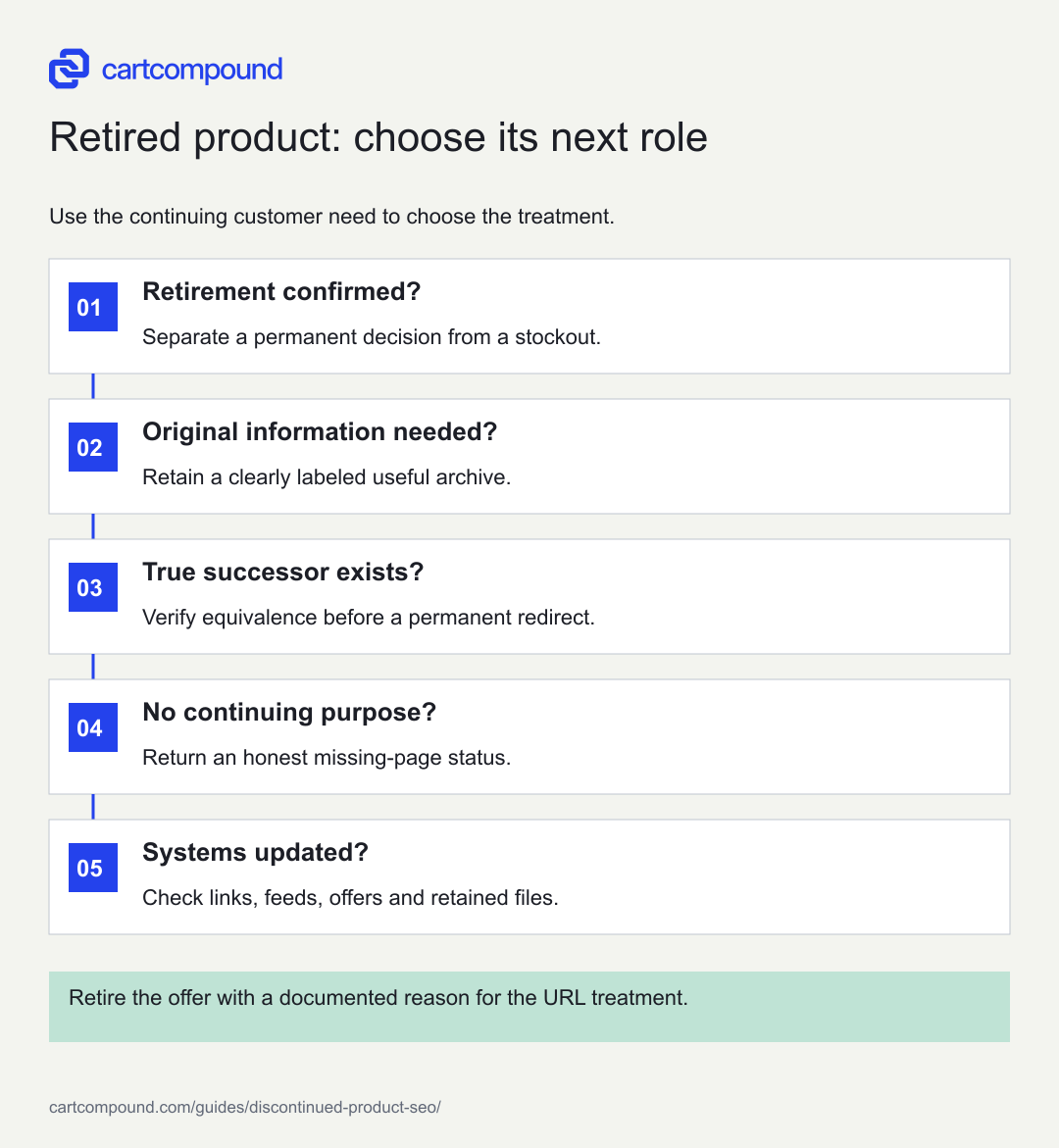
Retired product: choose its next role
Use the continuing customer need to choose the treatment.
- Retirement confirmed?Separate a permanent decision from a stockout.
- Original information needed?Retain a clearly labeled useful archive.
- True successor exists?Verify equivalence before a permanent redirect.
- No continuing purpose?Return an honest missing-page status.
- Systems updated?Check links, feeds, offers and retained files.
Retire the offer with a documented reason for the URL treatment.
Use the steps with your store data. Examples in this guide are illustrative unless a source is named.
Evaluate replacements against actual requirements
A successor should be more than an item in the same category. Compare use case, compatibility, dimensions, capacity, materials, included components and important price or fulfillment differences. A replacement part that fits a different model is not equivalent. A new product can be an option without being an appropriate automatic redirect destination.
Create a replacement worksheet with original product, proposed destination, shared requirements, changed requirements, compatibility evidence and reviewer. Include the exact URL and verify it is public, available in the relevant market and technically healthy. If the destination depends on selecting a particular variant, test the fresh-entry URL and the resulting cart item.
In an illustrative case, an old water-filter cartridge is replaced by a manufacturer-confirmed compatible version with the same installation method. A redirect may be reasonable if the new page clearly explains the succession. A cartridge from a different system should not receive the redirect merely because it is in stock. If compatibility is uncertain, preserve the original information and provide a clearly labeled comparison or category link instead of silently deciding for the shopper.
Build an archive that answers the original request
An archive should state near the top that the item is discontinued and cannot currently be purchased from the store. Retain the specifications, manuals and support information that people still need. Explain a successor or alternative where supported, including meaningful differences. Do not leave an active-looking purchase button or stale delivery promise on the page.
Consider the difference between a product archive and an orderable offer. Review structured data and any product-feed entry so systems do not continue advertising an unavailable purchase. A historical product page can describe the item without pretending a current offer exists. Use the actual platform and merchant requirements when deciding which offer data remains appropriate. Google's Merchant listing structured data and Product data specification are the relevant primary references.
Keep archived pages reachable through sensible support or historical paths when they serve owners, while prioritizing available products in shopping navigation. The archive does not need to dominate category grids. Review links from guides: a historical comparison can remain accurate with a clear note, while an active recommendation may need revision. Preserve useful context rather than rewriting history to make every old item look current.
Implement redirects as tested mappings
For each approved redirect, record old URL, final destination, retirement reason and review owner. Use a permanent server-side redirect when the change is permanent and the destination is appropriate. Avoid chains where an old product redirects to a temporary successor that redirects again. Test the final page directly and through the old address.
Google's site-move guidance recommends mapping URLs to relevant destinations and keeping redirects for at least a year, with longer retention useful for people and old links. A product-retirement redirect should likewise have an operational retention plan rather than being deleted during a later cleanup. Do not promise that a redirect preserves every search outcome. Search systems still evaluate the destination and the relationship.
Update internal links to the final destination where the new product actually fulfills the original context. A guide discussing the original specifications may need an archive reference rather than a rewritten product recommendation. Check feed links, navigation, recommendation widgets and structured references. The redirect catches residual visits; it should not become a permanent excuse for the site to keep generating obsolete internal routes.
Remove honestly when there is no continuing destination
When a retired page no longer has useful information and no equivalent destination exists, a missing-page response can be correct. A 404 is not automatically an SEO failure. The important distinction is between an intentionally removed page and an unexpectedly broken valuable page. Keep a removal record so future audits can tell them apart.
A helpful error page can return the appropriate status while offering a site search, relevant category links and a clear explanation. Do not return a successful status with only 'product not found' and expect the template to communicate the removal reliably. Google's HTTP guidance explains soft-error handling and the role of actual response codes. Verify the server response, not just the message in the browser.
Remove retired URLs from active sitemaps and inappropriate shopping links as the platform permits. Check whether a product deletion automatically creates a redirect or leaves one from an earlier change. Do not block a missing URL in robots merely to hide its report entry. Search systems may revisit removed pages for a period, and a report can continue reflecting historical activity. That does not require inventing a replacement destination.
Use a retirement register for bulk catalog changes
Bulk retirement magnifies small mistakes. A spreadsheet containing hundreds of discontinued products needs more than a column pointing them all to the homepage. Add treatment, justification, replacement equivalence, archive requirement, current status, destination status and approval. Split cases that need support review from obvious removals and straightforward successors.
For an illustrative 60-item retirement, the team might identify 15 pages with support value, 20 verified successor mappings and 25 pages without an ongoing role. These figures illustrate the process only. They are not a recommended distribution. The important feature is that each row has a defensible reason and a testable expected result.
Sample every distinct pattern before a bulk change and automate checks for all rows afterward where possible. Flag duplicate destinations for human review, especially when many old products converge on a broad category. A category can sometimes be the most useful recovery option, but it should not be assumed equivalent to every retired product. Keep a reversible export of prior content and redirects so mistaken retirement decisions can be corrected without reconstructing the catalog from memory.
Preserve support assets before deleting the commerce record
Check what deletion does in the specific platform before choosing it as the retirement action. The product record may supply images, downloadable files, related-item relationships or references used outside the storefront. Export the information the support team needs and verify the actual destination of every retained manual. A saved screenshot is not equivalent to retaining a searchable specification or a usable instruction file.
Use a handoff row for each archive dependency: asset, current address, future address, rights or retention condition, owner and tested access. Product documentation can belong to a manufacturer or another rights holder, so public availability does not authorize copying it to a new host. Preserve approved access or obtain the relevant authority rather than treating retirement as permission to republish material.
Define what happens when the successor also retires. An automatic chain of substitutions can eventually send an original owner to an unrelated product. Keep the original compatibility and historical information available where needed, and review the redirect relationship rather than extending it mechanically. A support archive may become the better destination after several product generations. This additional handoff protects a different task from the immediate shopping journey: someone who already owns the item needs reliable facts about that exact item, even when the store no longer sells anything equivalent.
Monitor customer recovery and review the archive over time
After retirement, check old landing visits, redirect errors, support questions and alternative-product interactions. Distinguish expected reduction in traffic to removed offers from unexpected loss of access to needed documentation. Watch whether customers arrive at a successor and immediately search for the old model, which may indicate the replacement explanation is unclear.
Recheck archive assets such as manuals and downloadable specifications. A retained HTML page is not useful if its important files disappear during a storage cleanup. Review replacement links when successors themselves retire. Keep the register as a chain of business decisions, and update redirects to relevant final destinations where appropriate without losing the original rationale.
The next action is to review ten retired products with merchandising and support. Complete the keep, redirect or remove worksheet for each and implement the clearest examples first. Verify status codes, destination relevance, current offer data and internal links. The result should be a store that tells the truth about retired items and still helps people complete the task that brought them there.
Your action checklist
Use this to decide what to do next. Your checks stay on this page and are not sent or saved.
0 of 6 checked
Common questions
Should every discontinued product redirect to its category?
No. A category may help someone continue shopping, but it is not automatically equivalent to the original product. Choose a redirect only when the destination provides a relevant continuation.
Can a discontinued page stay indexed?
A useful archive can remain a legitimate destination. Its status and content should make retirement explicit and avoid representing an unavailable item as a current purchasable offer.
Is 410 always better than 404?
Use an appropriate, correctly implemented missing-page status. The meaningful decision is whether the page should exist or redirect; a particular missing-page code is not a growth tactic.
Sources and review
Source documentation checked October 27, 2026. Platform features and interfaces can change. The recommendations and illustrative examples explain how to make the decision; they do not promise results.
- How HTTP status codes affect Google crawlers
Behavior of successful responses, redirects and missing pages. - Site moves with URL changes
URL mapping, permanent redirects, monitoring and redirect retention. - Merchant listing structured data
Product offers, current price, currency, availability and merchant eligibility. - Product data specification
Merchant Center identifiers, URLs, images, variant grouping, price and availability.
Talk through your store question
Bring one problem you want to solve.
A free 20-minute call with Hamid can help you decide what to investigate next.
Book a free 20-minute call
About the author
Hamid Khan
Hamid co-founded CartCompound and works with ecommerce founders on their stores and growth priorities.
Profile and guides