The short answer
Use a fixed, relevant set of shopping questions and record the service, date, context, response, citations and product accuracy for each observation. Report visibility within that sample, keep referral traffic separate, and distinguish technical eligibility from observed appearance and business impact.
Define visibility as an observation
“AI visibility” can mean a brand mention, a cited page, a product card, a recommendation or a click to the store. These are different events. Define the one you want to measure before choosing software. A brand named in a cautionary comparison is not equivalent to a suitable product recommendation. A citation to a care guide is useful evidence of source use but does not necessarily create shopping traffic.
Write operational definitions that two reviewers can apply consistently. For example, “a visible link to an owned domain in the recorded answer” is easier to score than “the assistant trusts our brand.” Include relevance and accuracy as separate fields. Specify the services and experiences tested because an ordinary chat answer, a search-enabled answer and a shopping interface may behave differently. Your result describes those observations. It should not be named a universal rank or extrapolated to all shoppers without evidence about the population being represented.
Build a panel from real purchase questions
Use category research, support questions, internal site search and documented buying objections to choose prompts. Include the constraints that actually change the product decision: budget, dimensions, compatibility, material, delivery destination, care or an excluded use. Keep branded verification prompts separate from unbranded discovery prompts. Asking about your own brand nearly guarantees a different kind of response than asking for an unknown product to solve a need.
Create categories with a deliberate balance. A store selling technical backpacks might include fit, laptop size, weather exposure, carry-on requirements and alternatives for different budgets. Do not add hundreds of trivial wording variants to inflate the sample. Record why each prompt belongs and what an appropriate answer should consider. Keep a stable core panel for comparison and a separate exploratory panel for new questions. Replacing weak prompts with prompts that favor the store can create an apparent improvement without any actual change in the service's behavior.
 Keep this framework
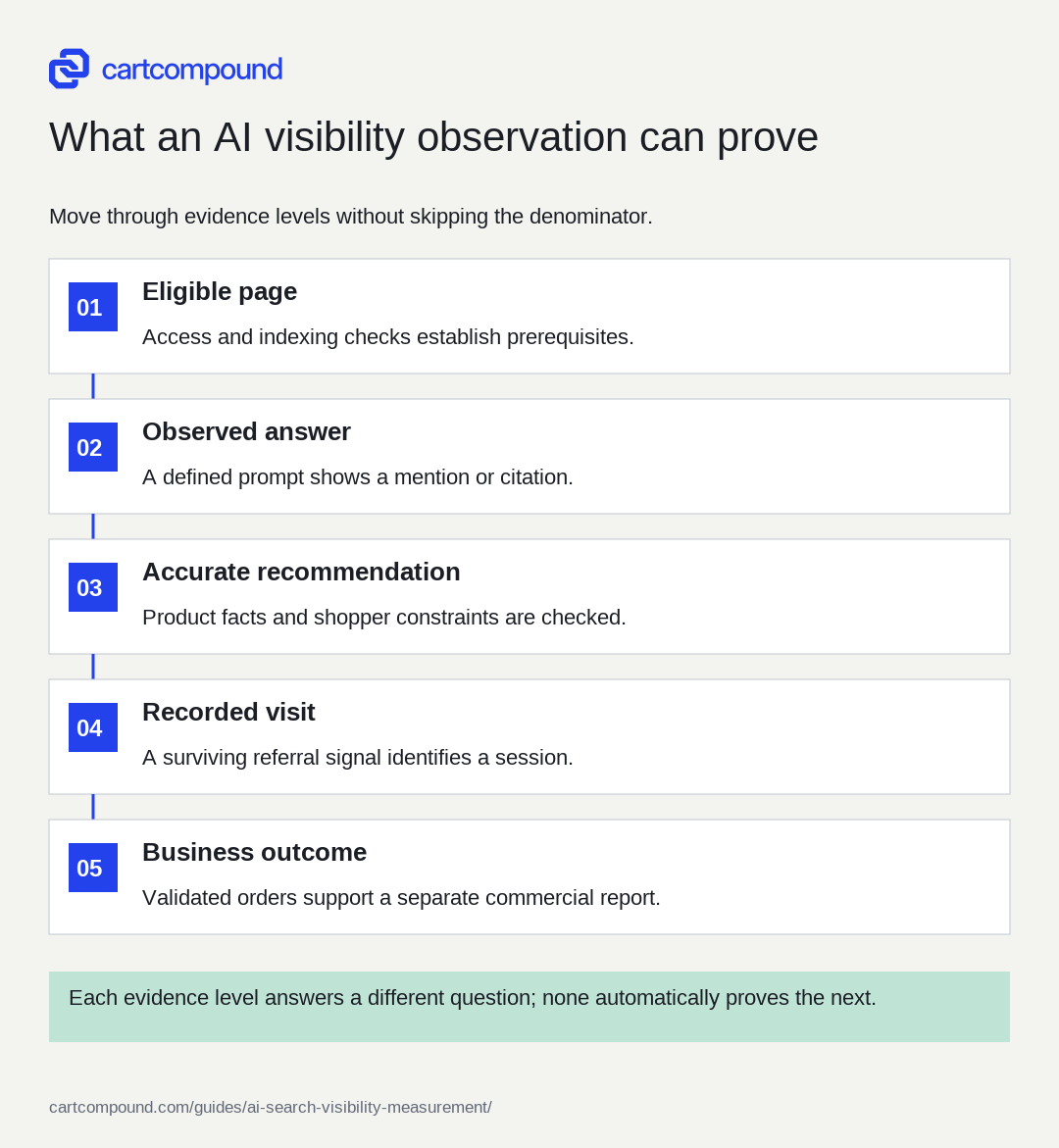
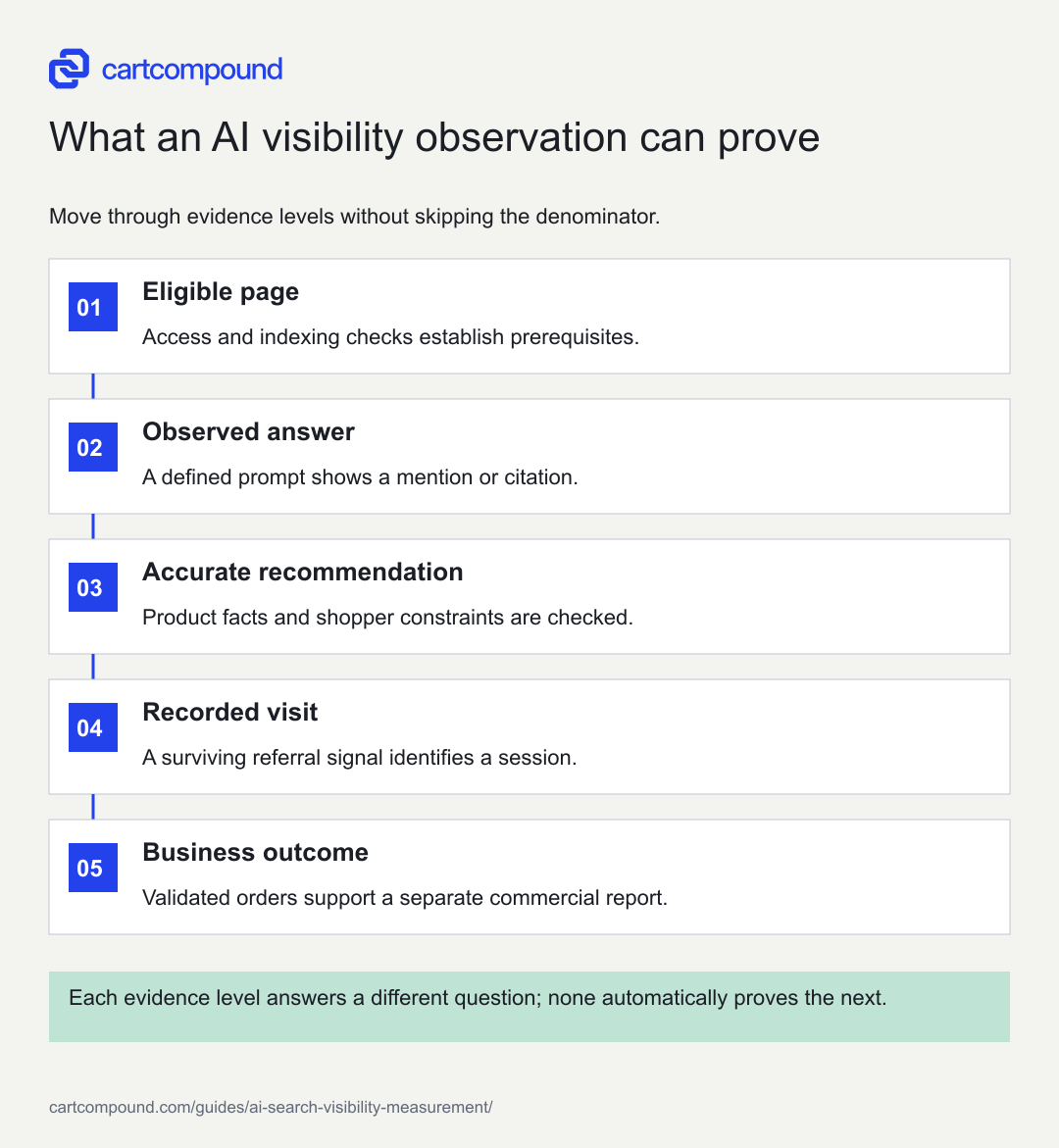
What an AI visibility observation can prove
Move through evidence levels without skipping the denominator.
- Eligible pageAccess and indexing checks establish prerequisites.
- Observed answerA defined prompt shows a mention or citation.
- Accurate recommendationProduct facts and shopper constraints are checked.
- Recorded visitA surviving referral signal identifies a session.
- Business outcomeValidated orders support a separate commercial report.
Each evidence level answers a different question; none automatically proves the next.
Use the steps with your store data. Examples in this guide are illustrative unless a source is named.
Control what you can and record what you cannot
Record the exact prompt, service, experience, date, language, market context, logged-in state where relevant and whether prior conversation could influence the answer. Use fresh conversations for the stable panel when the protocol calls for independent questions. Avoid adding favorable brand hints in follow-up messages and then counting the result as unprompted discovery. Preserve the visible answer or an authorized record that another reviewer can inspect.
You cannot control every underlying model update, retrieval choice, personalization factor or experiment. State those limits instead of implying a laboratory-perfect test. If a service changes its interface or available mode, annotate the change and consider starting a new series. A comparison across materially different experiences can still be useful, but it should be described as such. Do not collect customer conversations or personal information simply to make the panel more realistic. Use anonymized purchase needs and approved testing methods.
Score appearance, accuracy and usefulness separately
On a small screen, swipe the table to see every column.
| Measure | Operational question | Example coding |
|---|---|---|
| Owned citation | Does the answer visibly link an owned page? | Yes, no or unavailable |
| Brand mention | Is the brand named in the answer? | Positive, neutral or negative context |
| Product fit | Does the suggested item meet stated constraints? | Meets, fails or cannot verify |
| Fact accuracy | Are material product assertions correct? | Correct, incorrect or unknown |
| Landing quality | Does the link reach a useful current page? | Works, wrong variant or broken |
Keep the raw evidence beside the score. A reviewer should be able to explain why a product failed a constraint without reading the analyst's mind. Do not collapse every measure into a proprietary score unless its weights are explicit and useful for a business decision. An increase in mentions accompanied by more price errors is not an unqualified improvement.
Use a worked sample with honest arithmetic
Suppose an illustrative panel contains 20 fixed unbranded prompts, each observed once in a defined service during a weekly run. The store receives owned citations in six answers. The observed citation rate is 6 divided by 20, or 30%, within that run. It is not the share of all possible questions or shoppers. If four cited answers are materially accurate and two contain important errors, report that distinction rather than celebrating six citations alone.
The following week has eight cited answers from the same panel. That is 40%, a ten percentage-point increase within the observations. With a small, variable sample, this is a signal to investigate, not proof of a durable gain or the effect of a page edit. Inspect which prompts changed and whether the sources or service experience changed. If the panel itself changed, recalculate a comparable subset or clearly start a new baseline. Counts and denominators should remain visible beside every percentage.
Connect technical eligibility to a separate diagnosis
When a useful page never appears, investigate whether it is accessible, indexed where relevant, accurate and internally discoverable. Google states that pages supporting its AI features must be indexed and eligible for a snippet, with no extra technical requirement, in its AI features guidance. Passing eligibility checks still does not guarantee selection. Use technical evidence to identify a fixable defect rather than reverse-engineering an answer from one missing mention.
For ChatGPT, review the current documented search-access controls in OpenAI's crawler reference. Keep search access separate from potential training preferences. A valid robots rule does not prove the CDN serves useful content, so inspect the full public retrieval path where appropriate. These checks can explain some failures, but many nonappearances will remain uncertain. Do not label every absent citation as a penalty, trust deficit or missing proprietary optimization when the underlying system provides no evidence for that conclusion.
Classify errors into actionable buckets
On a small screen, swipe the table to see every column.
| Observed issue | Potential action | What not to infer |
|---|---|---|
| Wrong product dimension | Resolve conflicting public specifications | A single site edit caused all answers |
| Outdated price | Check page and supported catalog freshness | The assistant has a fixed refresh schedule |
| Broken owned link | Repair the landing path | More mentions equal more useful visits |
| No appearance | Check suitability and eligibility | A universal ranking position exists |
Assign errors to the source owner when the evidence is clear. If an obsolete retailer page supplies the incorrect fact, record that source and the current authoritative value. If the answer gives no traceable source, classify the cause as unknown. Keep an exception log for unresolved issues rather than manufacturing a theory to fill every blank. Prioritize errors that could cause an unsuitable purchase, followed by broken paths and missing information for commercially relevant questions.
Keep referrals and influence in separate reports
Identifiable referral sessions show observed visits with surviving source information. A visibility panel shows answers observed under defined conditions. The two datasets do not necessarily describe the same people or the same period of influence. Do not divide total store sales by panel mentions and call the result an AI conversion rate. That calculation has no coherent denominator.
Use GA4 session acquisition fields for the referral question, with the scope distinctions described in Google's acquisition documentation. Inspect landing pages and validated purchases. Google also includes its Search AI feature activity within overall Web Search Console performance rather than providing a complete independent visibility count through that report. Keep these reporting boundaries in the dashboard notes. Referral growth, better prompt accuracy and overall commercial health can inform the same decision without being combined into a falsely precise attribution funnel.
Evaluate vendors using reproducibility
Ask a monitoring vendor to show the prompt list, market context, collection cadence, scoring definitions and raw supporting records. Find out whether it measures visible consumer experiences, APIs, simulated responses or another environment. These can produce different observations. Ask how it handles failed runs, changed prompts, unavailable features and duplicate prompts. A smooth trend line can conceal changes in the measurement process.
Check whether competitors are selected deliberately and whether the same question set is used for each. Review export options and data retention so the team can examine an unexpected change. Avoid choosing a tool solely because it produces a large “share of voice” number. The denominator, sampling method and interpretation determine whether that number is useful. For a small store, a carefully maintained manual panel can answer the initial question before a recurring software commitment is justified. Expand tooling when the volume of meaningful observations and the decisions supported make that investment worthwhile.
Protect the panel from sampling drift
Maintain a panel register containing prompt ID, question, intent category, rationale, version and active dates. If the store adds a new product category, place new questions in the exploratory set before changing the stable series. If a question becomes irrelevant, retire it with a reason rather than silently replacing it with a more favorable question. Keep a comparable core for period-over-period reporting and show the active denominator for every run.
Separate missing observations from negative observations. A failed collection run, unavailable feature or incomplete response should be coded unavailable under the protocol, not automatically counted as no brand mention. Report the number attempted, completed and unavailable. Otherwise an outage in the monitoring tool can look like a visibility decline. Likewise, do not remove unsuccessful or unfavorable answers after collection. Review ambiguous scoring with a second person and preserve the disagreement if it cannot be resolved from the evidence.
A useful change report can list prompts that gained a relevant citation, lost one, changed product facts or remained stable. This is more actionable than one aggregate score. For example, if compatibility questions become more accurate while broad “best product” prompts remain variable, the team has evidence of a specific information improvement worth checking further. It still cannot isolate the cause without a stronger design. Keep that distinction in the reporting language. Consistent sampling, complete records and explicit unavailable cases make a modest panel reproducible enough to support decisions while preventing measurement changes from being mistaken for changes in how all shoppers encounter the store.
Create a review cadence with a decision log
Run the stable panel at a pace the team can review properly. Catalog price checks may need frequent automation; a broad buying-guide panel may be useful at a slower cadence. Record material site, catalog and measurement changes alongside observations. Use those annotations to generate hypotheses, not automatic causal claims. If multiple changes occur together, acknowledge that the panel cannot isolate their effects.
For the next work session, choose twelve to twenty meaningful prompts, write the scoring definitions and have two reviewers independently score a few sample answers. Resolve disagreements before scaling the panel. Then record a baseline and identify the highest-impact factual or landing-page defect. The output of each review should be a small set of actions with owners and evidence, plus an honest statement of uncertainty. Measurement becomes useful when it guides better information and buying experiences, rather than merely creating more screenshots of favorable AI answers.
Your action checklist
Use this to decide what to do next. Your checks stay on this page and are not sent or saved.
0 of 5 checked
Common questions
Is there a single AI ranking for my store?
No single observation establishes a universal rank. Results vary by service, question, context and time. Report appearance within a defined panel and keep the denominator visible.
How many prompts should I track?
Start with a manageable set covering meaningful decisions. Relevance, stable definitions and review quality matter more than a large set of near-duplicate prompts.
Can an improvement prove my content edit worked?
A before-and-after panel can suggest a hypothesis. Service updates, retrieval changes and other site edits can also change results, so causal claims need stronger evidence.
Sources and review
Source documentation checked October 27, 2026. Platform features and interfaces can change. The recommendations and illustrative examples explain how to make the decision; they do not promise results.
- AI features and your website
Eligibility, absence of additional requirements and Search Console reporting boundaries. - Overview of OpenAI crawlers
Search access is distinct from training controls. - Scopes of traffic-source dimensions
Session acquisition measurement scope.
Talk through your store question
Bring one problem you want to solve.
A free 20-minute call with Hamid can help you decide what to investigate next.
Book a free 20-minute call
About the author
Hamid Khan
Hamid co-founded CartCompound and works with ecommerce founders on their stores and growth priorities.
Profile and guides