The short answer
Use session-scoped source and medium to identify observed AI referrals, preserve the underlying source rows, and connect them to validated ecommerce events. Treat the result as identifiable referral activity, not a complete measure of AI impressions, recommendations or incremental sales.
Decide which question the report answers
Write the reporting question before creating a channel label. “How many recorded sessions arrived from an identifiable AI service?” is answerable from acquisition data when the signal survives. “How much revenue would disappear without AI?” is a causal question that a referral filter cannot answer. “How often does our brand appear?” requires separate visibility observations. Keeping these questions apart prevents a convenient dashboard from becoming an unsupported business claim.
Set the reporting unit, period, timezone and revenue definition. A founder reviewing the last complete week needs consistent dates and a note about delayed purchase events or refunds. Decide whether you need all identifiable services or separate rows for each service. Preserve landing-page detail so an unusual increase can be investigated. Use a written definition such as “sessions with a recorded source matching our reviewed AI-service domain list.” This definition is less exciting than “AI revenue,” but it describes what the data can actually establish.
Choose session scope for visit acquisition
GA4 distinguishes first-user, session and event attribution scopes. Its scope documentation places session acquisition dimensions in Traffic acquisition. Use session source or session source/medium when your question concerns the origin of observed visits. First user source answers a different question about the user's initial acquisition and can retain an older source while the person returns through another service.
Do not combine similarly named dimensions without checking their scope. A report of sessions grouped by first-user source can describe a useful audience cohort, but it does not show the source of every session. Likewise, an attributed revenue metric can follow rules that differ from a simple same-session purchase count. Name the report and its columns accordingly. Save the scope in the metric dictionary and include it in exports. This small documentation step helps prevent two team members from reporting different totals under the same “AI traffic” heading.
 Keep this framework
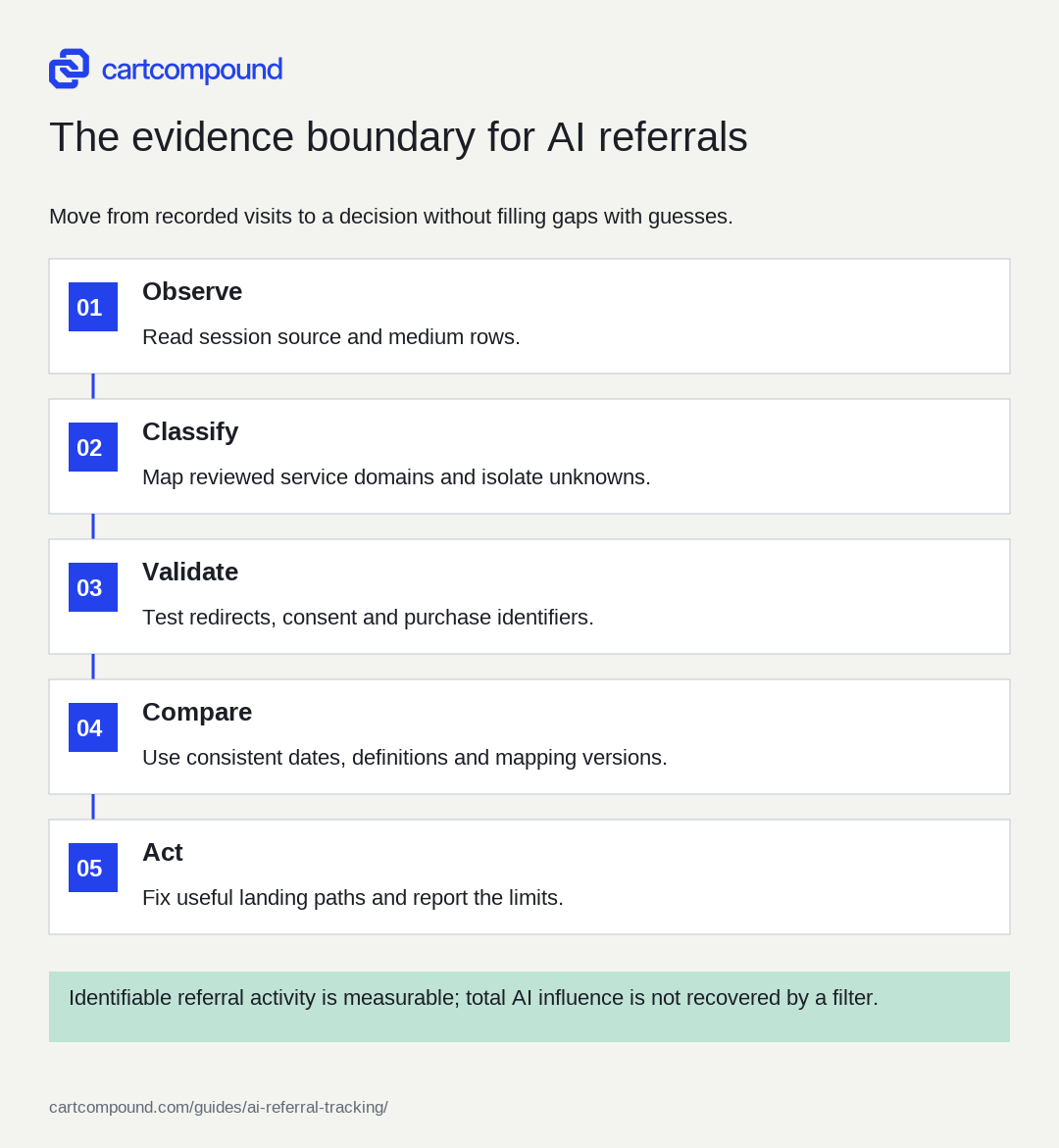
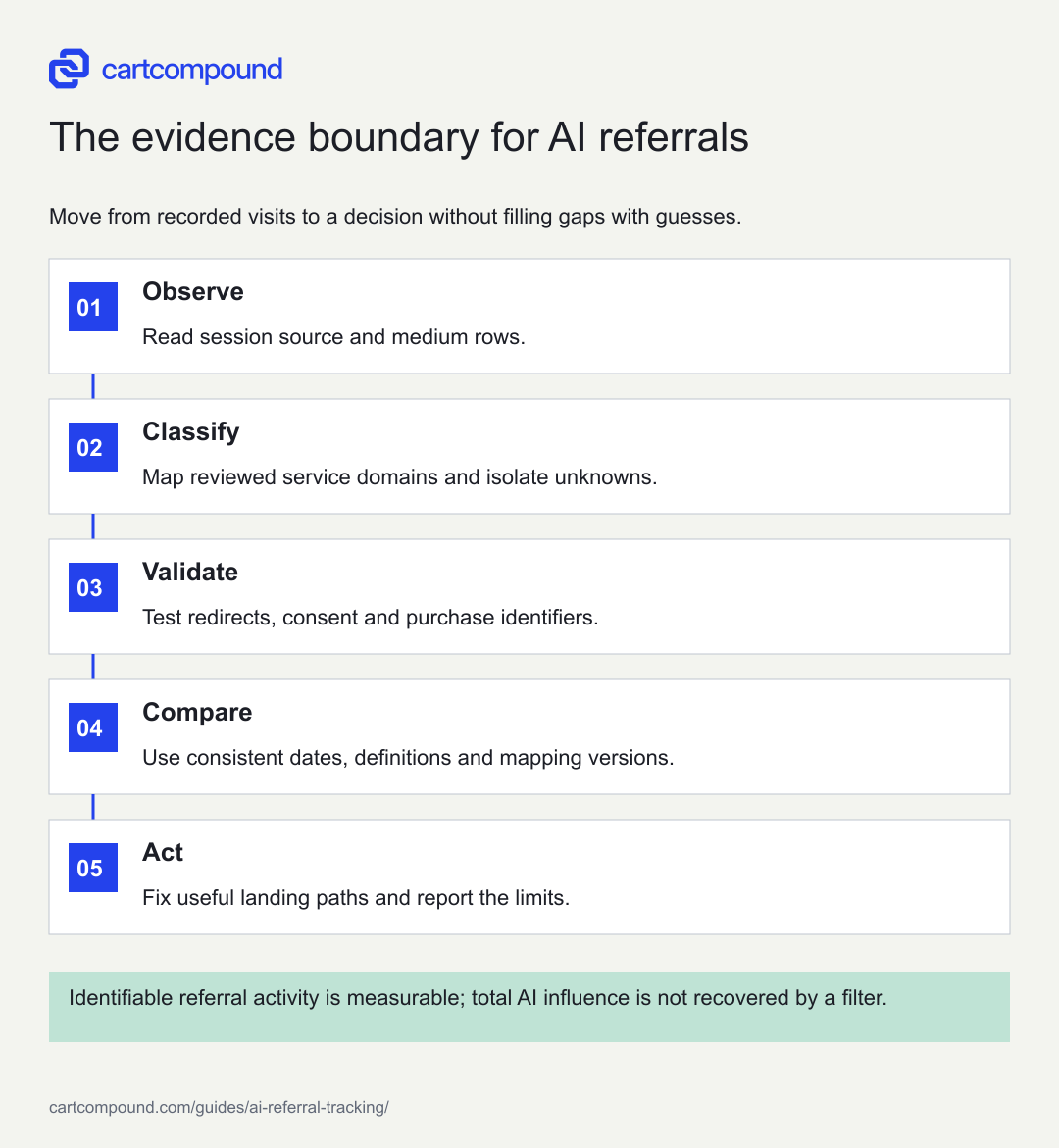
The evidence boundary for AI referrals
Move from recorded visits to a decision without filling gaps with guesses.
- ObserveRead session source and medium rows.
- ClassifyMap reviewed service domains and isolate unknowns.
- ValidateTest redirects, consent and purchase identifiers.
- CompareUse consistent dates, definitions and mapping versions.
- ActFix useful landing paths and report the limits.
Identifiable referral activity is measurable; total AI influence is not recovered by a filter.
Use the steps with your store data. Examples in this guide are illustrative unless a source is named.
Inspect actual source rows before writing rules
Open the available acquisition report or exploration and examine recorded session sources for the relevant period. Search for recognizable service domains and review the rows individually. Do not assume all services use one consistent hostname or that every visit has medium referral. Maintain a mapping table containing the observed value, normalized service label, reason for inclusion and date reviewed. Keep uncertain rows outside the confirmed total until investigated.
Google's traffic-source documentation explains the role of source, medium and campaign dimensions. Those fields are evidence collected or assigned under analytics rules, not an independent certificate of who recommended the product. A misleading campaign tag can produce a familiar-looking source. Investigate sudden spikes, unfamiliar subdomains and internal tests. Exact observed values give you a defensible starting point; copying a long internet regex can silently include unrelated sites or exclude changed service domains.
Build a readable classification worksheet
On a small screen, swipe the table to see every column.
| Observed source | Classification | Reason and treatment |
|---|---|---|
| Recognized AI-service domain | Confirmed mapping | Include after checking real referral behavior |
| Unknown lookalike domain | Review | Keep separate until ownership and visit path are understood |
| (direct) | Unidentified origin | Do not relabel as AI without evidence |
| Owned tagged test link | Internal test | Exclude from commercial interpretation |
Use the worksheet to build a saved filter or custom grouping supported by your property. Start with explicit domain matches. If a regular expression is necessary, anchor it and test positive and negative examples so partial strings do not create false matches. Keep the raw source/medium dimension beside the normalized label during quality checks. Version the mapping, because adding a newly recognized source can raise reported AI sessions without any change in underlying traffic. Annotate that date rather than calling the increase organic channel growth.
Preserve campaign information through the landing path
Test a real, permitted click from an AI service to a public page. Observe the destination URL, redirects, consent behavior and recorded session source. A privacy-conscious test uses a staff session and a simple product URL, without customer details in parameters. If you control a published link, use an agreed UTM convention and verify that redirects preserve it. You cannot add tags retroactively to every citation created by a third party.
Google documents campaign and source processing in its campaigns and traffic sources guide. A new campaign value does not necessarily create a new session. Avoid drawing conclusions from a test performed midway through an already active analytics session. Record the sequence and use a clean test context when appropriate. Do not place UTMs on internal navigation to make the dashboard look more complete; that introduces misleading campaign data and obscures the real acquisition path you are trying to inspect.
Validate purchases before interpreting revenue
A source report only becomes commercially useful when the purchase events are credible. Compare a sample of transaction identifiers, currencies and values with the commerce system. Check for duplicate purchase events from overlapping integrations, missing checkout measurement and unexpected payment-gateway referrals. Review refunds separately and understand whether your chosen revenue column includes them. Consent choices and blocked measurement can prevent otherwise genuine visits or orders from appearing.
Use Google's ecommerce implementation reference for event semantics. The practical question is whether the dataset is good enough for this decision. If a large portion of purchase tracking is missing or duplicated, source-level revenue comparisons should wait. Add a data-quality status to the report. A small referral channel can look dramatically better or worse because one expensive order was counted twice or omitted. The store's order ledger and analytics answer related questions, but their totals should not be expected to match automatically.
Work an example without overstating conversion
Suppose an illustrative weekly report contains 120 identifiable AI referral sessions and four purchase events. After checking transaction IDs, one purchase is a duplicate, leaving three valid observed purchases. The session-based observed purchase ratio is 3 divided by 120, or 2.5%. Call it a purchase ratio only if the numerator's event basis is clear; if measuring purchasing sessions, count the three distinct purchasing sessions instead. Multiple orders within one session otherwise change the meaning.
Assume those valid orders total $240 in the revenue definition used. That is recorded revenue associated with the chosen report logic, not proof of $240 in incremental revenue. One customer might have known the brand already, and an untracked visitor may have arrived from the same service. Keep the two uncertainties separate. Do not “correct” the total by applying an invented missing-referrer multiplier. Report the observed figures, the duplicate correction and the measurement limitations together so the founder can assess their practical significance.
Diagnose changes before celebrating a trend
On a small screen, swipe the table to see every column.
| Observation | First investigation |
|---|---|
| Sessions rise after a grouping edit | Recalculate the earlier period with the same mapping |
| AI referrals disappear | Check source rows, tagging, redirects and consent changes |
| Revenue spikes on flat sessions | Inspect order count, transaction duplicates and large orders |
| Direct traffic grows | Investigate broadly; do not assign the increase to AI |
Compare enough complete periods to see ordinary variation. Segment by landing page, device and market when sample size permits. A referral increase to a support article has different implications from an increase to purchasable products. Preserve reporting annotations for launches, tracking changes, service-domain additions and consent changes. These explain discontinuities that a trend line alone conceals. When there are only a few orders, present counts alongside rates and avoid confident percentage comparisons between tiny groups.
Explain what the report cannot observe
A person can read an AI answer without clicking, copy a URL, switch devices, open an app browser or buy later through another route. The original recommendation may not survive as a measurable referral. Conversely, a recorded service source does not reveal the whole conversation, the assistant's exact reasoning or whether the merchant would have received the order anyway. No reporting label removes those limits.
Keep complementary evidence in separate datasets: referral sessions, standardized prompt observations, customer-reported discovery and overall commercial performance. A voluntary post-purchase discovery question can add context if designed carefully, but self-reporting is also incomplete and can reflect the most memorable touch rather than every influence. Do not combine these datasets into one supposedly precise impression-to-sale funnel when they do not describe the same people. They can inform a decision together without being added together or forced to reconcile.
Reconcile session outcomes with attributed outcomes
Build a second worksheet when the founder asks why a source report and an attribution report show different order totals. For a small approved sample, record the transaction identifier, recorded purchase time, purchase-session source, first-user source and the attribution view being compared. Keep customer details out of the worksheet. The goal is to understand the reporting logic, not to recreate a person's private browsing history. Verify that the same qualifying orders, currency and date basis are being compared before investigating channel credit.
Consider an illustrative customer who first discovers the store through an identifiable AI referral, later clicks an email and purchases during that later visit. A first-user report, a purchase-session report and a model-based attribution report can reasonably describe that journey differently. None should be relabeled to force agreement. The AI referral is evidence of an earlier measured visit; the later purchase does not prove that the earlier recommendation caused the sale. The email's credited revenue also does not establish that it created the whole order.
Define the business question beside each view. Use session acquisition for where observed visits came from, an appropriate attribution view for how a specified model distributes credit, and commerce records for qualifying store orders. If the analytics interface cannot supply a complete path because measurement is missing, record that limit. Do not infer an unseen path from the service name alone. This reconciliation is especially useful before changing budgets or presenting a channel return figure. It turns an apparent data contradiction into an understandable difference in scope while leaving genuine event defects, such as duplicate transaction IDs or missing currency, available for correction.
Turn the report into a weekly action
Use a compact view containing service, raw source/medium, sessions, landing page, validated purchasing sessions or orders, revenue definition and data-quality notes. Add the comparable prior period and a link to the mapping version. Assign ownership for unexpected rows and tracking defects. The weekly action should follow a specific observation, such as repairing an inaccurate product landing page receiving relevant visits.
For the next review, inspect the last complete month of source rows, build a confirmed domain list, test one legitimate click path and reconcile a sample of purchases. Then save the report and write its limitations directly into the handoff. If identifiable volume remains small, keep monitoring at modest cost while improving product information for all shoppers. Avoid expanding a measurement project solely to produce a larger “AI” number. A trustworthy small report is more useful than a broad category assembled from guesses about unidentified traffic.
Your action checklist
Use this to decide what to do next. Your checks stay on this page and are not sent or saved.
0 of 5 checked
Common questions
Should direct traffic be counted as AI traffic?
No. Missing referral information has many causes. Treat direct as unidentified origin unless separate, reliable evidence establishes a specific source for a defined case.
Can I track every AI citation with UTMs?
Only links you control can reliably follow your tagging convention. Third-party systems may generate or modify links, and UTMs cannot recover past visits with missing source signals.
Why do two AI revenue reports disagree?
Check date range, timezone, domain mapping, dimension scope, revenue definition and attribution rules. Also inspect purchase duplicates and consent-related gaps before comparing results.
Sources and review
Source documentation checked October 27, 2026. Platform features and interfaces can change. The recommendations and illustrative examples explain how to make the decision; they do not promise results.
- Scopes of traffic-source dimensions
First-user, session and event scope distinctions. - About traffic-source dimensions
Source, medium, campaigns and source identification. - Campaigns and traffic sources
Campaign processing and session behavior. - Measure ecommerce
Purchase and refund event implementation.
Talk through your store question
Bring one problem you want to solve.
A free 20-minute call with Hamid can help you decide what to investigate next.
Book a free 20-minute call
About the author
Hamid Khan
Hamid co-founded CartCompound and works with ecommerce founders on their stores and growth priorities.
Profile and guides