The short answer
Plan the decision, baseline, smallest meaningful effect, sample, duration, and guardrails before testing. If the required sample is impractical, fix confirmed defects, run task research, or make a bounded monitored release. A different statistical label cannot create missing information.
Start with the decision and the uncertainty
An A/B test is useful when you need to compare alternative experiences and can randomize enough eligible people to learn something meaningful. It is not a requirement for every store change. A broken quantity calculation, inaccessible control, or incorrect shipping statement is a defect to correct and verify. The uncertainty in those cases is whether the fix works, not whether the defect should remain for half the audience.
Write the proposed decision before choosing a tool. For example: should a clearer size-selection design replace the current design for product-page visitors? Define what would make the change worth adopting and what harm would stop it. Include purchase quality, returns, errors, or contribution where relevant. A test with no decision rule can run indefinitely while the team waits for an attractive number.
Identify the eligible population. Storewide traffic is irrelevant if only a small share sees the changed component. Count the people who can actually encounter the experience and complete the outcome. If assignment occurs at user level, plan and analyze at that level rather than treating every repeat session as independent. The measurement design should match how the experience is delivered.
Choose a meaningful outcome and effect size
Select one primary outcome tied to the decision. Purchase conversion can be appropriate, but it may require a large sample. Revenue or contribution per eligible user captures basket changes but can have substantial variation. Add a few guardrails such as checkout errors, returns, or page performance. Avoid a long menu of metrics from which a winner can be selected after the fact.
Define the smallest effect that would matter to the business. This is not the lift you hope to see; it is the difference worth detecting given cost, risk, and implementation effort. Express it in both absolute and relative terms. A move from 2.0% to 2.4% is 0.4 percentage points and a 20% relative increase. Confusing those units can badly distort sample planning.
Use a baseline from a representative period and the actual eligible population. Note uncertainty when the baseline itself comes from few purchases. If the proposed effect is implausibly large for the change, do not use it only to produce a convenient short duration. Revisit the idea, broaden the meaningful treatment carefully, or choose another evidence method.
 Keep this framework
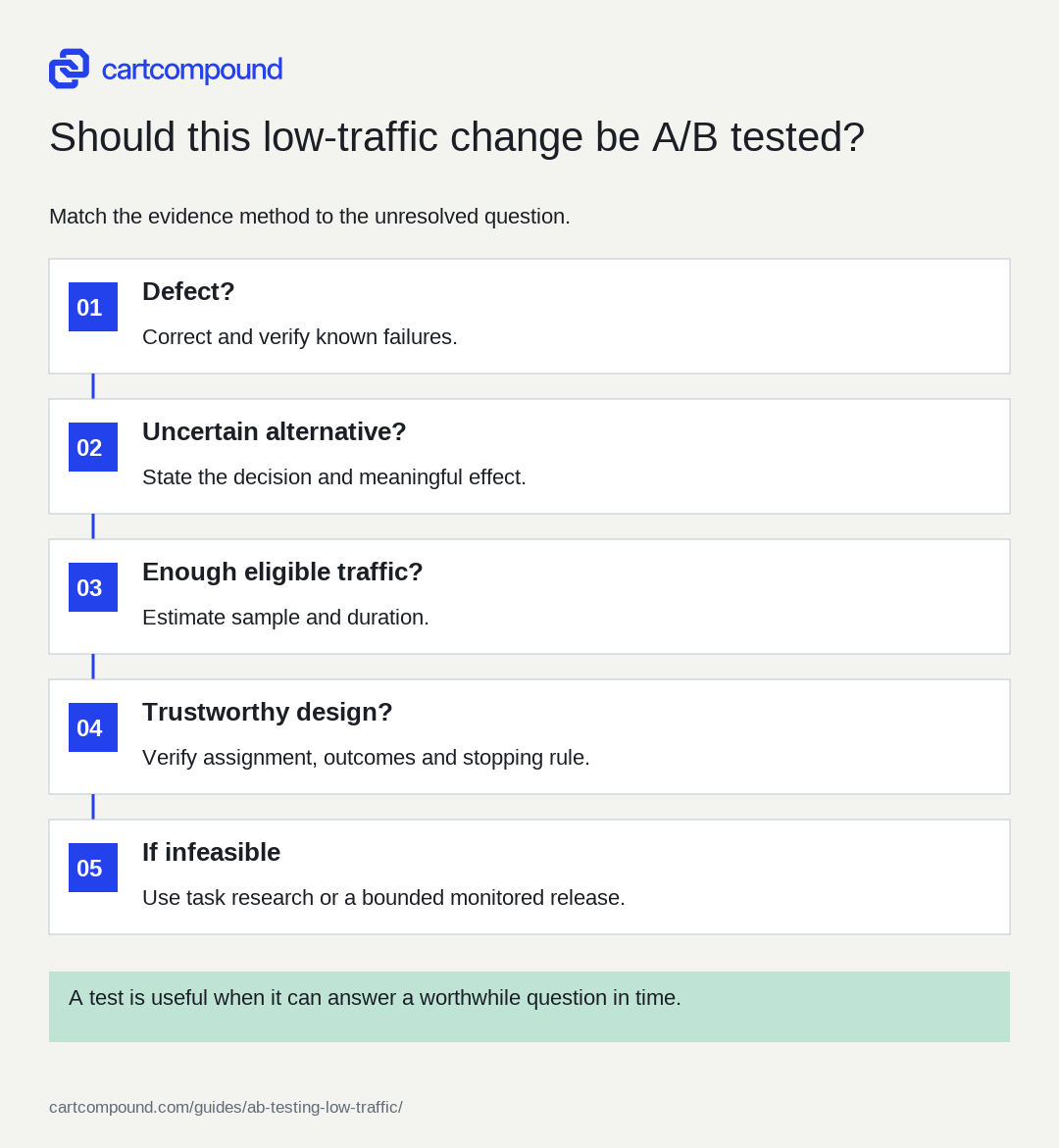
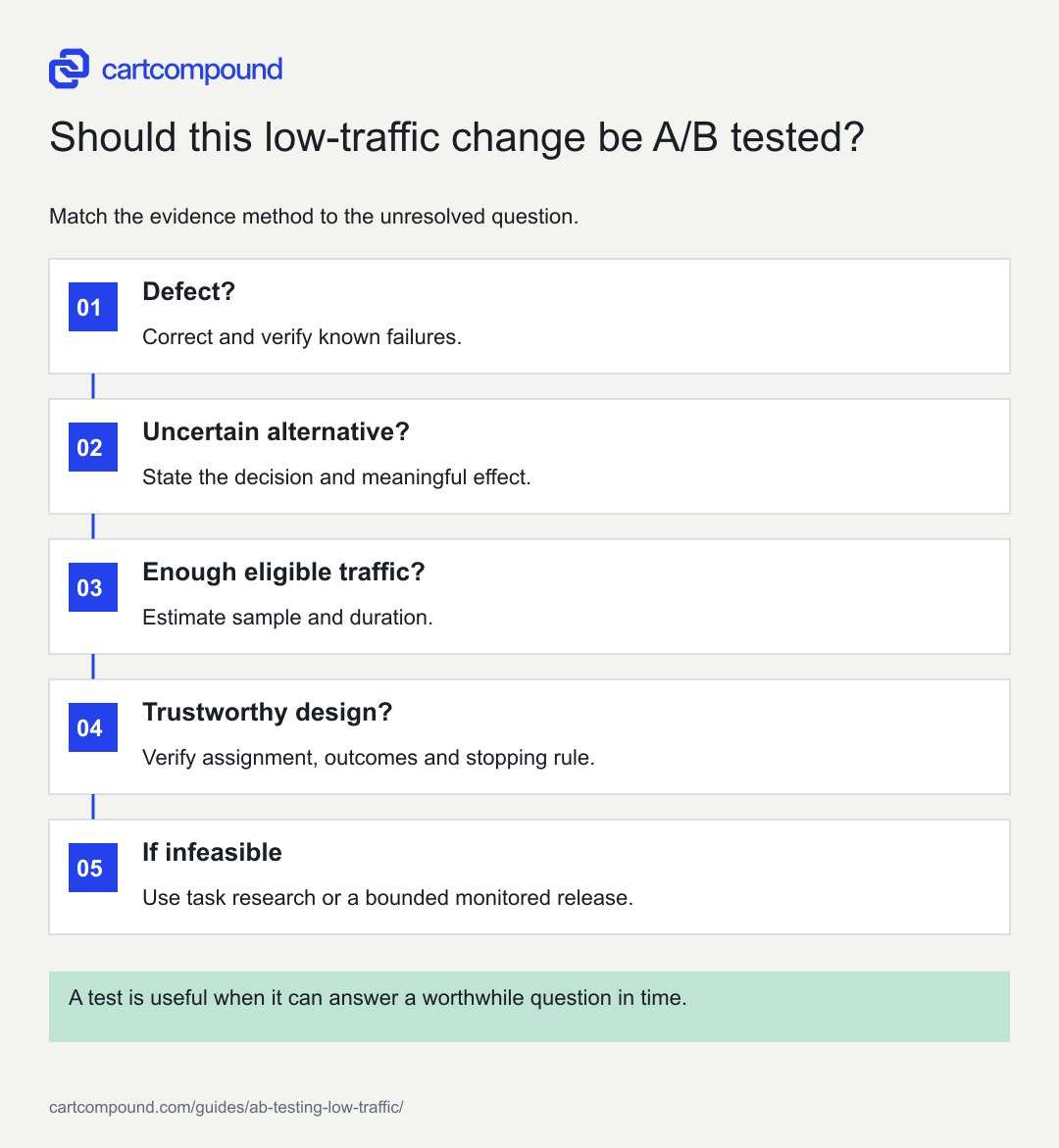
Should this low-traffic change be A/B tested?
Match the evidence method to the unresolved question.
- Defect?Correct and verify known failures.
- Uncertain alternative?State the decision and meaningful effect.
- Enough eligible traffic?Estimate sample and duration.
- Trustworthy design?Verify assignment, outcomes and stopping rule.
- If infeasibleUse task research or a bounded monitored release.
A test is useful when it can answer a worthwhile question in time.
Use the steps with your store data. Examples in this guide are illustrative unless a source is named.
Estimate sample needs before launching
Sample size depends on baseline behavior, outcome variation, effect size, power, significance level, assignment, and analysis method. Use a calculator or statistical support that matches the planned test. Evan Miller's A/B testing explanation provides a useful approximation for a binary outcome and explains why repeated unplanned stopping is problematic. Treat the approximation as planning guidance, not a substitute for a complete design.
For an illustrative two-arm binary test with baseline p = 0.02 and absolute effect 0.004, the common approximation n = 16 × p × (1 − p) ÷ effect² gives 19,600 users per arm. The total is about 39,200 eligible users. At 2,000 eligible users per month, that is about 19.6 months before additional timing requirements. These assumptions illustrate why small relative gains can be difficult to detect at low volume.
If the meaningful absolute effect were 0.01 under the same simplified approximation, the estimate becomes 3,136 per arm, or 6,272 total. That is still more than three months at the illustrative traffic level. A formal calculator may give different values, especially for larger changes. The point is to examine feasibility before committing traffic and attention.
Design the allocation and duration carefully
Keep users in a consistent assigned experience and verify that both variants receive the intended eligible population. A test can be invalidated by missing exposure events, caching, assignment changes, or a treatment that fails only in one browser. Run implementation checks before interpreting any outcome. Inspect the planned allocation against observed assignment as part of trustworthiness review.
Set a maximum duration that remains commercially and operationally meaningful. Very long tests can span catalog changes, seasonality, campaigns, and redesigns that make the original question less relevant. Include complete business cycles where appropriate, but do not assume that running for one week or two weeks solves a sample problem. Calendar duration and information volume are separate requirements.
Record exclusions, bot handling, staff traffic, overlapping experiments, and planned segment analysis. Avoid removing groups after seeing unfavorable results unless there is a documented data-quality reason, and report that decision. The goal is a comparison that can be understood and reproduced, not a dashboard that becomes favorable after enough filters are applied.
Avoid shortcuts that manufacture certainty
Do not stop a fixed-horizon test the first time a significance indicator turns green. Use the stopping rule associated with the planned method. Sequential methods can support valid interim decisions when designed correctly, but an ordinary fixed-horizon test does not become sequential because someone checks it daily. Bayesian methods also require sound assumptions, a decision rule, and enough information for the decision.
The A/B Testing Intuition Busters research discusses misleading intuitions in controlled experiments. One practical lesson is to inspect the measurement and design rather than treating a tool's confidence display as proof. Large apparent gains deserve data-quality checks, particularly when the purchase count is small.
Do not swap the primary outcome to add-to-cart merely because it produces a faster favorable result. An upstream metric can answer whether the new design changes that step, but it does not establish a purchase or profit effect. More people may add unsuitable products or encounter a later problem. Use upstream behavior as diagnostic evidence and retain the final business guardrails.
Choose an alternative method when testing is impractical
On a small screen, swipe the table to see every column.
| Uncertainty | Useful method | What it can establish |
|---|---|---|
| Does the control work? | Functional and accessibility QA | Correct behavior in tested states |
| Can shoppers understand the choice? | Task-based usability research | Observed comprehension and failure patterns |
| Which questions are missing? | Support and return-reason review | Recurring customer uncertainty |
| Does the change appear operationally safe? | Bounded monitored rollout | Errors and observed outcomes with causal limits |
| Which variant causes more purchases? | Adequately designed randomized test | Comparative effect under the test assumptions |
Choose the method that answers the question honestly. A usability session can reveal that people cannot identify their selected size; it does not estimate a storewide conversion lift. A before-and-after release can show a change in orders; it does not isolate the change from seasonality or media. Keep those limits visible while still using the evidence to make a practical decision.
Low traffic does not mean doing nothing. It means spending effort on meaningful uncertainties. Correct factual errors, improve product information, fix broken flows, and validate the result. Save controlled testing for changes where competing options remain plausible and the available sample can support the decision.
Work through an illustrative low-volume choice
Suppose a store has 4,000 monthly visitors, but only 1,500 reach the affected product template. The proposed test changes a size guide, and the team wants to detect a small purchase-rate difference. Using all 4,000 as the planning population would understate duration because most visitors never encounter the treatment. First define exposure and verify the baseline for the 1,500 eligible visitors.
Direct task research then shows that several participants measure the wrong part of the garment because the current diagram is mislabeled. This is a factual instruction problem. Correct the diagram, have the product specialist verify it, and test whether new participants can follow it. The team does not need to leave the wrong diagram live in order to learn whether accuracy is preferable.
A later question, such as choosing between two accurate guidance formats, may still justify an A/B test if the sample and risk support it. Keep that question separate. The first release solves a verified problem; the later experiment compares uncertain alternatives. Report the evidence for each without converting usability observations into an invented revenue percentage.
Distinguish learning from proving equivalence
A small experiment may reveal an operational problem even when it cannot estimate purchase lift precisely. Use it to inspect assignment, exposure, errors, and whether the intended treatment actually appears. Report that learning separately from the comparative business result. An experiment with broken delivery should not be rescued by a favorable outcome number.
If the goal is to establish that a cheaper or simpler experience is sufficiently close to the current one, define the acceptable loss before testing and obtain the appropriate statistical design. A conventional nonsignificant difference does not prove equivalence or noninferiority. The uncertainty may still include a loss large enough to matter.
Also record the cost of waiting. A reversible accuracy or usability improvement can be worth releasing on strong task evidence when a long experiment would delay necessary work. That is a business judgment with causal limits, not a statistical shortcut. State the evidence, monitor the guardrails, and preserve the option to revise the decision.
Write a decision record and act on it
Create a one-page record with hypothesis, eligible population, assignment unit, primary outcome, baseline, meaningful effect, sample plan, duration, guardrails, stopping rule, and implementation checks. Add what you will do for positive, negative, and inconclusive results. An inconclusive result does not prove the alternatives are equivalent; it may mean the test could not distinguish the effects that matter.
If the design is infeasible, document the alternative evidence method and the limits of the claim. A bounded release can still be a reasonable business decision when the change is reversible and supported by strong task evidence. Define monitoring, rollback conditions, and the owner. Keep the old version and the release date so later performance reviews have context.
The next action is to calculate feasibility for one proposed test using eligible traffic rather than total traffic. If the duration is impractical, identify the uncertainty that can be resolved through direct research or QA. Complete that work and make the smallest justified change. This keeps improvement moving while preserving an honest distinction between observation and causal evidence.
Your action checklist
Use this to decide what to do next. Your checks stay on this page and are not sent or saved.
0 of 8 checked
Common questions
Can Bayesian testing solve low traffic?
It can provide a different inferential framework, but it cannot create missing information. Priors, decision thresholds, uncertainty, and business risk still matter. Use a method and stopping rule you understand.
Can I test add-to-cart instead of purchases?
Yes, if the question concerns that step. Keep purchase and quality guardrails and avoid claiming that an add-to-cart improvement proves a sales improvement.
What does an inconclusive test mean?
The data did not establish the planned decision under the chosen method. It does not prove no effect or equivalence. Review the uncertainty interval, sample, implementation, and decision cost.
Sources and review
Source documentation checked October 27, 2026. Platform features and interfaces can change. The recommendations and illustrative examples explain how to make the decision; they do not promise results.
- How Not To Run an A/B Test
Sample-size approximation for binary outcomes and repeated-significance stopping problem. - A/B Testing Intuition Busters
Controlled-experiment misconceptions and need for trustworthy design.
Talk through your store question
Bring one problem you want to solve.
A free 20-minute call with Hamid can help you decide what to investigate next.
Book a free 20-minute call
About the author
Hamid Khan
Hamid co-founded CartCompound and works with ecommerce founders on their stores and growth priorities.
Profile and guides